

Appeal launched to halt Winnipeg ground squirrel control

Advertisement
Read this article for free:
or
Already have an account? Log in here »
To continue reading, please subscribe:

Digital Subscription
One year of digital access for only $205*
- Enjoy unlimited reading on winnipegfreepress.com
- Read the E-Edition, our digital replica newspaper
- Access News Break, our award-winning app
- Play interactive puzzles
*First annual payment billed as $205.00 + GST for one year. This annual subscription will automatically renew at $233.00 + GST every 52 weeks (10% off the regular annual price of $259.35). Offer available to new and qualified returning subscribers only. Cancel any time.
To continue reading, please subscribe:
Add Free Press access to your Brandon Sun subscription for only an additional
$1 for the first 4 weeks*
- Enjoy unlimited reading on winnipegfreepress.com
- Read the E-Edition, our digital replica newspaper
- Access News Break, our award-winning app
- Play interactive puzzles
*Your next Brandon Sun subscription payment will increase by $1.00 and you will be charged $17.95 plus GST for four weeks. After four weeks, your payment will increase to $24.95 plus GST every four weeks.
Read unlimited articles for free today:
or
Already have an account? Log in here »
The city began using pesticides to control its ground squirrel population Tuesday as animal groups appealed to halt the plan, arguing it puts pets at risk.
City of Winnipeg officials say the treatment is necessary to protect people and pets from tripping hazards and keep sport fields safe for use.
The Winnipeg Humane Society, the animal law group Animal Justice and a University of Manitoba biologist are appealing a one-year provincial permit that will allow the city to use Rozol RTU field rodent bait and RoCon concentrate rodenticide to control squirrels at nine parks.
They hope to convince the province to immediately suspend the permit, then revoke it.
JOHN WOODS / FREE PRESS Warning signs are seen at Valour Community Centre after the City of Winnipeg announced it will start a ground squirrel management program using rodent bait and rodenticide at several city parks, Tuesday.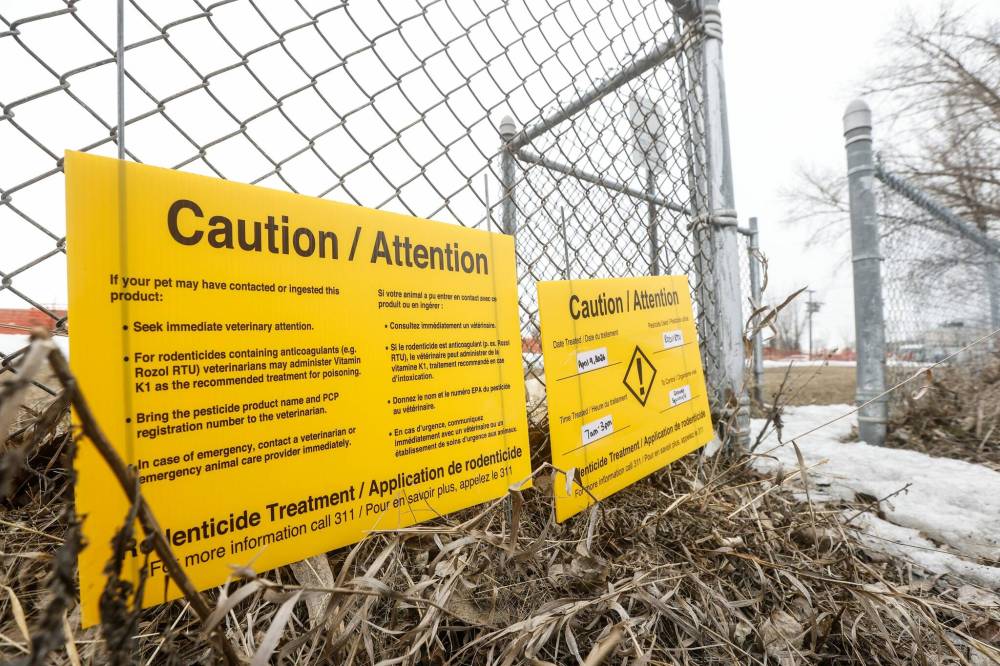
A key concern is that Rozol will cause a very painful demise for the ground squirrels, said appellant James Hare, a U of M professor emeritus of biological sciences.
“They die a very slow death. It’s over a period of days. They begin … hemorrhaging and they basically bleed out. It’s not a humane death at all,” he said.
Last year, the city planned to use “Giant Destroyer” to combat ground squirrels, a pesticide that involves sulfur gas. That didn’t happen because the province refused to provide a required permit, following community opposition.
However, Hare said he believes Rozol will cause the animals more prolonged suffering than Giant Destroyer and poses a greater threat to other animals.
“They die a very slow death. It’s over a period of days. They begin … hemorrhaging and they basically bleed out. It’s not a humane death at all.”
“(Rozol) … is (more) persistent in the environment. Not only do other species get into the treated baits, but they gain access to the carcasses of poisoned ground squirrels as well. Predators, scavengers, etc., will consume those and end up ingesting lethal doses,” he said.
Hare said pets could also be at risk of ingesting the bait.
The biologist said he does agree the city must do something to control the squirrel population to prevent trips and falls.
“You do have to, sadly … take some action … I would love to see them trap (ground squirrels) and then humanely euthanize them,” said Hare.
Coun. Jeff Browaty (North Kildonan) said the city is pursuing the most reasonable option it has right now, though he’s open to considering others, especially if one is deemed more humane.
“Anytime you have to intervene in nature, it’s not my preferred course of action. But these athletic fields… are literally dangerous because of the presence of the ground squirrels,” said Browaty.
Dave Domke, the city’s manager of parks and open space, said the city plan is based on best practices from other cities.
JOHN WOODS / FREE PRESS The Winnipeg Humane Society, the animal law group Animal Justice and a University of Manitoba biologist are appealing a one-year provincial permit that will allow Winnipeg to use chemicals to control ground squirrels at nine city parks.
“There’s not a lot of choices that are on the market for controlling ground squirrels,” said Domke.
He noted ground squirrel holes and dips have been blamed for sprained ankles among people and dogs.
“It’s all about public safety and people being able to use fields … There has to be a balance between human health and animal welfare,” said Domke.
Recreation programs have also been interrupted at some sites due to uneven surfaces, which recently led the city to remove soccer nets from Fairgrove Bay Park, he said.
“There are hundreds of ground squirrels (at some parks) … and there’s literally holes all over the place,” said Domke.
This year, the city will treat the parks at Fairgrove Bay, Beryl Watts Park/Vince Leah Community Centre, Charleswood Place, Shaughnessy Park, St. James Memorial Sports Park, Theodore Niitzhotay Fontaine Park (formerly known as Wellington Park), Weston Memorial Community Centre, Woodsworth Park and the Clifton site of the Valour Community Centre.
The city’s use of Rozol will continue for a few weeks, until ground squirrels produce offspring, when it will switch to solely using RoCon.
The province has confirmed treatment can continue during the appeal process, Domke said.
“It’s all about public safety and people being able to use fields … There has to be a balance between human health and animal welfare.”
The city is required to check treatment sites and remove dead squirrels twice a day to reduce the risk to other animals. Municipal officials are also required to join an Environmental Advisory Committee, which will include some critics of the current method and help determine treatments for future years.
Domke said the option of trapping and euthanizing ground squirrels could be discussed within that group.
However, he expects that process would be much more expensive and come with some unwanted side effects.
“It’s very complicated to undertake … We can’t really leave the animals trapped inside the live traps for any length of time because that’ll cause other stressors,” said Domke.
Manitoba Environment Minister Mike Moyes was not available for an interview Tuesday. In an email, a spokesperson noted the pesticides are approved by Health Canada and “have undergone rigorous scientific evaluation to ensure they do not pose unacceptable risks when used as directed.”
The spokesperson said it’s not clear how long the appeal process will take.
joyanne.pursaga@freepress.mb.ca
X: @joyanne_pursaga

Joyanne is city hall reporter for the Winnipeg Free Press. A reporter since 2004, she began covering politics exclusively in 2012, writing on city hall and the Manitoba Legislature for the Winnipeg Sun before joining the Free Press in early 2020. Read more about Joyanne.
Every piece of reporting Joyanne produces is reviewed by an editing team before it is posted online or published in print — part of the Free Press‘s tradition, since 1872, of producing reliable independent journalism. Read more about Free Press’s history and mandate, and learn how our newsroom operates.
Our newsroom depends on a growing audience of readers to power our journalism. If you are not a paid reader, please consider becoming a subscriber.
Our newsroom depends on its audience of readers to power our journalism. Thank you for your support.
Joyanne is city hall reporter for the Winnipeg Free Press. A reporter since 2004, she began covering politics exclusively in 2012, writing on city hall and the Manitoba Legislature for the Winnipeg Sun before joining the Free Press in early 2020. Read more about Joyanne.
Every piece of reporting Joyanne produces is reviewed by an editing team before it is posted online or published in print — part of the Free Press‘s tradition, since 1872, of producing reliable independent journalism. Read more about Free Press’s history and mandate, and learn how our newsroom operates.
Our newsroom depends on a growing audience of readers to power our journalism. If you are not a paid reader, please consider becoming a subscriber.
Our newsroom depends on its audience of readers to power our journalism. Thank you for your support.
Related Articles
City to start treating ground squirrels in nine parks



Advertisement Advertise With Us
Advertisement Advertise With Us