

Voting fraud in U.S. elections
Advertisement
Read this article for free:
or
Already have an account? Log in here »
To continue reading, please subscribe:

Digital Subscription
One year of digital access for only $205*
- Enjoy unlimited reading on winnipegfreepress.com
- Read the E-Edition, our digital replica newspaper
- Access News Break, our award-winning app
- Play interactive puzzles
*First annual payment billed as $205.00 + GST for one year. This annual subscription will automatically renew at $233.00 + GST every 52 weeks (10% off the regular annual price of $259.35). Offer available to new and qualified returning subscribers only. Cancel any time.
To continue reading, please subscribe:
Add Free Press access to your Brandon Sun subscription for only an additional
$1 for the first 4 weeks*
- Enjoy unlimited reading on winnipegfreepress.com
- Read the E-Edition, our digital replica newspaper
- Access News Break, our award-winning app
- Play interactive puzzles
*Your next Brandon Sun subscription payment will increase by $1.00 and you will be charged $17.95 plus GST for four weeks. After four weeks, your payment will increase to $24.95 plus GST every four weeks.
Read unlimited articles for free today:
or
Already have an account? Log in here »
Among the long list of lies U.S. President Donald Trump has repeatedly told, the one that has caused the most damage to American democracy has been that he lost the 2020 presidential election to Joe Biden because the contest was allegedly “rigged.” According to Trump, he was supposedly done in by a fraudulent system exemplified by “corrupt as hell” mail-in voting (or “mail-in cheating,” as he calls it) and no-excuse absentee voting.
A majority of states have some provision for mail-in and absentee voting (with and without an excuse). This includes Florida, where Trump is a resident, and where he voted by mail in the recent state special election. Predictably, when challenged, he denied he was being hypocritical.
Apart from waging war in Iran, nothing has recently occupied Trump more than having the Senate pass the SAVE America Act (it passed in the House of Representatives in February) which would impose strict voter ID requirements that could make it much more difficult for millions of U.S. citizens to vote. The act would also make it hard to register to vote as well as to vote by mail.
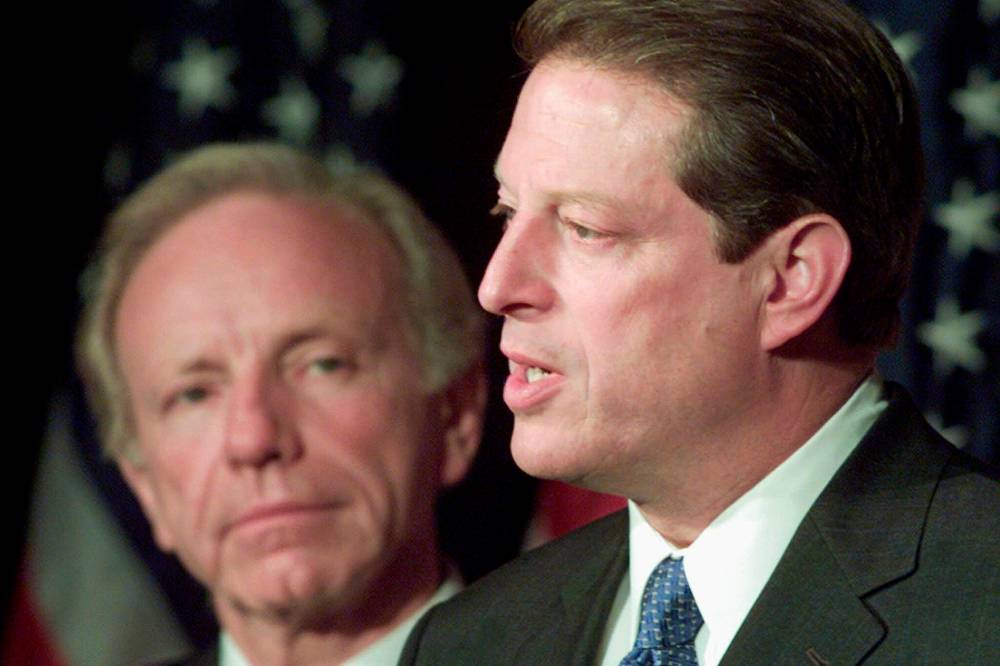
Doug Mills / The Associated Press Files
Democratic presidential candidate Vice-President Al Gore (right) delivers a brief statement in Nashville, Tenn., on the ongoing vote recount in Florida, as his running mate Sen. Joseph Lieberman, D-Conn., watches in a 2008 file photo.
Trump insists that the legislation must be passed at all costs. He believes that without these restrictions, the Republicans will lose the House and possibly the Senate in the midterm elections to be held in November. That these alleged “corrupt” practices existed in the 2024 elections in which Trump was victorious and the Republicans won control of both the House and the Senate is conveniently ignored.
Impatient for the Senate to act, at the end of March Trump signed an executive order that restricts mail-in voting. Such a declaration, however, violates state jurisdiction and is most likely unconstitutional. Already, a coalition of 23 states with Democratic party majorities and the District of Columbia have filed a federal lawsuit to halt Trump’s order.
The fact is there was no rigging or corruption in the 2020 election. After Biden was declared the winner, the Republicans launched 62 lawsuits. Judges appointed by Democrats and Republicans, including by Trump, dismissed 61 of them, finding no evidence of fraud or any other cheating (the lone minor case that was decided in the Republicans’ favour was in Pennsylvania where a judge ruled about voters having proper identification.)
That, however, does not mean that election rigging and fraud does not have a long history in the U.S. — a history that goes back more than 250 years.
As detailed in the 2005 book Deliver the Vote by University of Kentucky historian Tracy Campbell, violence, intimidation, fraud, vote-buying, unfairly discounting ballots and disenfranchisement were endemic in American elections at the federal, state and local levels for generations.
During the 19th century, after the Civil War, officials in southern states worked diligently to deprive African-Americans of the right to vote. Leading white citizens in those states, as Campbell writes, “considered their efforts to eradicate the African-American vote a patriotic duty.”
Even after voting by secret ballot was instituted by a majority of states in 1888, a law that helped curtail the violent intimidation that was perpetrated on citizens who had to vote openly, “creative” methods were still used to rig elections.
In New York, Tammany Hall, the Democratic Party’s powerful political machine, was especially adept. Paying newly arrived immigrants to vote for a particular candidate was common, as was bringing in voters from other districts in an era when voter ID was non-existent. Schemes were also devised so that individuals could vote three and four times in the same election (men with beards were paid to vote and then shave, so they would not be recognized, and then were able to vote again). This was the reason why in so many New York elections, thousands more votes were cast than there were citizens who lived in a voting district.
Campell’s research suggests that numerous presidential elections including those in 1884, 1888 and 1960, in which John F. Kennedy narrowly defeated Richard Nixon, were hampered by corrupt voting practices.

In the 1960 contest, Chicago’s influential mayor Richard Daley almost certainly used underhanded tricks to ensure Kennedy was victorious in Illinois. And in the controversial 2000 presidential election in which George W. Bush barely defeated Al Gore by eventually winning in Florida, the “culture of corruption,” as Campbell describes it, played a part in the questionable rejection of 175,000 votes. These were votes that would have likely enabled Gore to win — a victory that would have altered the trajectory of American history over the past 26 years.
Still, what Trump refuses to acknowledge is that the situation has dramatically improved. In the past decade, states have instituted safeguards to prevent fraud in mail-in voting. A study of elections held in 2016, 2018, 2020 and 2022 by the non-partisan Washington, D.C. based Brookings Institute, for instance, showed that “cases of mail voting fraud are very rare, accounting for only 0.000043 per cent of total mail ballots cast, or about four cases out of every 10 million mail votes.”
For the contested 2020 election, the figure for voter fraud was 0.000051 per cent.
In short, Trump’s incessant claims about a rigged election are false.
Now & Then is a column in which historian Allan Levine puts the events of today in a historical context. His most recent book is The Dollar-A-Year Men: How the Best Business Brains in Canada Helped to Win the Second World War.