Moon mission Earth photo could change your worldview

Advertisement
Read this article for free:
or
Already have an account? Log in here »
To continue reading, please subscribe:

Digital Subscription
One year of digital access for only $205*
- Enjoy unlimited reading on winnipegfreepress.com
- Read the E-Edition, our digital replica newspaper
- Access News Break, our award-winning app
- Play interactive puzzles
*First annual payment billed as $205.00 + GST for one year. This annual subscription will automatically renew at $233.00 + GST every 52 weeks (10% off the regular annual price of $259.35). Offer available to new and qualified returning subscribers only. Cancel any time.
To continue reading, please subscribe:
Add Free Press access to your Brandon Sun subscription for only an additional
$1 for the first 4 weeks*
- Enjoy unlimited reading on winnipegfreepress.com
- Read the E-Edition, our digital replica newspaper
- Access News Break, our award-winning app
- Play interactive puzzles
*Your next Brandon Sun subscription payment will increase by $1.00 and you will be charged $17.95 plus GST for four weeks. After four weeks, your payment will increase to $24.95 plus GST every four weeks.
Read unlimited articles for free today:
or
Already have an account? Log in here »
When I was a kid in the early ’90s, I was in an environmental club called Kids for Saving Earth.
Makes sense: it was an era defined by anxiety about the hole in the ozone layer and acid rain. I don’t remember much about the specifics of the club itself — I think we “adopted” a whale? — but I do vividly remember the logo: a scribbly, childlike crayon drawing of Earth, with its amorphous green and brown blobs, on a misshapen blue ball. Exactly how I would have drawn it as a kid and maybe how you would have, too.
I am happy to see this club still exists; I didn’t know it at the time, but KSE is a non-profit organization based in Minnesota founded in 1989 by an elementary school student named Clinton Hill, who tragically died of cancer at the age of 11. I am also happy to see that the logo is unchanged.
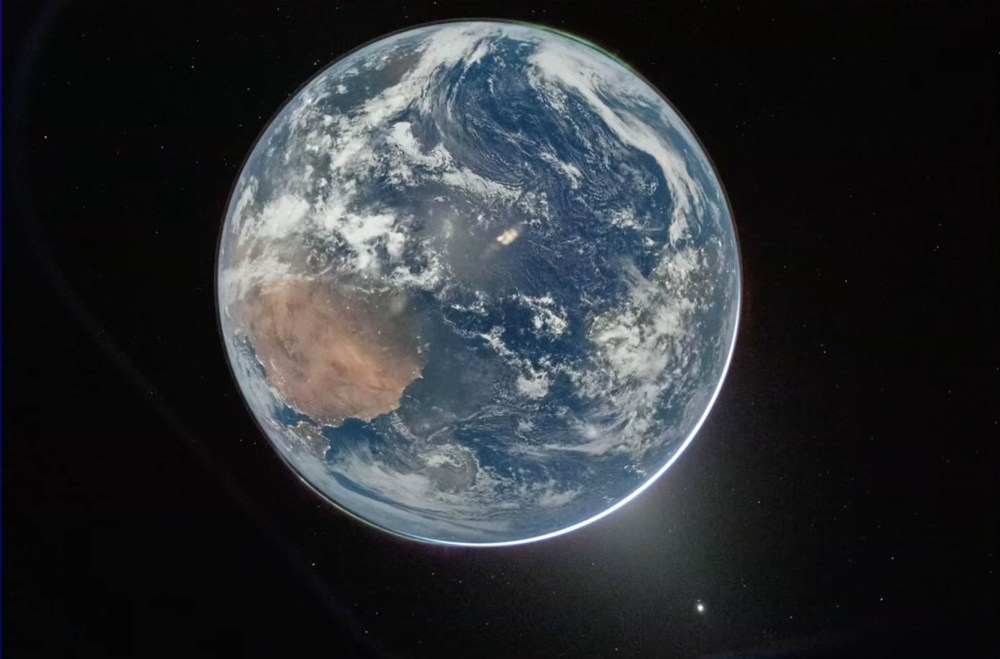
Earth feels like an ubiquitous image, so familiar a child can draw it, the stuff of solar-system models and textbooks. But being able to see actual images of the pale blue dot we call home is a relatively recent human achievement.
The Blue Marble, taken by Harrison Schmitt aboard the Apollo 17 on Dec. 7, 1972, is one of the most iconic and reproduced photographs in history, and with good reason: it was the first time Earth was captured as a whole, fully illuminated, by a human. A bright, vivid ball, floating in an expanse of darkness.
When you think of our planet, it’s very likely that this is the image your mind recalls (well, the widely distributed rotated version, that is; the original photograph has the south pole at the top). It’s also very likely that this is the image on which the Kids for Saving Earth logo is based.
Having a photo of Earth — the whole Earth — taken by a human is an incredible thing. And now we have a new one, captured last week by Artemis II mission Commander Reid Wiseman who has, along with fellow NASA astronauts Victor Glover and Christina Koch, and Canadian Space Agency astronaut Jeremy Hansen, travelled farther into space than any other human before.
With visible auroras and a sliver of light as the Earth eclipses the sun, it’s a beautiful image. But it’s also a deeply moving one. Look at Earth, the whole of it, and consider: everything that has ever happened, happened there.
Every person who ever existed, from ancient civilizations until now. Every living thing, too, from the smallest organisms to the dinosaurs. Every grain of sand and every wave and every mountaintop. Every word ever written, every note of music ever composed, every painting ever created, everything ever built, from the Great Wall of China to Machu Picchu to the Pyramids. Everything ever made and everything ever destroyed. Everything ever invented and everything ever thrown away. Every war, every famine, every pandemic, every storm, every volcano, every earthquake. Every person who ever looked up at the stars in the sky and tried to make sense of our place in the universe.
Everything that has ever happened happened there: a vulnerable spinning rock out there in that endless, unfathomable sea of black.
Space missions like this one are a reminder that there’s still wonder, that there’s still discovery. But they are also a reminder of our humanity; that we’re all in one place, together.

As it happens, I am currently reading Atmosphere, the latest novel from Taylor Jenkins Reid (Daisy Jones & The Six), about a stars-obsessed physics and astronomy professor named Joan who decides to shoot her shot and answer NASA’s call for women scientists to join its space-shuttle program in the 1980s.
When Joan finally gets to space and sees Earth from that vantage — “the rarest of perspectives” — she comes to a radically different conclusion than that of a crewmate. His take-home message is that human life is meaningless. Joan, meanwhile, looks at the hazy atmosphere surrounding the Earth, and realizes it is keeping everything that ever meant anything to her alive.
“Space belonged to no one, but Earth belonged to all of them.”
We forget that, though. So when we’re offered a glimpse at that rarest of perspectives — a gift, really — we can see all that’s at stake, all that we take for granted and, hopefully, all that’s worth saving.
winnipegfreepress.com/jenzoratti
Jen Zoratti is a columnist and feature writer working in the Arts & Life department, as well as the author of the weekly newsletter NEXT. A National Newspaper Award finalist for arts and entertainment writing, Jen is a graduate of the Creative Communications program at RRC Polytech and was a music writer before joining the Free Press in 2013. Read more about Jen.
Every piece of reporting Jen produces is reviewed by an editing team before it is posted online or published in print – part of the Free Press‘s tradition, since 1872, of producing reliable independent journalism. Read more about Free Press’s history and mandate, and learn how our newsroom operates.
Our newsroom depends on a growing audience of readers to power our journalism. If you are not a paid reader, please consider becoming a subscriber.
Our newsroom depends on its audience of readers to power our journalism. Thank you for your support.
Jen Zoratti is a columnist and feature writer working in the Arts & Life department, as well as the author of the weekly newsletter NEXT. A National Newspaper Award finalist for arts and entertainment writing, Jen is a graduate of the Creative Communications program at RRC Polytech and was a music writer before joining the Free Press in 2013. Read more about Jen.
Every piece of reporting Jen produces is reviewed by an editing team before it is posted online or published in print – part of the Free Press‘s tradition, since 1872, of producing reliable independent journalism. Read more about Free Press’s history and mandate, and learn how our newsroom operates.
Our newsroom depends on a growing audience of readers to power our journalism. If you are not a paid reader, please consider becoming a subscriber.
Our newsroom depends on its audience of readers to power our journalism. Thank you for your support.
Related Articles
In pictures: Artemis II crew captures eclipse, Earthrise, far side of moon during lunar flyby





Advertisement Advertise With Us
Advertisement Advertise With Us