A lost icon: The American chestnut and its central place in the eastern landscape

Advertisement

Advertise with us

WASHINGTON (AP) — In a quiet stretch of western Massachusetts stands a sycamore so old it was around when the Constitution was signed. It’s awe-inspiring, with branches bigger than the entire trunks of most trees.

Read this article for free:


or

Already have an account? Log in here »

To continue reading, please subscribe:

Subscribe and receive a limited-edition Free Press branded hat or tote.

Digital Subscription

One year of digital access for only $205*

  • Enjoy unlimited reading on winnipegfreepress.com
  • Read the E-Edition, our digital replica newspaper
  • Access News Break, our award-winning app
  • Play interactive puzzles

*First annual payment billed as $205.00 + GST for one year. This annual subscription will automatically renew at $233.00 + GST every 52 weeks (10% off the regular annual price of $259.35). Offer available to new and qualified returning subscribers only. Cancel any time.

To continue reading, please subscribe:

Add Free Press access to your Brandon Sun subscription for only an additional

$1 for the first 4 weeks*

  • Enjoy unlimited reading on winnipegfreepress.com
  • Read the E-Edition, our digital replica newspaper
  • Access News Break, our award-winning app
  • Play interactive puzzles
Start now

*Your next Brandon Sun subscription payment will increase by $1.00 and you will be charged $17.95 plus GST for four weeks. After four weeks, your payment will increase to $24.95 plus GST every four weeks.

WASHINGTON (AP) — In a quiet stretch of western Massachusetts stands a sycamore so old it was around when the Constitution was signed. It’s awe-inspiring, with branches bigger than the entire trunks of most trees.

But it’s also notable because it’s an outlier. It is a tree with a majestic presence that dwarfs the common maples and pines nearby — a living reminder of how much old-growth forest has been lost.

In the eastern United States, that rare sense of awe was once supplied in bulk by the American chestnut.
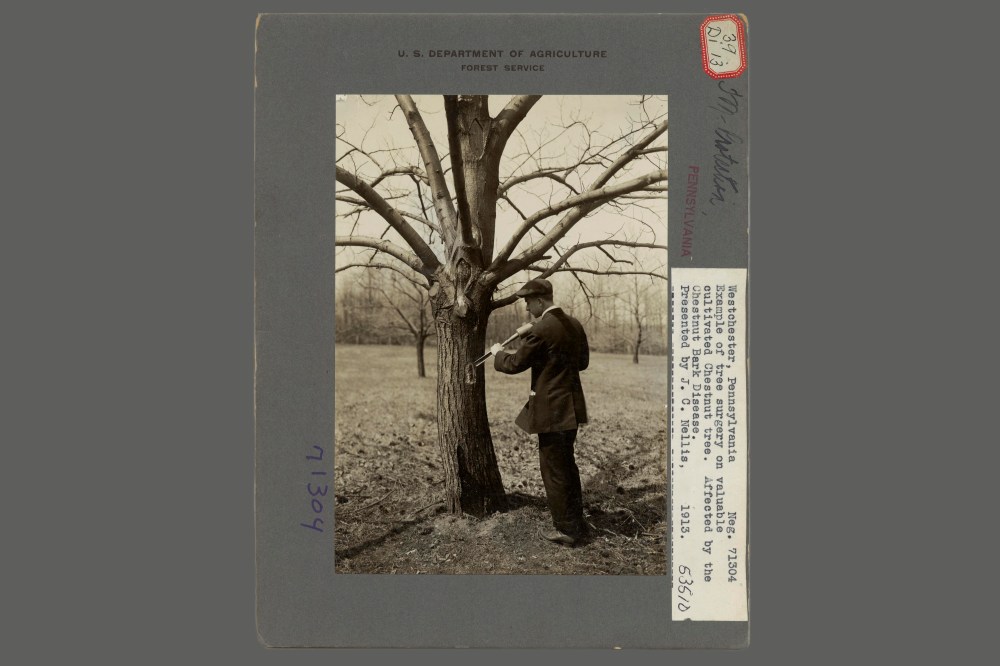
This 1913 handout image from the U.S. National Archives and Records shows a man performing tree surgery on a valuable cultivated chestnut tree affected by the chestnut bark disease in Westchester, PA, 1913. (U.S. National Archives and Recordsvia AP)

Its presence stunned: mature trees rose above the hardwood canopy supported by trunks wider than a person is tall. It was a centerpiece of the ecosystem, producing so many chestnuts that it boosted the numbers of turkeys, bears and deer that, in turn, spread the trees’ seeds. American chestnut’s straight grain was useful in furniture and it made fenceposts that encircled farms and shrugged off pests and wear.

There were billions of them at the turn of the 20th century, their abundant fruit moved by railcar to cities for sale on street corners. We still sing about them during the holidays.

And then they started dying.

It was disease that forever changed the American landscape. A deadly airborne fungal blight coupled with a lethal root rot that killed them by the millions. By the 1950s, the tree was functionally extinct.

That was long enough ago that few remember what it was like to live among them. But what they once offered isn’t forgotten. Their size still impresses in old photos. Associations are dedicated to their story. And to bringing them back.

Another type of chestnut, the Chinese chestnut, had been introduced to the United States for its valuable nuts. It doesn’t grow as tall, but it can resist disease.

Arborists have tried to breed the advantageous, disease-resistant attributes into the American chestnut. That has turned out to be tremendously hard. Simple breeding techniques don’t work well, and recent efforts to sequence the DNA of the trees reveals why — their desirable traits are scattered across multiple spots along their genome.

But the DNA sequence also provides a map to breed trees that are more likely to survive.

Researchers hope in the coming decades, there will be enough healthy trees for the species to not need humans, to once again rely on the meanderings of bears and forgetfulness of squirrels.

___

This story is part of a recurring series, “American Objects,” marking the 250th anniversary of the United States. For more stories on the anniversary, click here. The Associated Press receives support from the Walton Family Foundation for coverage of water and environmental policy. The AP is solely responsible for all content. For all of AP’s environmental coverage, visit here.

Report Error Submit a Tip

More Stories

Kinew, Canadian ambassador to U.S. discuss trade

Free Press staff 2 minute read 2:01 AM CDT

Canada’s ambassador to the United States met Manitoba Premier Wab Kinew and local business leaders during a visit to Winnipeg this week.

Mark Wiseman and Kinew spoke about trade uncertainty with the United States and opportunities for Manitoba businesses, a government news release says.

The provincial U.S. Trade Council, the Business Council of Manitoba and part of the Premier’s Business and Jobs Council spoke to Wiseman about the impacts of trade uncertainty.

Province down 4,400 jobs

‘Please excuse us from writing these notes …’

Editorial 4 minute read Preview

‘Please excuse us from writing these notes …’

Editorial 4 minute read Yesterday at 2:01 AM CDT

It’s a common-sense prescription for the health-care system. The only wonder is that it took so long to happen.

Read
Yesterday at 2:01 AM CDT

Late philanthropist, family fill Harvest’s Empty Bowls with record-setting $5-M donation

Morgan Modjeski 3 minute read Preview

Late philanthropist, family fill Harvest’s Empty Bowls with record-setting $5-M donation

Morgan Modjeski 3 minute read Updated: Yesterday at 11:54 PM CDT

It was a record-breaking night for Harvest Manitoba made possible by a genuine Winnipeg hero and his family.

The organization’s annual Empty Bowls Celebrity Auction Dinner on Thursday raised $6.5 million to support Manitobans facing hunger and food insecurity.

And it was a $5-million legacy donation from late city philanthropist Doug Harvey and his family that will see the event go down in the history books as the largest gala fundraising total ever recorded in Manitoba.

“There was literally nothing that lit my dad up more than contributing himself, but even more so, inspiring others to give,” his daughter Lauren Harvey said Friday.

Read
Updated: Yesterday at 11:54 PM CDT

A Rocky day on the mayoral campaign trail for Kevin Klein

Malak Abas 12 minute read Preview

A Rocky day on the mayoral campaign trail for Kevin Klein

Malak Abas 12 minute read Yesterday at 12:00 PM CDT

Kevin Klein acknowledges it’s hard to foresee what he’ll wake up to each morning in the final weeks of a mayoral campaign.

But the seasoned politician, who has served as both a city councillor and a provincial cabinet minister, couldn’t have predicted the events — what he describes as “drama” — that unfolded last Sunday.

Fellow mayoral candidate Mike Vogiatzakis accused Klein’s campaign team of offering him a job to drop out of the race, while a guest writer’s column in the Winnipeg Sun that questioned the deaths of Indigenous children at residential schools, just days after the National Day for Truth and Reconciliation, sparked condemnation from a prominent Indigenous organization. (Klein is the CEO of the Klein Group, the company that owns the Sun. He has maintained he is not involved in its operations while running for mayor.)

The Free Press had already been scheduled to join Klein on the campaign trail Monday, intending to document a day in the life of the front-running candidate to unseat incumbent Scott Gillingham, before the controversies hit.

Read
Yesterday at 12:00 PM CDT

A lost icon: The American chestnut and its central place in the eastern landscape

Michael Phillis, The Associated Press 3 minute read Preview

A lost icon: The American chestnut and its central place in the eastern landscape

Michael Phillis, The Associated Press 3 minute read Thursday, Apr. 16, 2026

WASHINGTON (AP) — In a quiet stretch of western Massachusetts stands a sycamore so old it was around when the Constitution was signed. It’s awe-inspiring, with branches bigger than the entire trunks of most trees.

But it’s also notable because it’s an outlier. It is a tree with a majestic presence that dwarfs the common maples and pines nearby — a living reminder of how much old-growth forest has been lost.

In the eastern United States, that rare sense of awe was once supplied in bulk by the American chestnut.

Its presence stunned: mature trees rose above the hardwood canopy supported by trunks wider than a person is tall. It was a centerpiece of the ecosystem, producing so many chestnuts that it boosted the numbers of turkeys, bears and deer that, in turn, spread the trees’ seeds. American chestnut’s straight grain was useful in furniture and it made fenceposts that encircled farms and shrugged off pests and wear.

Read
Thursday, Apr. 16, 2026

Phoneless concert a beautiful chance to bask in moment

Jen Zoratti 6 minute read Preview

Phoneless concert a beautiful chance to bask in moment

Jen Zoratti 6 minute read 2:01 AM CDT

Outside the Scotiabank Arena in Toronto, digital billboards flashed fans their singular photo op for the night: “I took this photo before I saw Phoebe Bridgers: The Lost Tour 2026.”

It is, as it is for so many other people, my only documentation of a concert by one of my favourite artists. The American singer-songwriter — who I discovered at the Winnipeg Folk Festival in 2018 — has had a meteoric rise in the past few years, winning three Grammys in 2024 as one third of Boygenius, the indie-rock supergroup rounded out by Lucy Dacus and Julien Baker, and opening for Taylor Swift on select dates of her titanic Eras Tour.

Now, Bridgers is touring in support of Lost Weekend, her third album and first since 2020’s Punisher. It’s a feat of a record, a richly textured meditation on loss and grief, written in the aftermath of the death of her dad, with whom she had a complicated relationship.

So she is in a position to not only play multiple sold-out arena shows, but also insist that those shows be phone-free.

Read
2:01 AM CDT