

2 candidates with starkly different visions for Peru vie for a runoff spot
Advertisement
Read this article for free:
or
Already have an account? Log in here »
To continue reading, please subscribe:

Digital Subscription
One year of digital access for only $205*
- Enjoy unlimited reading on winnipegfreepress.com
- Read the E-Edition, our digital replica newspaper
- Access News Break, our award-winning app
- Play interactive puzzles
*First annual payment billed as $205.00 + GST for one year. This annual subscription will automatically renew at $233.00 + GST every 52 weeks (10% off the regular annual price of $259.35). Offer available to new and qualified returning subscribers only. Cancel any time.
To continue reading, please subscribe:
Add Free Press access to your Brandon Sun subscription for only an additional
$1 for the first 4 weeks*
- Enjoy unlimited reading on winnipegfreepress.com
- Read the E-Edition, our digital replica newspaper
- Access News Break, our award-winning app
- Play interactive puzzles
*Your next Brandon Sun subscription payment will increase by $1.00 and you will be charged $17.95 plus GST for four weeks. After four weeks, your payment will increase to $24.95 plus GST every four weeks.
Read unlimited articles for free today:
or
Already have an account? Log in here »
LIMA, Peru (AP) — Results Thursday from Peru’s presidential election showed such a tight race for second and third place that it could take weeks to finalize the top two candidates for the country’s required runoff election in June.
A nationalist congressman allied with an imprisoned former president and an ultraconservative politician who promises to reinstate the death penalty are top contenders to face Keiko Fujimori, who was virtually assured of taking the top slot among the 35 candidates in Sunday’s election.
With 93% of the ballots tallied, official results on Tuesday showed Fujimori, the conservative daughter of disgraced former President Alberto Fujimori, leading the count with 17.06%, though far below the required 50% needed to avoid a runoff.
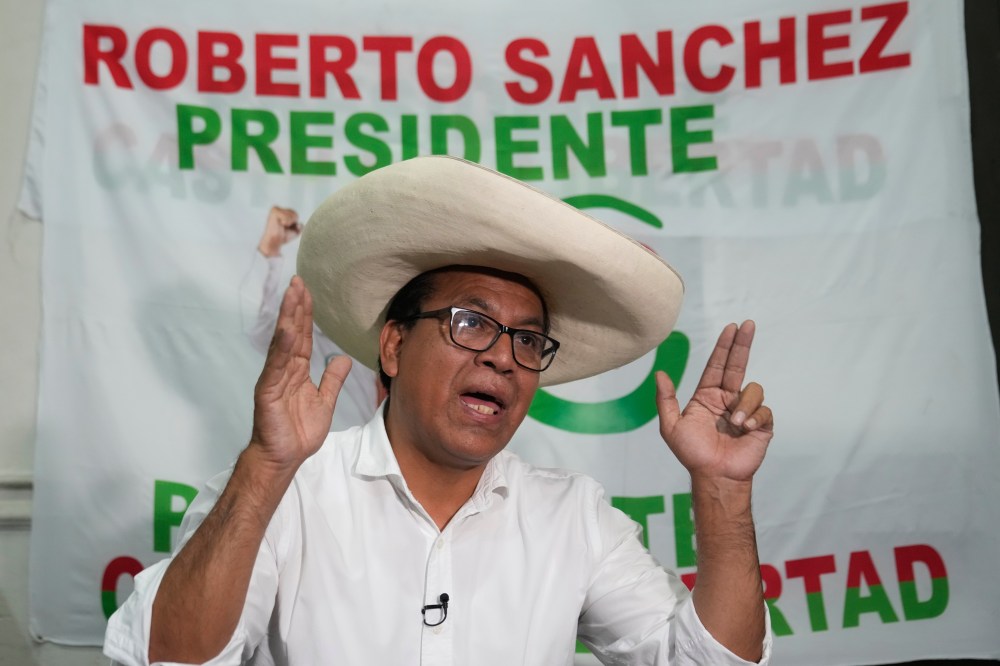
Behind her, Roberto Sánchez, a nationalist congressman and former minister under imprisoned ex-President Pedro Castillo, earned 11.97%. Trailing narrowly in third place was Rafael López Aliaga, the ultraconservative former mayor of Peru’s capital, Lima, with 11.91%.
Suspense mounted over who would advance to the June 7 runoff, with the margin between Sánchez and López Aliaga closer than 8,000 votes in the most recent results.
They couldn’t be more different politically.
Sánchez, frequently seen in the wide-brimmed peasant hat that has become his trademark, has promised major economic changes, including a dramatic expansion of government spending, an extensive reform of the tax system and partial nationalization of Peru’s natural resources.
López Aliaga, the ultraconservative former mayor of Peru’s capital, Lima, focuses on a hardline security agenda, proposing to build prisons in the country’s Amazon region, allowing judges to conceal their identities and expelling foreigners who are living illegally in Peru.
The narrow margin is compounded by approximately 1,600 pending tally sheets from remote villages and abroad. Additionally, another 5,000 sheets have been challenged, leaving the electoral courts with an appeals process that could take weeks to resolve.
“In Peru, a percentage of tally sheets are always ‘challenged’ due to potential mathematical errors,” explained Álvaro Henzler, president of Transparencia, a democracy-watchdog group that deployed 4,000 observers. “When this occurs, they are sent to 60 special electoral boards for review.”
In 2021, Peru’s electoral tribunal proclaimed first-round results 37 days after the April 11 vote. At that time, however, the gap between the second-place contenders exceeded 238,000 votes from the start, leaving little room for suspense.
“In this case, since the race is so tight, the contested tally sheets could end up altering the standings; that is why it is taking longer,” Henzler noted.
A presidential candidate needs more than 50% of votes to win outright. The two candidates with the most votes in a first round advance to the runoff on June 7.
The winner will be Peru’s ninth president in just 10 years and will replace José María Balcázar, who was elected interim president in February. He replaced another interim leader who was ousted over corruption allegations just four months into his term.
In her fourth bid for the presidency, Fujimori has promised to crack down on crime but has also defended laws that experts say make it difficult to prosecute criminals. The laws, which her party backed in recent years, eliminated preliminary detention in certain cases and raised the threshold for seizing criminal assets.
___
Follow AP’s coverage of Latin America and the Caribbean at https://apnews.com/hub/latin-america