Iran reopens Strait of Hormuz, but threatens to close it again as the US maintains its blockade
Advertisement
Read this article for free:
or
Already have an account? Log in here »
To continue reading, please subscribe:

Digital Subscription
One year of digital access for only $205*
- Enjoy unlimited reading on winnipegfreepress.com
- Read the E-Edition, our digital replica newspaper
- Access News Break, our award-winning app
- Play interactive puzzles
*First annual payment billed as $205.00 + GST for one year. This annual subscription will automatically renew at $233.00 + GST every 52 weeks (10% off the regular annual price of $259.35). Offer available to new and qualified returning subscribers only. Cancel any time.
To continue reading, please subscribe:
Add Free Press access to your Brandon Sun subscription for only an additional
$1 for the first 4 weeks*
- Enjoy unlimited reading on winnipegfreepress.com
- Read the E-Edition, our digital replica newspaper
- Access News Break, our award-winning app
- Play interactive puzzles
*Your next Brandon Sun subscription payment will increase by $1.00 and you will be charged $17.95 plus GST for four weeks. After four weeks, your payment will increase to $24.95 plus GST every four weeks.
Read unlimited articles for free today:
or
Already have an account? Log in here »
BEIRUT (AP) — Iran said it fully reopened the Strait of Hormuz to commercial vessels, but questions lingered Saturday about how much freedom ships actually had to transit the waterway as Tehran maintained its grip on the who got through and threatened to close it again if the U.S. kept in place its blockade of Iranian ships and ports.
Iran’s Friday announcement about the opening of the crucial body of water, through which 20% of the world’s oil is shipped, came as a 10-day truce between Israel and the Iranian-backed Hezbollah militant group in Lebanon appeared to hold.
U.S. President Donald Trump, meanwhile, said the American blockade “will remain in full force” until Tehran reaches a deal with the U.S., including on its nuclear program.
Asked by a reporter Friday night what he will do if there’s no deal when the ceasefire expires next week, Trump said, “I don’t know. … But maybe I won’t extend it, so you’ll have a blockade and unfortunately we’ll have to start dropping bombs again.” But he also told reporters accompanying him aboard Air Force One to Washington that a deal is “going to happen,” and flatly rejected the idea of restrictions or tolls by Iran on the Strait of Hormuz.
Trump had earlier celebrated the Iranian announcement, posting on social media that the strait was “fully open and ready for full passage.” But minutes later, he issued another post saying the U.S. Navy’s blockade would continue “UNTIL SUCH TIME AS OUR TRANSACTION WITH IRAN IS 100% COMPLETE.”
Iranian Foreign Minister Abbas Araghchi posted on X that ships would use routes designated by the Islamic Republic in coordination with Iranian authorities, suggesting Iran planned to retain some level of control over the channel. It was not clear if vessels would have to pay tolls.
Iranian officials said the blockade was a violation of last week’s ceasefire agreement between Iran and the U.S. The strait “will not remain open” if the blockade continues, Iran’s parliamentary speaker, Mohammad Bagher Qalibaf, posted on X early Saturday.
A data firm, Kpler, said movement through the strait remained confined to corridors requiring Iran’s approval.
U.S. forces have sent 21 ships back to Iran since the blockade began on Monday, U.S. Central Command said on X.
Trump says new talks could happen soon
Trump imposed the blockade as part of his effort to force Iran to open the strait and accept a Pakistan-brokered ceasefire to end almost seven weeks of war that has raged between Israel, the U.S. and Iran.
The president’s decision to continue the blockade despite Iran’s announcement appeared aimed at sustaining pressure on Tehran as the fate of the two-week ceasefire reached last week remained uncertain.
Direct talks between the U.S. and Iran last weekend were inconclusive, as the two nations could not agree about Iran’s nuclear program and other points.
Trump suggested a second round of talks could happen this weekend.
“The Iranians want to meet,” he said in a brief telephone interview with the news outlet Axios. “They want to make a deal. I think a meeting will probably take place over the weekend.”
Oil prices fell Friday on hopes the U.S. and Iran were drawing closer to an agreement . The head of the International Energy Agency had warned that the energy crisis could get worse if the strait did not reopen.
Two Iranian semiofficial news agencies seemed to challenge Araghchi’s announcement about the strait.
Considered close with Iran’s powerful Revolutionary Guard, the Fars news agency issued a series of posts on X criticizing what it said was a lack of clarity over the decision to reopen the waterway and a “strange silence from the Supreme National Security Council and the negotiating team.”
Iran’s Supreme National Security Council has recently acted as the country’s de facto top decision-making body, amid doubts over the status of the new supreme leader, Mojtaba Khamenei, who was reportedly wounded early in the war.
The Mehr news agency also said the decision to reopen the strait needed “clarification” and required the supreme leader’s approval.
Truce in Lebanon could help US-Iran peace efforts
The ceasefire in Lebanon could clear one major obstacle to an agreement between Iran, the United States and Israel to end the war. But it was unclear to what extent Hezbollah would abide by a deal it did not play a role in negotiating and which will leave Israeli troops occupying a stretch of southern Lebanon.
Trump said in another post that Israel is “prohibited” by the U.S. from further strikes on Lebanon and that “enough is enough” in the Israel-Hezbollah war.
The State Department said the prohibition applies only to offensive attacks and not to actions taken in self-defense.
Shortly before Trump’s post, Israeli Prime Minister Benjamin Netanyahu said Israel agreed to the ceasefire in Lebanon “at the request of my friend President Trump,” but that the campaign against Hezbollah is not complete.
He claimed Israel had destroyed about 90% of Hezbollah’s missile and rocket stockpiles and added that Israeli forces “have not finished yet” with the dismantling of the group.
Celebrations in Beirut
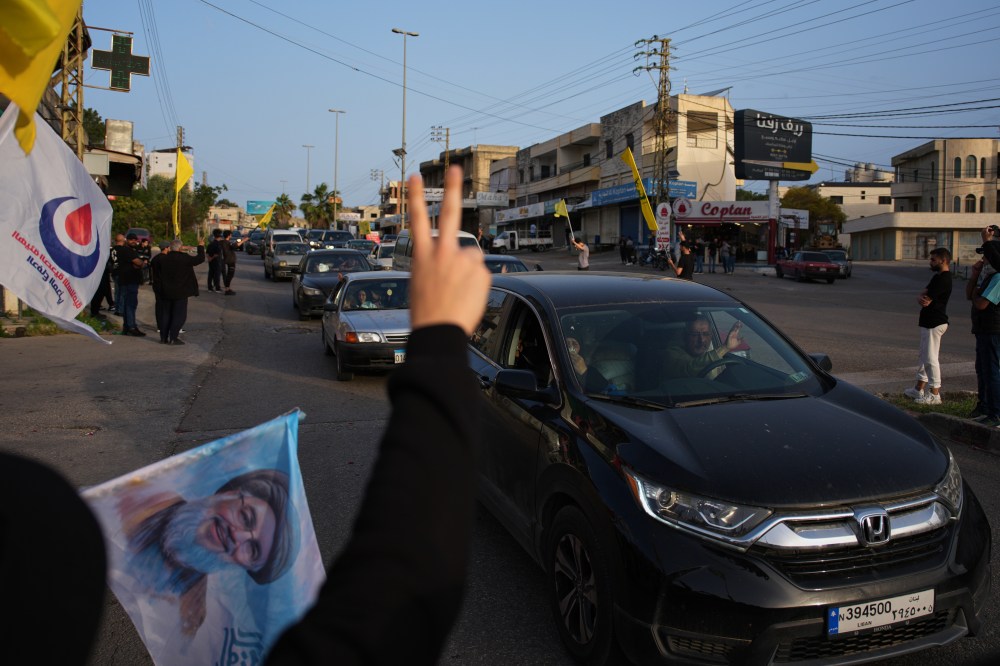
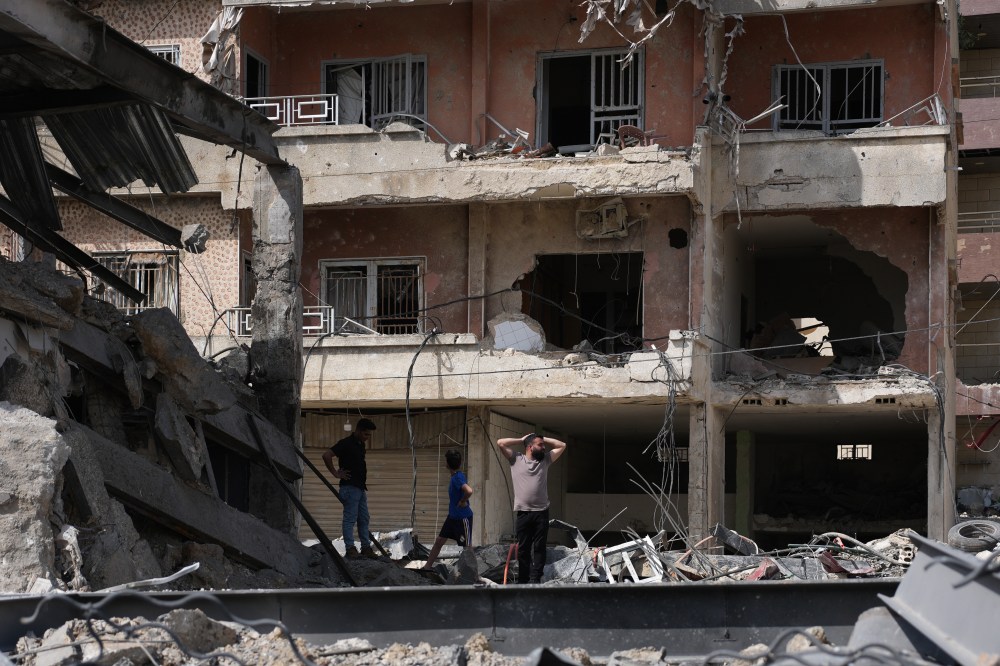
In Beirut, celebratory gunshots rang out at the start of the truce. Displaced families began moving toward southern Lebanon and Beirut’s southern suburbs despite warnings by officials not to return to their homes until it became clear whether the ceasefire would hold.
The Lebanese army and U.N. peacekeepers in southern Lebanon had reported sporadic artillery shelling in some parts of southern Lebanon in the hours after the ceasefire took effect.
An Israeli strike in the area of Kounine hit a car and a motorcycle, killing one person and wounding three, including a Syrian citizen, the Lebanese Health Ministry said Friday. It was the first airstrike and first fatality reported since the truce took effect.
There was no immediate response from the Israeli army or Hezbollah.
An end to Israel’s war with Hezbollah was a key demand of Iranian negotiators, who previously accused Israel of breaking last week’s ceasefire with strikes on Lebanon. Israel had said that deal did not cover Lebanon.
The fighting has killed at least 3,000 people in Iran, more than 2,290 in Lebanon, 23 in Israel and more than a dozen in Gulf Arab states. Thirteen U.S. service members have also been killed.
Israel says it will keep troops in Lebanon
Israel’s hard-line Defense Minister Israel Katz said Israel would continue to hold all the places where it is currently stationed, including a buffer zone extending 10 kilometers (6 miles) into southern Lebanon. He said many homes in the area would be destroyed and Lebanese residents will not return.
Hezbollah has said Lebanese people have “the right to resist” Israeli occupation and that their actions “will be determined based on how developments unfold.”
Israel and Hezbollah have fought several wars and have been fighting on and off since the day after the start of the Israel-Hamas war in Gaza. Israel and Lebanon reached a deal to end the earlier fighting in November 2024, but Israel has kept up near-daily strikes in what it says is an effort to prevent the Iran-backed militant group from regrouping. That escalated into another invasion after Hezbollah again began firing missiles at Israel in response to its war on Iran.
Mediators seek compromise on three points
In the Iran war, mediators are pushing for compromise on three main points: Iran’s nuclear program, the Strait of Hormuz and compensation for wartime damages, according to a regional official involved in the mediation efforts.
Trump on Friday suggested Iran has agreed to hand over its enriched uranium.
“The USA will get all the nuclear dust,” Trump said in a speech in Arizona. “We’re going to get it by going in with Iran with lots of excavators.”

Nuclear dust is the shorthand Trump frequently uses to refer to the highly enriched uranium that is believed buried under nuclear sites the U.S. bombed during last year’s 12-day war between Israel and Iran.
If true, it would be a major concession from Iran and would lock in a key demand of the U.S. to end the conflict. Neither Iran nor countries acting as intermediaries in the conflict have said Tehran has made such an agreement.
Trump said no money would exchange hands to end the war.
___
Madhani reported from Washington. Associated Press writers Matthew Lee and Ben Finley in Washington, Samy Magdy and Amir Rajdy in Cairo, Munir Ahmed in Islamabad, Abby Sewell in Beirut and Melanie Lidman in Tel Aviv, Israel, contributed to this report.
The Free Press acknowledges the financial support it receives from members of the city’s faith community, which makes our coverage of religion possible.