

Crossing the floor: crossing your voters?

Advertisement
Read this article for free:
or
Already have an account? Log in here »
To continue reading, please subscribe:

Digital Subscription
One year of digital access for only $205*
- Enjoy unlimited reading on winnipegfreepress.com
- Read the E-Edition, our digital replica newspaper
- Access News Break, our award-winning app
- Play interactive puzzles
*First annual payment billed as $205.00 + GST for one year. This annual subscription will automatically renew at $233.00 + GST every 52 weeks (10% off the regular annual price of $259.35). Offer available to new and qualified returning subscribers only. Cancel any time.
To continue reading, please subscribe:
Add Free Press access to your Brandon Sun subscription for only an additional
$1 for the first 4 weeks*
- Enjoy unlimited reading on winnipegfreepress.com
- Read the E-Edition, our digital replica newspaper
- Access News Break, our award-winning app
- Play interactive puzzles
*Your next Brandon Sun subscription payment will increase by $1.00 and you will be charged $17.95 plus GST for four weeks. After four weeks, your payment will increase to $24.95 plus GST every four weeks.
Read unlimited articles for free today:
or
Already have an account? Log in here »
If dictatorships are a one-way street, then democracies at least promise two-way traffic, so the saying goes. But what if the two-way traffic involves crossing the floor? Does that undermine democracy?
Fair question, given that the Liberal Mark Carney government has gained its majority after the election from opposition members of Parliament, not voters during the election.
The obvious political machinations of an MP or MLA standing up on one side of the House to sit on the other, invites buckets of speculation on motives and method of the individual in question. But it is also an invitation to consider citizens’ expectations of how democracy should be practiced and what we expect from the people we elect.
Adrian Wyld / The Canadian Press
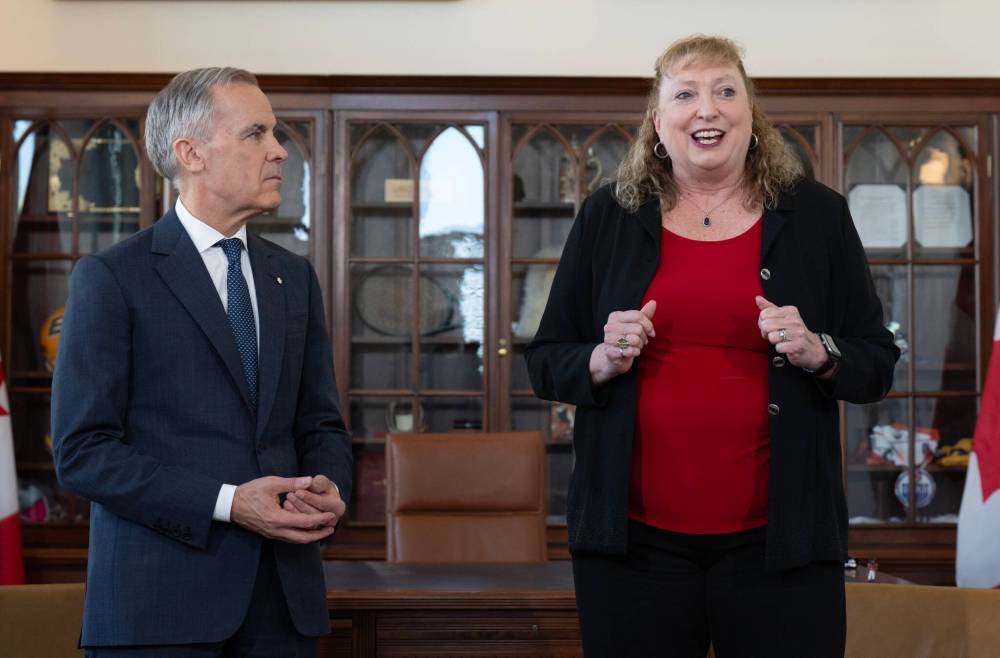
Prime Minister Mark Carney looks on as MP for Sarnia-Lambton-Bkejwanong Marilyn Gladu speaks in Ottawa, April 8. Gladu is the latest Conservative MP to cross the floor to the governing Liberals.
Fidelity to us or fidelity to themselves? Representing the community or representing their principles? Respecting our votes or respecting their conscience?
Beyond one person, one vote, there is no obvious single democratic maxim that can neatly and forthrightly sum up an agreed version of democracy in Canada. But surely, we can agree that if you were voted in as a Conservative or a New Democrat or a Liberal, you should remain a Conservative, New Democrat, or a Liberal?
Not so fast. If voters are allowed to change their minds, why not the MPs or MLAs they voted for? After all, freedom of political expression is guaranteed under Section 2 of our Charter of Rights and Freedoms. That includes elected officials.
But public opinion is hardening against this as an unrestricted right as one recent survey by Leger shows. While 42 per cent of respondents felt floor crossing should be allowed, only 20 per cent said this should be an unrestricted right without any conditions such as a byelection or sitting as an independent.
Since our Westminster system is built on the foundational premise that we elect MPs to represent us, not parties, or premiers or prime ministers, anything that touches upon the rights and privileges of MPs demands careful scrutiny.
Similarly, as we grouse about excessive party discipline and MPs not being allowed to speak or vote their minds, we also like the benefits of stable government that flows from that very party discipline. Democratic principle and democratic practice are not nearly as neat as one might wish.
Reconciling all this can be done in two ways: by law or by convention.
A political convention is a non-legal rule or practice that has become widely accepted and practiced. It is codified in conduct if not in law. Breaking the convention brings political sanctions at the ballot box via voters, not legal sanctions via the courts.
An attempt to ban or restrict floor crossing through law is unworkable. There have been at least eight attempts to legislate against floor crossing in the House of Commons over the past 25 years. All failed. Why? Because every political party has benefited from floor crossing in the past or thinks they can benefit from it in the future, or it has been thought contrary to the Charter, or it has been deemed as an infringement upon the rights and privileges of members of Parliament.
Only two jurisdictions in Canada — Manitoba in 2006 and New Brunswick in 2014 — successfully passed legislation on floor crossing. Neither province sought to ban it. Rather, each placed such severe conditions on it that the practice would have effectively curtailed, if not outright eliminated.
Both required that any MLA who “leaves the caucus of the political party for which he or she is elected” (N.B.) or “ceases to belong to the caucus of that party during the term for which he or she was elected” (Manitoba), must sit as an independent member of the legislative assembly or (in the case of N.B.) resign their seat. Manitoba repealed this section of the Legislative Assembly Act in 2019, and New Brunswick repealed its stand-alone law in 2015, both following the election of different governments that had originated them.
Neither law in Manitoba nor New Brunswick was tested in court, so some question remains about their ultimate legality. But it was the “chill effect’” that counts. Don’t try to cross the floor in the first place.
These efforts were meant to legislate behaviour, imposing a moral threshold not just on floor crossing but leaving a caucus in the first place. The real result is to keep even tighter party grip and discipline on members.

Therein lies the issue. Democratic tenets are upheld only so long as parties agree with them. While citizens should expect political parties to be good and proper stewards of democracy at all times, we sadly cannot expect them to always act in democracy’s best interests when it conflicts with their own.
Laws restricting floor crossing seek to subvert the will of voters in the future by freezing in place the choice of voters from the past.
In our parliamentary system, the best and truest democratic sanction can only come from voters of the affected constituency. It is they who must pronounce ‘yay’ or ‘nay’ on their local representative. That comes at election time.
Anything that gets in the way of that ultimate judgment is anti-democratic by putting parties first, not people.
David McLaughlin is a former clerk of the executive council and cabinet secretary in the Manitoba government.
Our newsroom depends on a growing audience of readers to power our journalism. If you are not a paid reader, please consider becoming a subscriber.
Our newsroom depends on its audience of readers to power our journalism. Thank you for your support.
Our newsroom depends on a growing audience of readers to power our journalism. If you are not a paid reader, please consider becoming a subscriber.
Our newsroom depends on its audience of readers to power our journalism. Thank you for your support.
Advertisement Advertise With Us
Advertisement Advertise With Us