Ritual of remembrance

Saying names aloud keeps memories of Holocaust victims alive

Advertisement

Advertise with us

On a designated spring morning for more than three decades, members of Winnipeg’s Jewish community, representatives of other faith communities, high school students and local government officials have met near the Holocaust Memorial on the grounds of the Manitoba Legislature to take turns reading aloud the names of men, women and children whose lives ended more than 80 years ago.

Read this article for free:


or

Already have an account? Log in here »

To continue reading, please subscribe:

Subscribe and receive a limited-edition Free Press branded hat or tote.

Digital Subscription

One year of digital access for only $205*

  • Enjoy unlimited reading on winnipegfreepress.com
  • Read the E-Edition, our digital replica newspaper
  • Access News Break, our award-winning app
  • Play interactive puzzles

*First annual payment billed as $205.00 + GST for one year. This annual subscription will automatically renew at $233.00 + GST every 52 weeks (10% off the regular annual price of $259.35). Offer available to new and qualified returning subscribers only. Cancel any time.

To continue reading, please subscribe:

Add Free Press access to your Brandon Sun subscription for only an additional

$1 for the first 4 weeks*

  • Enjoy unlimited reading on winnipegfreepress.com
  • Read the E-Edition, our digital replica newspaper
  • Access News Break, our award-winning app
  • Play interactive puzzles
Start now

*Your next Brandon Sun subscription payment will increase by $1.00 and you will be charged $17.95 plus GST for four weeks. After four weeks, your payment will increase to $24.95 plus GST every four weeks.

On a designated spring morning for more than three decades, members of Winnipeg’s Jewish community, representatives of other faith communities, high school students and local government officials have met near the Holocaust Memorial on the grounds of the Manitoba Legislature to take turns reading aloud the names of men, women and children whose lives ended more than 80 years ago.

The reading of the names is the main component of Unto Every Person There is a Name, a program organized and hosted by the League for Human Rights of B’nai Brith Canada for Holocaust Remembrance Day. That day, which commemorates the six million Jewish victims of the Nazi genocide, fell this year on April 14.

“Six million is a staggering number,” says Ruth Ashrafi, B’nai Brith Canada’s regional director for Manitoba. “It is hard to fully comprehend the scale of the killings. Reading the names of the individuals out loud, together with the location of their murder — and in the case of children their age of death — puts a human face on this number. ”
MIKAELA MACKENZIE / FREE PRESS
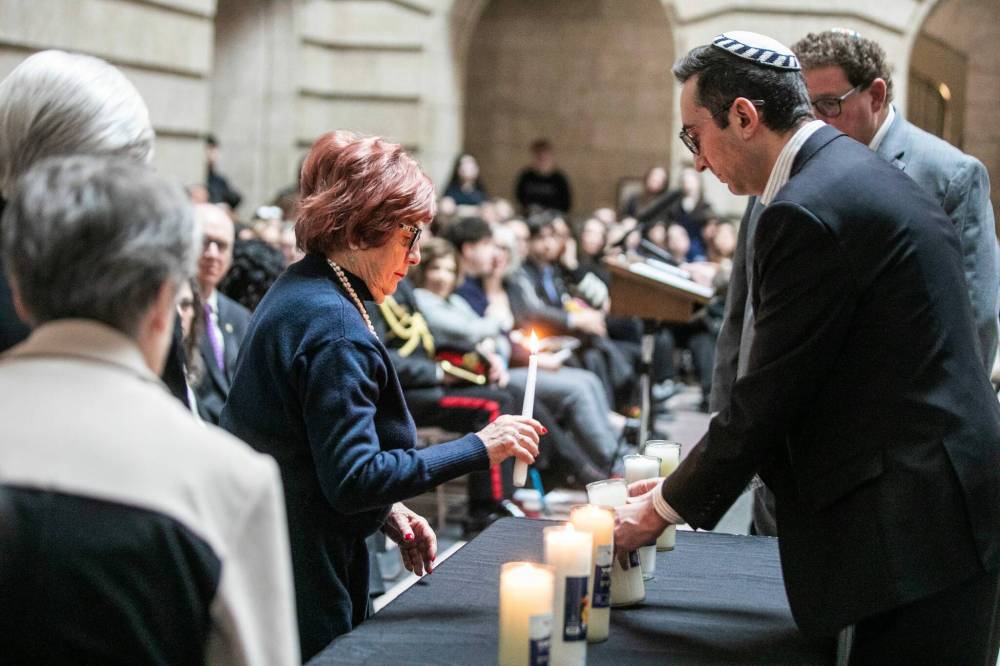
                                Judith Lavitt lights a candle at the Yom HaShoah annual Holocaust commemoration at the Manitoba Legislative Building, April 14.

MIKAELA MACKENZIE / FREE PRESS

Judith Lavitt lights a candle at the Yom HaShoah annual Holocaust commemoration at the Manitoba Legislative Building, April 14.

This year’s event was chaired by Winnipegger Rob Berkowits, a second-generation Holocaust survivor who has been one of the name readers since the program’s inception in 1990.

“By reciting their names, we remember that each victim was an individual — a mother or father, a son or daughter, a sister or brother, a child, a friend, “ Berkowits explains. “Each had hopes and dreams and, like all people, each clung to life.”

“Unto Every Person There Is a Name,” he adds, “gives names back to those who were stripped of their identities before they were robbed of their lives.”

The names that Berkowits recites in public each year include David, Chaia, Moishe, Shlome, Pearl, Rochel, Lazer, Bateu and Hantza, who were all members of his late father Alex’s family.

Alex Berkowits was 13 years old when he was transferred with his parents and siblings into the ghetto in his hometown of Sighet, Romania in 1944. In the months that followed he endured vicious brutality, inhumane forced labour, death camps and death marches, before being liberated from the Buchenwald concentration camp, alongside his friend and future Nobel Peace Prize recipient Elie Wiesel, in April 1945.

Alex Berkowits was one of 130 Jewish orphans who were brought to Winnipeg after the war. That group of children also included John Hirsch, the late co-founder of the Manitoba Theatre Centre.

They were the lucky ones.

One and a half million Jewish children were murdered in the Holocaust. Thanks to the local organization One More Candle, the identities of many of those children have been preserved and their names have been added to the roster of the names read aloud at the B’nai Brith memorial event each year.

“In Judaism we are commanded to remember,” Ashrafi says, “not only so that we won’t forget but also so that we will do everything we can to prevent such an atrocity from happening again. With the passing of time, the memory of the Holocaust grows more distant. An annual commemoration ensures that we will not forget its horrors and its lessons.”

Rob Berkowitz concurs that it is especially critical in this current day and age that the horrors of the Holocaust and the identity of its victims continue to be talked about and remembered.

“The more recent surge in Jew hating and the need to combat it have highlighted for me the need for consistent vigilance and education about the Holocaust,” he says. “As the world faces new challenges, initiatives such as Unto Every Person There is a Name remains a vital reminder of the dangers of unchecked hatred and the need for collective responsibility to protect and promote peace.”

swchisvin@gmail.com

The Free Press is committed to covering faith in Manitoba through our Religion in the News project. This reporting continues because readers like you step forward to fund it.

Donate now to support our reporting on religion.

Your donation is eligible for a charitable tax receipt. BECOME A FAITH JOURNALISM SUPPORTER

Report Error Submit a Tip

The Free Press acknowledges the financial support it receives from members of the city’s faith community, which makes our coverage of religion possible.
More Stories

Don’t settle for being ‘reasonable facsimile’

Maureen Scurfield 5 minute read 2:00 AM CDT

Don’t settle for being ‘reasonable facsimile’

DEAR MISS LONELYHEARTS: I always fall in love when the leaves start turning to fall colours. But, this year I have a big problem that could get me in terrible trouble. My heart is burning for a guy I can’t have — because he used to be married to my older sister. My sister is “possessive for life” and would divorce me as a family member if I took up with him.

Still, he’s been calling me at night to talk about her and I have been giving him advice during the long calls. You know what that means — a lot of things are being said in conversation after midnight, especially when both of us have been drinking wine!

The trouble is I know deep down I’m only a substitute for my older sister. I even look like her! He was crazy about her, but he wasn’t true to her, and she can’t forgive him for that!

Province announces free daycare for low-income families

Nicole Buffie 3 minute read Preview

Province announces free daycare for low-income families

Nicole Buffie 3 minute read Wednesday, Sep. 2, 2026

Eligible parents will have their child-care fees waived come Sept. 13.

Read
Wednesday, Sep. 2, 2026

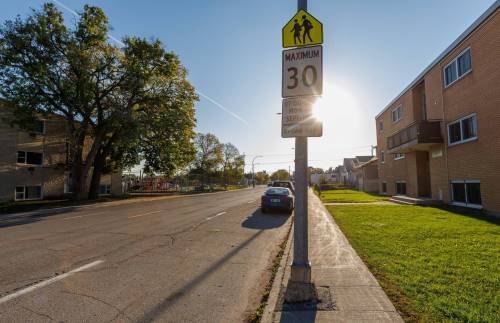
No more playing around, make 30 km/h school zones permanent

Tom Brodbeck 5 minute read Preview

No more playing around, make 30 km/h school zones permanent

Tom Brodbeck 5 minute read Yesterday at 2:07 PM CDT

Winnipeg has already decided that 30 kilometres per hour is the right speed around schools.

It’s time to stop pretending that decision should expire every summer.

The city’s reduced school-zone speed limits returned Tuesday, a full week before the 2026-27 school year begins. They apply on weekdays from 7 a.m. to 5:30 p.m., from Sept. 1 until July 1.

Then, for two months, they disappear.

Read
Yesterday at 2:07 PM CDT

Explaining Canada’s superior employment rate

Wayne Simpson 5 minute read Preview

Explaining Canada’s superior employment rate

Wayne Simpson 5 minute read 2:00 AM CDT

Donald Trump regularly makes outrageous claims. Fentanyl was pouring across the northern border from Canada and had to be stopped. Canada is nasty to deal with and has the highest tariffs in the world. Canada needs the U.S. but the U.S. doesn’t need Canada. Canadians want to become the 51st state. And so on.

In the latest trade dispute, after Mark Carney walked away from negotiations, Trump made a new claim that Canada’s unemployment rate was 10 per cent and climbing rapidly. Insofar as the unemployment rate is closely monitored, reported monthly, and given similar attention to the rates of inflation and economic growth, the comment was likely intended to signal Canada’s weakness. It fits Trump’s narrative that Canada needs the U.S. for its livelihood and protection and would be better off more directly under U.S. influence as a 51st state, or perhaps a protectorate like the Philippines or Panama in the past.

Fact checkers quickly reported that Canada’s unemployment rate is really 6.4 per cent for July, not 10 per cent, has fallen from 6.9 per cent in April, and is at its lowest rate since May 2024. Some astute observers pointed out that Canada’s method for the calculation of the unemployment rate leads to a higher rate than the U.S. by about one per cent. Under the American methodology, then, our unemployment rate would be 5.4 per cent, not that far off the U.S. July rate of 4.1 per cent.

Detection of unemployment is less straightforward that might appear, as it is sandwiched between the labour force statuses of employment and inactivity at a particular point in time. The internationally established standard for determination of unemployment is the notion of searching for work — you are unemployed if you do not have paid employment and you are looking for work without success. Surveys have been developed to categorize respondents as employed, unemployed or inactive, including the labour force survey (LFS) in Canada and the current population survey (CPS) in the U.S.

Read
2:00 AM CDT

‘Where are they going to go?’: encampment policy blamed for homeless people sleeping outside thrift store

Scott Billeck 5 minute read Preview

‘Where are they going to go?’: encampment policy blamed for homeless people sleeping outside thrift store

Scott Billeck 5 minute read Wednesday, Sep. 2, 2026

The owner of a Portage Avenue thrift shop says the city’s encampment ban has pushed dozens of homeless people from tent communities to spaces near her store.

Susan Lockhart, who runs Just Like New to You at 635 Portage Ave., says anywhere from 25 to 50 people can be found at any given time behind the store and along the back lane stretching between Sherbrook and Furby streets.

“Where are they going to go?” she said Wednesday from her shop. “I was just here on the weekend and I couldn’t get to our back door. There were people everywhere. Mattresses.”

Earlier this week, the city reported 275 people were known to be living in 72 encampments across Winnipeg — down from 100 encampments housing about 700 people last September. The report also noted that 141 sites have been remediated since the city’s encampment policy came into effect in November.

Read
Wednesday, Sep. 2, 2026

Manitoba’s next power plant already under construction

Colleen Kuruluk 4 minute read 2:00 AM CDT

Across Manitoba, we’re rapidly moving toward a more electrified future, as homes, businesses, industries, and transportation increasingly turn to electricity. This transition offers a significant opportunity to reduce greenhouse gas emissions, but it also requires us to rethink how we plan for and participate in our energy future.

Manitoba Hydro’s 2025 integrated resource plan (IRP), currently under review with the Public Utilities Board, projects that our province will need significant additional capacity over the next decade to meet growing electricity demand. Much of the public discussion following the IRP has focused on how to meet that growing demand and what new generation sources may need to be built.

These are important conversations, but I believe there’s another question that deserves just as much attention.

How much of that growing demand can we address by using energy more efficiently?