

Advocates praise move to ban social media use among youths

Advertisement
Read this article for free:
or
Already have an account? Log in here »
To continue reading, please subscribe:

Digital Subscription
One year of digital access for only $205*
- Enjoy unlimited reading on winnipegfreepress.com
- Read the E-Edition, our digital replica newspaper
- Access News Break, our award-winning app
- Play interactive puzzles
*First annual payment billed as $205.00 + GST for one year. This annual subscription will automatically renew at $233.00 + GST every 52 weeks (10% off the regular annual price of $259.35). Offer available to new and qualified returning subscribers only. Cancel any time.
To continue reading, please subscribe:
Add Free Press access to your Brandon Sun subscription for only an additional
$1 for the first 4 weeks*
- Enjoy unlimited reading on winnipegfreepress.com
- Read the E-Edition, our digital replica newspaper
- Access News Break, our award-winning app
- Play interactive puzzles
*Your next Brandon Sun subscription payment will increase by $1.00 and you will be charged $17.95 plus GST for four weeks. After four weeks, your payment will increase to $24.95 plus GST every four weeks.
Read unlimited articles for free today:
or
Already have an account? Log in here »
Child advocates are praising the Manitoba government for announcing its intention to ban the use of social media and artificial intelligence chatbots for youths.
Premier Wab Kinew told a crowd at a party event Saturday night the NDP government will move to restrict children from using social media accounts and artificial intelligence chatbots. The proposal is intended to protect kids from technology platforms that he says hurt their development.
Details on the plan are scant, like the age limit he is considering or how a ban would be enforced. He did not speak to reporters after his speech and was not available for comment Sunday.
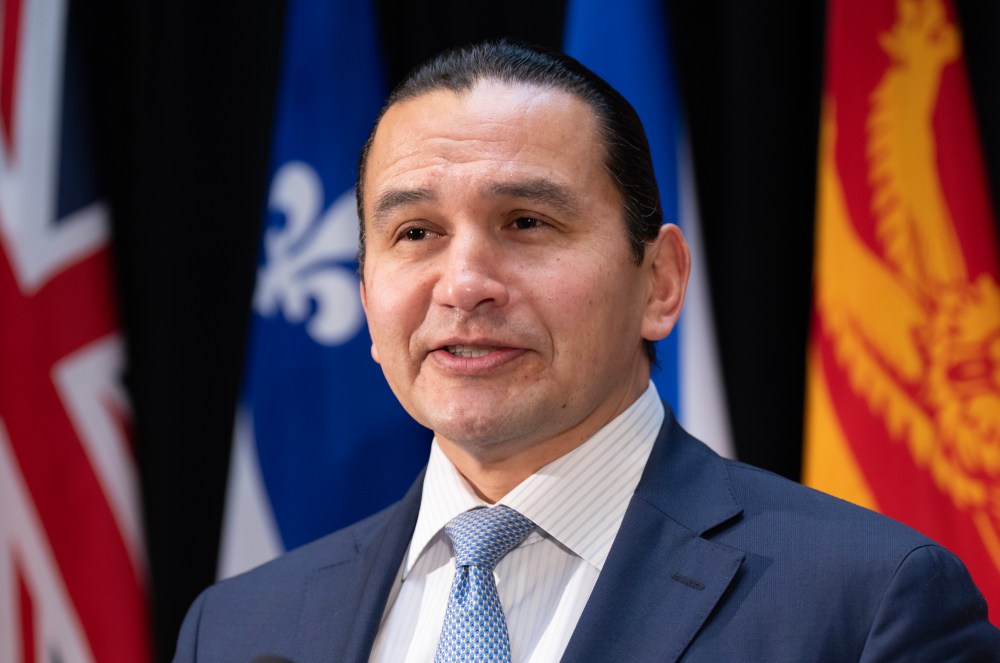
Kinew’s director of communications, Amy Tuckett-McGimpsey, said the premier will likely speak more about the idea in the coming days.
Child advocates lauded Kinew’s intent, saying time is of the essence when it comes to protecting children online.
“When I think about these things, it’s in weeks and months, not years or decades,” said Robin Sherk, who does national advocacy for Unplugged Canada, a parent-led group calling for restrictions on smartphones and social media.
“The cost of inaction is so high. How many more kids are we going to let be put into this environment?”
The group was founded in 2024 and works to lobby for regulations that would prevent digital harm on youth.
The Toronto-based mom of four says while there is a responsibility for parents to talk to their kids about managing their social media use, the approach needs to be multi-layered and must involve government intervention.
“I think this is really encouraging. I think it’s a recognition of the urgency of this issue and the desire to see swift, meaningful action happen.”
“I think this is really encouraging. I think it’s a recognition of the urgency of this issue and the desire to see swift, meaningful action happen,” Sherk said.
Australia became the first country last December to create a law enforcing age limits on social media accounts, and introduced multimillion-dollar fines for companies found non-compliant.
Jeannie Paterson, a professor of law in consumer protection at the University of Melbourne, says the legislation has created friction in the online market and not every tech company is doing all it can to enforce the restriction, but it is still early days and the ban has resulted in millions of accounts being removed online.
“It’s not perfect, but it’s clearly impactful, and impact is enough,” she said Sunday.
Paterson echoed Sherk’s statement that social media moderation is a shared responsibility, but noted that a blanket ban might not be the best solution.
The professor worries that without media literacy education teens will be thrust online as soon as they turn 16 years old (Australia’s age minimum) without any prior involvement and be unsure how to navigate potentially harmful content.
“We need social media literacy education, so that the overall population improves its social literacy, digital literacy, and dealing with these technologies,” said Paterson, who is also the co-founding director of the Centre for Artificial Intelligence and Digital Ethics at the university.
She applauded the inclusion of artificial intelligence in Manitoba’s proposed ban, noting that generative AI has made content on social media go from bad to worse.
A study from the American-based National Library of Medicine found that using generative AI and AI bots in social media can result in a more severe social media manipulation.
“We need social media literacy education, so that the overall population improves its social literacy, digital literacy, and dealing with these technologies.”
The Canadian Centre for Child Protection said it gives its full support to Kinew’s proposal. The non-profit said the harm to children’s well-being as a result of unregulated social media use has been happening at an “industrial scale” for years.
“Our first-hand experience helping tens of thousands of children across the country who have been seriously victimized on these unregulated platforms leaves us with no doubt that setting age minimums is one of several steps needed to safeguard children online,” said a statement from Lianna McDonald, executive director for the Canadian Centre for Child Protection.
The centre is encouraging the Canadian government and other provinces to follow suit.

Federal Liberal party members recently passed a non-binding resolution with the same idea, and Prime Minister Mark Carney has said the idea merits consideration.
Unplugged Canada penned an open letter to the federal government asking for action on the matter ahead of the Liberal convention in April. The letter garnered more than 4,000 signatures.
Polls suggest Canadians, by and large, support restrictions on social media use among youth. According to a poll commissioned by the Angus Reid Institute, 75 per cent of respondents say they would support a ban on social media use for anyone under the age of 16.
– with files from the Canadian Press
nicole.buffie@freepress.mb.ca
Nicole Buffie
Multimedia producer
Nicole Buffie is a reporter for the Free Press city desk. Born and bred in Winnipeg, Nicole graduated from Red River College’s Creative Communications program in 2020 and worked as a reporter throughout Manitoba before joining the Free Press newsroom as a multimedia producer in 2023. Read more about Nicole.
Every piece of reporting Nicole produces is reviewed by an editing team before it is posted online or published in print — part of the Free Press‘s tradition, since 1872, of producing reliable independent journalism. Read more about Free Press’s history and mandate, and learn how our newsroom operates.
Our newsroom depends on a growing audience of readers to power our journalism. If you are not a paid reader, please consider becoming a subscriber.
Our newsroom depends on its audience of readers to power our journalism. Thank you for your support.
Nicole Buffie
Multimedia producer
Nicole Buffie is a reporter for the Free Press city desk. Born and bred in Winnipeg, Nicole graduated from Red River College’s Creative Communications program in 2020 and worked as a reporter throughout Manitoba before joining the Free Press newsroom as a multimedia producer in 2023. Read more about Nicole.
Every piece of reporting Nicole produces is reviewed by an editing team before it is posted online or published in print — part of the Free Press‘s tradition, since 1872, of producing reliable independent journalism. Read more about Free Press’s history and mandate, and learn how our newsroom operates.
Our newsroom depends on a growing audience of readers to power our journalism. If you are not a paid reader, please consider becoming a subscriber.
Our newsroom depends on its audience of readers to power our journalism. Thank you for your support.
Related Articles
Manitoba premier says social media ban coming for kids, like Australia




Advertisement Advertise With Us
Advertisement Advertise With Us