

Lots of accolades, little details in Kinew’s proposed social media ban

Advertisement
Read this article for free:
or
Already have an account? Log in here »
To continue reading, please subscribe:
Digital Subscription
One year of digital access for only $1.44 a week*
- Enjoy unlimited reading on winnipegfreepress.com
- Read the E-Edition, our digital replica newspaper
- Access News Break, our award-winning app
- Play interactive puzzles
*Billed as $5.77 plus GST every four weeks. After 52 weeks, price increases to the regular rate of $19.95 plus GST every four weeks. Offer available to new and qualified returning subscribers only. Cancel any time.
To continue reading, please subscribe:
Add Free Press access to your Brandon Sun subscription for only an additional
$1 for the first 4 weeks*
- Enjoy unlimited reading on winnipegfreepress.com
- Read the E-Edition, our digital replica newspaper
- Access News Break, our award-winning app
- Play interactive puzzles
*Your next Brandon Sun subscription payment will increase by $1.00 and you will be charged $17.95 plus GST for four weeks. After four weeks, your payment will increase to $24.95 plus GST every four weeks.
Read unlimited articles for free today:
or
Already have an account? Log in here »
Premier Wab Kinew made national news headlines on the weekend when he promised to institute a ban on social media use by youth. Although Ottawa and several other provinces have promised similar efforts, the industrious Manitoba premier beat them to the punch and the accolades.
Kinew was no doubt aware that separating children from social media has become an international obsession. Seizing upon this issue, and holding court with a hotel ballroom full of 900 loyal New Democratic supporters, he announced his intention to save Manitoba children from the social and psychological ravages of social media.
Unfortunately, Kinew does not yet know, or is not prepared to say, at what age his ban would take effect, how it would be enforced or which platforms would be affected. But why sweat the details?
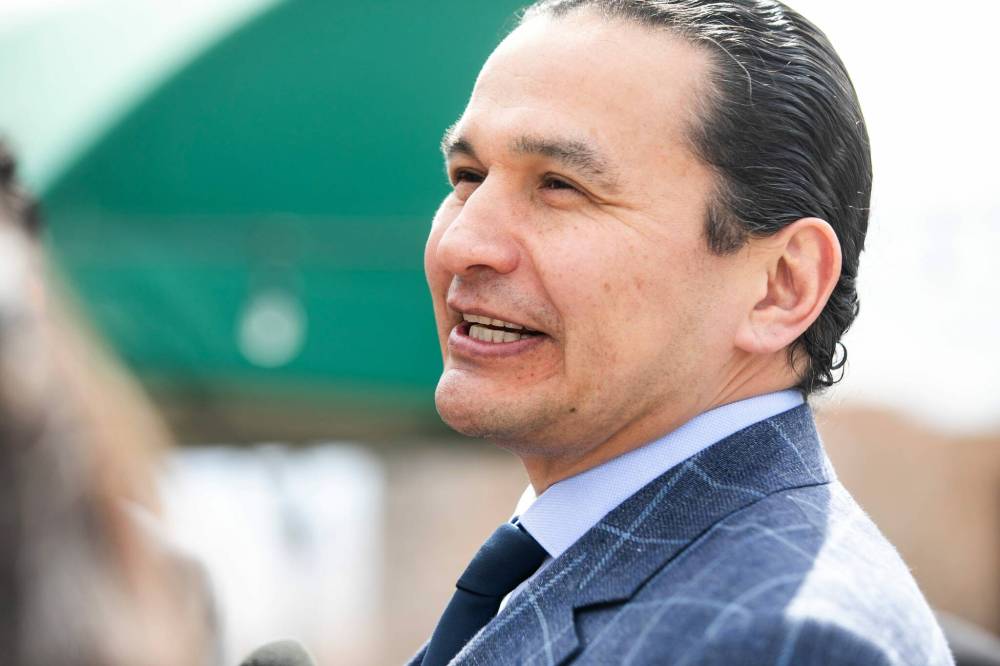
MIKAELA MACKENZIE / FREE PRESS FILES
There is a very real chance Premier Wab Kinew’s trailblazing pledge may be just promise with no real pathway to enforcement.
This pledge is a winner with voters.
A month before Kinew’s announcement, an Angus Reid Institute survey found that 74 per cent of Canadians support a ban on social media use by youth under the age of 16. This kind of result tells us that political leaders who do a good job of measuring public opinion are going to weigh in on social media bans.
The big challenge for Kinew is how to follow through.
Despite the existence of social media bans in jurisdictions around the world, nobody has perfected the methodology of verifying the age of a user to restrict access to certain kinds of content.
In describing his intentions, Kinew cited Australia, the first country to legally restrict young people from accessing social media. The example Manitoba’s premier is using, however, is hardly encouraging for those who would like to set up a firewall between their children and social media.
Various reports and surveys suggest that despite the ban, six in 10 Australian teenagers continue to access social media. News reports have contained examples of workarounds, including virtual private networks and a variety of techniques to foil face-recognition software.
Australia’s struggles have prompted other jurisdictions to look for a better age-verification mouse trap.
This year, the European Union hopes to widely deploy a Digital Identify App that users and sites offering restricted content can use to meet commission regulations on age verification. Even though the EU’s app is a step forward, it’s not being universally celebrated because online security experts believe it is ripe for hackers.
Add up the collective global experience, and there is a very real chance Kinew’s trailblazing pledge may be just promise with no real pathway to enforcement.
However, before we lament the insurmountable challenges of age verification, we might ask whether a ban can actually accomplish what it is set out to: a reduction in social-media related bullying and improved youth mental health.
Right now, there is no jurisdiction anywhere in the world that has had a ban in place long enough to come to conclusions about efficacy. As the number of bans increases, and methodology on age verification becomes more refined, we will get some idea of whether keeping younger kids off Tiktok has any meaningful impact on social and psychological well-being.
Some of the anecdotal evidence from Australia is promising, notwithstanding the problems with age verification.
A YouGov survey in March found six in 10 Australians believe the ban has been successful in reducing the amount of cyberbullying while 43 per cent said they felt their children were having more in-person social interactions, 38 per cent said the children were “more present and engaged” and 38 per cent reported improved parent-child relationships.
This may be stating the obvious, but when a vast majority of parents wanted a social media ban, it’s not surprising that some are seeing the results they hoped for. That cynicism is warranted when you consider many mental-health practitioners and researchers believe a ban, on its own, is unlikely to have much impact.
In an expert commentary published by Science Media Centre, the non-profit determined there isn’t enough experience with social media bans to conclusively determine its impact, and that existing research suggested that social media does not, in and of itself, erode mental health.
Mental health, the experts argue, is determined by a range of factors including the relative strength of family dynamics, family predisposition of mental illness, and other external factors. Screen time, whether it’s to engage in social media or otherwise, does not have a strong connection to behaviour change, the experts aid.

“There is broad scientific agreement that we need to do more to keep children safe online and to ensure that the digital platforms they use are designed to support their well-being and development,” said Prof. Amy Orben, program leader at the MRC Cognition and Brain Sciences Unit at the University of Cambridge. “What we currently lack is strong scientific evidence on whether banning social media for certain ages is an effective way of achieving this.”
Where does that leave Kinew’s pledge?
For the moment, there are real concerns his proposed social media ban will not do what he hopes it will do.
On the other hand, it’s a winner in the court of public opinion.
dan.lett@freepress.mb.ca
Dan Lett is a columnist for the Free Press, providing opinion and commentary on politics in Winnipeg and beyond. Born and raised in Toronto, Dan joined the Free Press in 1986. Read more about Dan.
Dan’s columns are built on facts and reactions, but offer his personal views through arguments and analysis. The Free Press’ editing team reviews Dan’s columns before they are posted online or published in print — part of the our tradition, since 1872, of producing reliable independent journalism. Read more about Free Press’s history and mandate, and learn how our newsroom operates.
Our newsroom depends on a growing audience of readers to power our journalism. If you are not a paid reader, please consider becoming a subscriber.
Our newsroom depends on its audience of readers to power our journalism. Thank you for your support.
Dan Lett is a columnist for the Free Press, providing opinion and commentary on politics in Winnipeg and beyond. Born and raised in Toronto, Dan joined the Free Press in 1986. Read more about Dan.
Dan’s columns are built on facts and reactions, but offer his personal views through arguments and analysis. The Free Press’ editing team reviews Dan’s columns before they are posted online or published in print — part of the our tradition, since 1872, of producing reliable independent journalism. Read more about Free Press’s history and mandate, and learn how our newsroom operates.
Our newsroom depends on a growing audience of readers to power our journalism. If you are not a paid reader, please consider becoming a subscriber.
Our newsroom depends on its audience of readers to power our journalism. Thank you for your support.
Related Articles
Advocates praise move to ban social media use among youths





Advertisement Advertise With Us
Advertisement Advertise With Us
History
Updated on Tuesday, April 28, 2026 8:10 AM CDT: Changes wording to "will not do what he hopes it will do"