

The beautiful promise of the Pantages project

Advertisement
Read this article for free:
or
Already have an account? Log in here »
To continue reading, please subscribe:

Digital Subscription
One year of digital access for only $205*
- Enjoy unlimited reading on winnipegfreepress.com
- Read the E-Edition, our digital replica newspaper
- Access News Break, our award-winning app
- Play interactive puzzles
*First annual payment billed as $205.00 + GST for one year. This annual subscription will automatically renew at $233.00 + GST every 52 weeks (10% off the regular annual price of $259.35). Offer available to new and qualified returning subscribers only. Cancel any time.
To continue reading, please subscribe:
Add Free Press access to your Brandon Sun subscription for only an additional
$1 for the first 4 weeks*
- Enjoy unlimited reading on winnipegfreepress.com
- Read the E-Edition, our digital replica newspaper
- Access News Break, our award-winning app
- Play interactive puzzles
*Your next Brandon Sun subscription payment will increase by $1.00 and you will be charged $17.95 plus GST for four weeks. After four weeks, your payment will increase to $24.95 plus GST every four weeks.
Read unlimited articles for free today:
or
Already have an account? Log in here »
Last Saturday evening at Philips Square, I was reminded how profoundly the space in which we experience music shapes what we hear.
We welcomed friends and patrons of the Winnipeg Symphony Orchestra — alongside eight extraordinary musicians — for an evening of chamber music. It was part of the WSO’s Concertmaster’s Bow series: intimate salon-style gatherings where music is not just heard, but fully experienced.
In a beautifully restored space, with exceptional acoustics and a warmth that most concert halls rarely achieve, we listened. Mendelssohn’s String Octet — famously virtuosic, exuberant, and demanding — filled the room. Eight musicians playing as one, just feet from the audience.
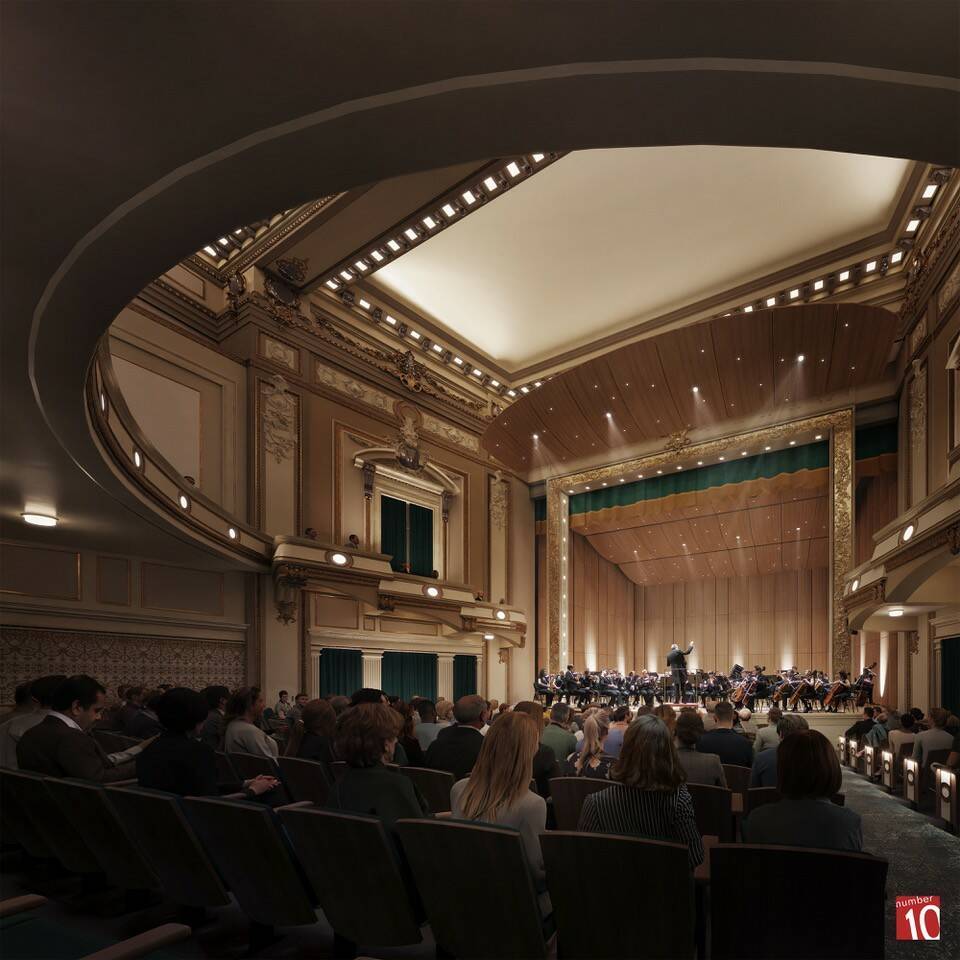
Submitted/Number TEN Architect Group
Pantages Theatre, hall view rendering.
No distance. No barrier. Just music, unfolding in real time.
It was an ideal setting — and it clarified something instantly: this is exactly what the Winnipeg Symphony Orchestra’s Pantages Theatre project aims to do.
At the concert, we also heard from WSO concertmaster Karl Stobbe (his 18th-century French violin bow in hand), CEO Angela Birdsell, and board chair Curt Vossen. Each spoke with clarity and conviction about the vision for a renewed home for the WSO at the historic Pantages Playhouse Theatre.
What struck me was not just the ambition of the project — but its timing.
This is not about building something new for the sake of it. It’s about finding the right space — at the moment it matters most.
The Pantages Theatre — like Philips Square — is a century-old structure with memory and meaning embedded in its walls. It carries the history of performance, gathering, and civic memory. But history alone is not enough. What matters is how we activate these spaces today — how we adapt them to contemporary artistic practice while honouring their past.
This is where the Pantages vision takes hold.
The proposal is not simply a renovation. It is a reimagining of what a performance space can be in the 21st century.
In presentations on the project, the design team led by Number TEN Architectural Group describe a “music-first” environment — where acoustics, sightlines, and intimacy are not refinements, but the foundation. It is not an attempt to replicate the traditional concert hall — with its distance, decorum, and inherited hierarchies — but to overturn it entirely.
In its place, they imagine something far more immediate: a flexible, immersive environment that brings audiences closer to the music, and to one another, in ways that reflect how we listen today.
It recognizes something fundamental: audiences are changing. Artists are seeking new ways to connect. The conventional separation between performer and listener — so often dictated by large, formal concert halls — is not always what we want, or need.
What we experienced at Philips Square proved exactly that.
When you are in close proximity to musicians — when you can see the movement of the bow, the positioning of instruments, the exchange of glances, the physicality of performance — you engage differently.
The music becomes direct, personal, and unmistakably human.
The Pantages project has the potential to bring that sensibility to a broader audience — at scale, without losing intimacy.
There is also a broader community case to be made.
For decades, Winnipeggers have spoken about the importance of its downtown: its vitality, its safety, its future.
Arts and culture are central to that conversation — not as an add-on, but as a driver.
The revitalization of the Pantages Theatre contributes directly to this vision. It strengthens the performing arts district, draws audiences into the downtown core, and creates a destination for shared cultural experiences.
And importantly, it does so through adaptive reuse.
In a time when sustainability is no longer optional, projects like this matter. Reinvesting in existing buildings — rather than building anew — is both environmentally responsible and artistically meaningful. It connects past and present in a tangible way.
I’ve seen this first-hand.
Working with architect Michael Maltzan on the design of Qaumajuq, the new Inuit art centre connected to the Winnipeg Art Gallery, our goal was simple: to bring the art to the people.
Within a few feet of entering, visitors are immersed in the visible vault — the largest of its kind in the world — a soaring, light-filled space revealing more than 5,000 Inuit stone carvings. The collection is not hidden away. It is present, immediate, and central to the experience. You don’t search for it — it meets you.
That idea — of removing distance between audience and art — is exactly what I see at the heart of the Pantages project. It is not just about restoring a building.
It is about reshaping the relationship between performer, space, and audience.
Projects like this ultimately come down to leadership.
WSO leaders like Stobbe, Birdsell, and Vossen are doing exactly that. They are advancing a vision that is not only about the future of the orchestra, but about how music in this city will be performed, experienced, and shared.
They are asking a fundamental question: what kind of cultural city does Winnipeg want to be?
And they are offering an answern — one that is creative, ambitious, and grounded in both history and possibility.
By the end of the evening last Saturday, with the final notes of Mendelssohn’s Octet, I remained immersed in the power of live performance — and in what it represented.
A moment. A model.
A glimpse of what becomes possible when space, sound, and people come together seamlessly.

The Pantages project is an extension of that idea.
It is about creating a place where music can live fully — where artists and audiences meet not at a distance, but in shared experience.
And right now, for the Winnipeg Symphony Orchestra, for the downtown, and for the city itself, it is exactly the right project at the right time.
In a city that often debates its future, this is a project that helps build it.
Stephen Borys is president and CEO of Civic Muse, and former director and CEO of the Winnipeg Art Gallery–Qaumajuq.
Our newsroom depends on a growing audience of readers to power our journalism. If you are not a paid reader, please consider becoming a subscriber.
Our newsroom depends on its audience of readers to power our journalism. Thank you for your support.
Our newsroom depends on a growing audience of readers to power our journalism. If you are not a paid reader, please consider becoming a subscriber.
Our newsroom depends on its audience of readers to power our journalism. Thank you for your support.
Related Articles
Concert showcases WSO the way it’s meant to be heard


Advertisement Advertise With Us
Advertisement Advertise With Us