In the PR battle for AI data centers, tech giants got a blue-collar ally
Advertisement
Read this article for free:
or
Already have an account? Log in here »
To continue reading, please subscribe:

Digital Subscription
One year of digital access for only $205*
- Enjoy unlimited reading on winnipegfreepress.com
- Read the E-Edition, our digital replica newspaper
- Access News Break, our award-winning app
- Play interactive puzzles
*First annual payment billed as $205.00 + GST for one year. This annual subscription will automatically renew at $233.00 + GST every 52 weeks (10% off the regular annual price of $259.35). Offer available to new and qualified returning subscribers only. Cancel any time.
To continue reading, please subscribe:
Add Free Press access to your Brandon Sun subscription for only an additional
$1 for the first 4 weeks*
- Enjoy unlimited reading on winnipegfreepress.com
- Read the E-Edition, our digital replica newspaper
- Access News Break, our award-winning app
- Play interactive puzzles
*Your next Brandon Sun subscription payment will increase by $1.00 and you will be charged $17.95 plus GST for four weeks. After four weeks, your payment will increase to $24.95 plus GST every four weeks.
Read unlimited articles for free today:
or
Already have an account? Log in here »
HARRISBURG, Pa. (AP) — Building trades unions — long fashioned as the voice of the American worker — are now intertwined with the richest companies in the world as they create America’s artificial intelligence economy.
Unionized workers are employed on a huge number of massive data center projects and scrambling to recruit new apprentices to feed the explosive demand.
They’ve also become an ally of tech giants and tech-friendly government officials, echoing the talking point that the United States is in a critical national security race with China for AI superiority.
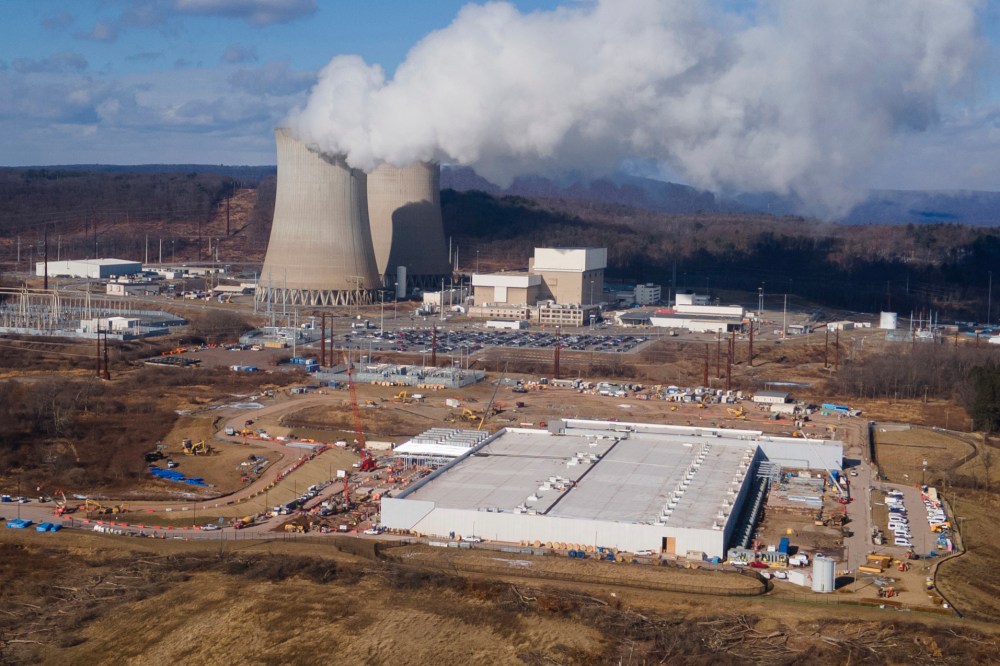
Unions are a visible force in helping counter fierce opposition in communities and hostile legislation in Congress and legislatures, often aligning with traditional Republican pro-business constituencies and forcing Democrats to choose between them and progressives who want to take a harder line.
Unions have aggressively answered complaints about data centers in ways that executives at tech giants and the development firms rarely do, unafraid to bluntly confront concerns about energy and water shortages, rising electric and water bills, or noise and quality-of-life objections.
“When people say, you know, ‘data centers are the root of all evil,’ we’re just saying, ‘look, they do create a hell of a lot of construction jobs, which we live and work in your communities,’” said Rob Bair, president of the Pennsylvania Building and Construction Trades Council.
Instead of “being just a blunt ‘no,’” Bair said, communities should figure out what they need and ask the tech companies for it — such as improvements to the project’s plans or millions of dollars for local schools. “If you don’t ask, you’re never gonna get,” he said.
Data centers a boon for unions
With data center construction accelerating, unions are expanding training centers and seeing their ranks grow faster than many union leaders have ever seen.
Unions in a number of states are reporting skyrocketing man hours, apprentice classes doubling in size and training centers undergoing expansions in anticipation of more work coming.
Data centers consume at least 40% of work hours done by members of the Columbus-Central Ohio Building and Construction Trades Council, a top official, Dorsey Hager, estimated. It’s at least 50% for the International Brotherhood of Electrical Workers Local 26 in metropolitan Washington, D.C., spokesperson Don Slaiman said.
The umbrella North America’s Building Trades Unions said it hit a record number of members and apprentices in 2025.
The organization’s president, Sean McGarvey, compared it to the build trades’ expansion in the 1950s. He attributes today’s growth to data centers, power plants and legislation under former President Joe Biden that subsidized the construction of semiconductor and electric vehicle battery factories, energy efficiency projects and grid transmission improvements.
Data centers’ voracious energy needs are setting off a power plant construction boom and delivering a one-two punch of new life to unions whose members also build and maintain boilers, ductwork, pipelines and other power infrastructure.
The Boilermakers Local 154, whose members have watched power plants shut down in southwestern Pennsylvania, went from recruiting zero apprentices for four years to now assembling a class of over 200 — and they need more, union official Shawn Steffee said.
For their part, tech giants say they need to train hundreds of thousands more workers in skilled trades. They are spending tens of millions of dollars on training programs, including partnerships with unions that they hire to build their multibillion-dollar projects.
“Across the country, highly skilled union construction workers are laying the foundation for the AI economy,” Sam Altman, co-founder and CEO of OpenAI, said in a joint statement in March with McGarvey’s organization.
Google said the majority of labor used to build its data centers is unionized, and pointed to a $10 million grant to a union-backed electricians training program that it said would help expand the electrician workforce pipeline by 70%.
‘The data centers would still be getting built’
Mark McManus, the general president of the United Association of Union Plumbers and Pipefitters, whose members work on pipelines, data centers and power plants, acknowledged criticism that organized labor is getting in bed with the richest, most powerful companies in the world.
But he rejected it as unrealistic.
“If we chose as a union to have a moratorium on building the data centers because we didn’t believe it was right for America, the data centers would still be getting built,” McManus said. “They’re not stopping because of organized labor.”
His union has a strong relationship with tech companies, is hitting all-time highs in membership and, based on an internal survey, has members working on over 90% of the data center projects in the United States.
“That’s a market share that we don’t have in a lot of other industries,” McManus said. “So it’s pretty near and dear to us.”
It’s difficult to pin down exactly how many data center projects involve union labor. An Associated General Contractors of America survey late last year suggested that the labor composition of data center construction likely mirrors the makeup of commercial construction, which is roughly one-third union, an AGC spokesperson said.
Showing up in towns and statehouses
National unions have negotiated labor agreements on major projects, including an Oracle and OpenAI Stargate campus in Michigan and the “Project Blue” data center campus in Arizona, with more in the works.
When Gov. Josh Shapiro stood with Amazon executives to announce that the tech giant would spend $20 billion on two data center projects in eastern Pennsylvania, Bair stood with them.
“This is really unique, what we’re building here in this commonwealth. People coming together with common purpose to get stuff done,” Shapiro said.
In statehouses, unions have worked against Maine’s since-vetoed proposal for a statewide data center moratorium; standards proposed in Illinois, including requiring data centers to supply their own energy; and an end to Virginia’s sales tax exemption that helped make it the world’s biggest data center destination.
Pennsylvania state Sen. Katie Muth said it has been difficult to collect support from fellow Democrats for her legislation to regulate data centers when it is competing with union-backed legislation that she views as weaker.
“The unions don’t want to promote anything that would impede data center development,” Muth said.
Union representatives have made their presence felt at packed council meetings in municipal buildings from St. Louis to Spring City, Pennsylvania.
Sometimes it’s not in a good way.
Speaking to the City Council in Joliet, Illinois, Alicia Morales complained that union members — who sat in the front row holding “vote yes for union jobs” signs — had been disrespectful and “bullied a lot of people” entering the meeting.
Sometimes, union representatives are the only people in a packed municipal meeting room to speak in favor of a project.
“I just want to commend you guys, thanks for being the adults in the room,” Chuck Curry, the president of Ironworkers Local 395, told City Council members in Hobart, Indiana, at a January meeting on an Amazon data center. “Knowing the tax structure, knowing business, that most of the people here don’t know.”
___
Follow Marc Levy at http://twitter.com/timelywriter