

The dangers of growing government debt

Advertisement
Read this article for free:
or
Already have an account? Log in here »
To continue reading, please subscribe:
Digital Subscription
One year of digital access for only $1.44 a week*
- Enjoy unlimited reading on winnipegfreepress.com
- Read the E-Edition, our digital replica newspaper
- Access News Break, our award-winning app
- Play interactive puzzles
*Billed as $5.77 plus GST every four weeks. After 52 weeks, price increases to the regular rate of $19.95 plus GST every four weeks. Offer available to new and qualified returning subscribers only. Cancel any time.
To continue reading, please subscribe:
Add Free Press access to your Brandon Sun subscription for only an additional
$1 for the first 4 weeks*
- Enjoy unlimited reading on winnipegfreepress.com
- Read the E-Edition, our digital replica newspaper
- Access News Break, our award-winning app
- Play interactive puzzles
*Your next Brandon Sun subscription payment will increase by $1.00 and you will be charged $17.95 plus GST for four weeks. After four weeks, your payment will increase to $24.95 plus GST every four weeks.
Read unlimited articles for free today:
or
Already have an account? Log in here »
What a difference a year makes. The federal government’s economic update was released one year ago to the day Mark Carney became prime minister. What was front and centre in Canadian politics has now been reduced to a passing reference.
It was 162 words. That’s it. That is the sum total contained in the spring economic update on renegotiating the Canada-United States-Mexico Agreement. That reference takes up barely a third of a page in a 150-page update tabled in Parliament.
Even then, there was no actual update provided. Just a banal note that “the government is working to ensure that the review of CUSMA continues to provide predictable and favourable conditions for Canadian trade and investment with the United States and Mexico.”
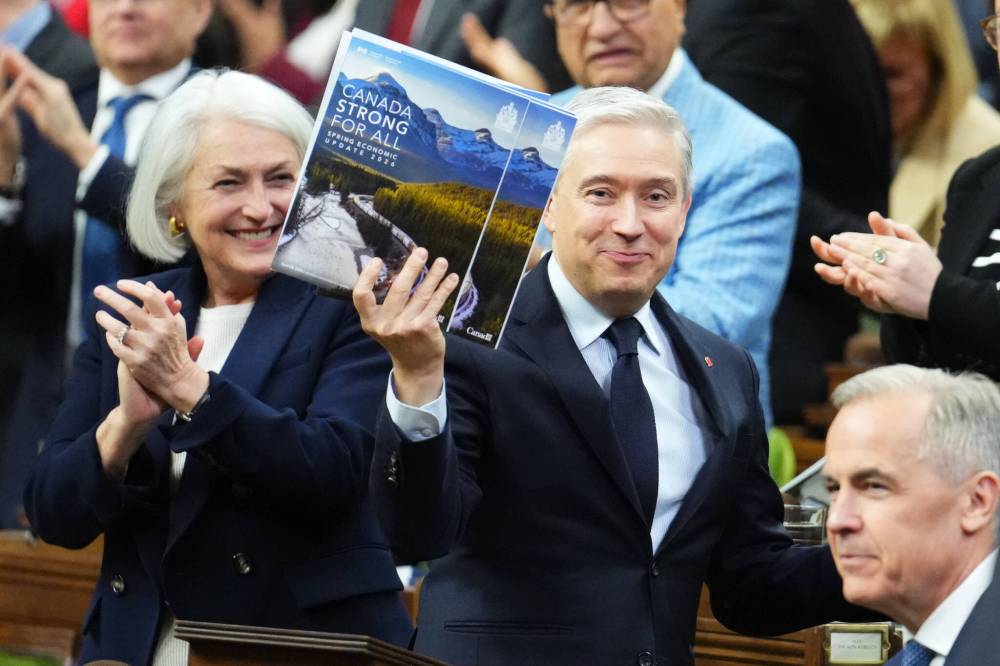
The Canadian Press
Federal Finance and National Revenue Minister Francois-Philippe Champagne holds up the book of the spring economic update as he delivers it in the House of Commons on Parliament Hill in Ottawa on April 28.
The explanation can be found in this other sentence: “In an uncertain world, Canada focuses on what it can control.” That means U.S. President Donald Trump, tariffs, and trade with America. The government is admitting it cannot control any aspect of CUSMA negotiations. This is remarkably, if backhandedly, honest.
It is also disturbing for Canada’s economic future.
Which actually makes the spring economic update all about the United States and our future economic relationship. The Carney government is deliberately moving on in a “sorry, not sorry” tone.
The update is replete with initiatives and money dedicated to generating economic growth from anywhere but the United States. There’s a $6 billion trade diversification strategy; a Canada-hosted global investment summit in the fall, sector investment strategies aimed at shoring up their financial independence from the U.S., even a new “sovereign wealth fund” aimed at generating growth by taking domestic equity positions in companies and projects.
Astute political observers have long since learned that governments and politicians are more revealing about their thinking with what they don’t say, rather than what they do.
More and more, a cone of silence is dropping over official Ottawa on the path to a renewed CUSMA and tariff relief. If there is an overriding expectation that there will be a deal with the U.S., it is not being telegraphed.
In fact, the opposite. It is deliberately being obscured and obfuscated, avoiding details. Instead, the official rhetoric has shifted to Canada already having the best trade access in the world to the U.S., with 85 per cent of our exports tariff-free.
If this sounds self-satisfying, it’s because it is. But when you can’t control either what your most important economic partner says or does, then this is what you do say.
To date, Canadians have been focused on the “what ifs” of Trump’s tariffs on the economy. They’ve been harsh on some sectors such as autos and steel and aluminum. Overall, the short-term effect was to slow economic growth last year but not tip us into recession.
But there’s another cost piling up more and more: debt.
The federal government’s actions to build economic resilience and independence have a cost. The economic update spells that out. Federal debt projections show no improvement over the next five years.
The federal deficit will remain above $50 billion per year for each of the next five years. Canada’s public debt charges — the interest we pay to finance borrowing for government services — will grow from $54 billion last year to $81 billion in 2030.
There’s a growing cost for Canadian independence and resilience. It’s more debt for our children and grandchildren. It’s an outcome the federal government is actively embracing. Exhibit one is the new $25-billion Canada Strong Fund. Hyped as a sovereign wealth fund, it is exactly the opposite of what these are. It is financed by debt, not profit.
Norway has one valued at over $2 trillion; but that is funded by oil and gas wealth surpluses. Canada’s is funded by taxpayer debt.
But this is no “rainy day fund” meant to stabilize finances through economic downturns. It is another bespoke investment stimulation vehicle sitting alongside all the other bespoke investment stimulation vehicles. Still, this is where the Carney government’s priorities are spoken loudly, not silently.
Canada needs to make big new private sector investment plays fast if it is to have any chance of overcoming our anemic growth performance.
The expectation is that the private sector needs government support to de-risk its investments. Otherwise, they won’t happen soon enough or large enough to make a difference. With years of weak labour productivity and tepid capital investment in machinery or innovation, our business has not yet shown the needed ambition for the moment we are in.
Can you blame them?

Governments still haven’t eliminated internal trade barriers between provinces. Red tape regulatory compliance to get major projects and infrastructure moving remains high and costly.
And governments’ preferred solution is more government. Unless governments tackle the fundamentals blocking big new investments, not much will change.
It’s true that we cannot control the world around us. From the Strait of Hormuz to the Taiwan Strait, from the Kremlin to the White House, events are whipsawing Canada.
But we can control what we spend. Until that spending and debt winds up controlling us.
David McLaughlin is a former clerk of the executive council and cabinet secretary in the Manitoba government.
Our newsroom depends on a growing audience of readers to power our journalism. If you are not a paid reader, please consider becoming a subscriber.
Our newsroom depends on its audience of readers to power our journalism. Thank you for your support.
Our newsroom depends on a growing audience of readers to power our journalism. If you are not a paid reader, please consider becoming a subscriber.
Our newsroom depends on its audience of readers to power our journalism. Thank you for your support.
Advertisement Advertise With Us
Advertisement Advertise With Us