WRHA pulls home-care services out of North End building over safety concerns Violent crime, drug use, possible gang activity blamed
Read this article for free:
or
Already have an account? Log in here »
To continue reading, please subscribe:

Digital Subscription
One year of digital access for only $205*
- Enjoy unlimited reading on winnipegfreepress.com
- Read the E-Edition, our digital replica newspaper
- Access News Break, our award-winning app
- Play interactive puzzles
*First annual payment billed as $205.00 + GST for one year. This annual subscription will automatically renew at $233.00 + GST every 52 weeks (10% off the regular annual price of $259.35). Offer available to new and qualified returning subscribers only. Cancel any time.
To continue reading, please subscribe:
Add Free Press access to your Brandon Sun subscription for only an additional
$1 for the first 4 weeks*
- Enjoy unlimited reading on winnipegfreepress.com
- Read the E-Edition, our digital replica newspaper
- Access News Break, our award-winning app
- Play interactive puzzles
*Your next Brandon Sun subscription payment will increase by $1.00 and you will be charged $17.95 plus GST for four weeks. After four weeks, your payment will increase to $24.95 plus GST every four weeks.
Read unlimited articles for free today:
or
Already have an account? Log in here »
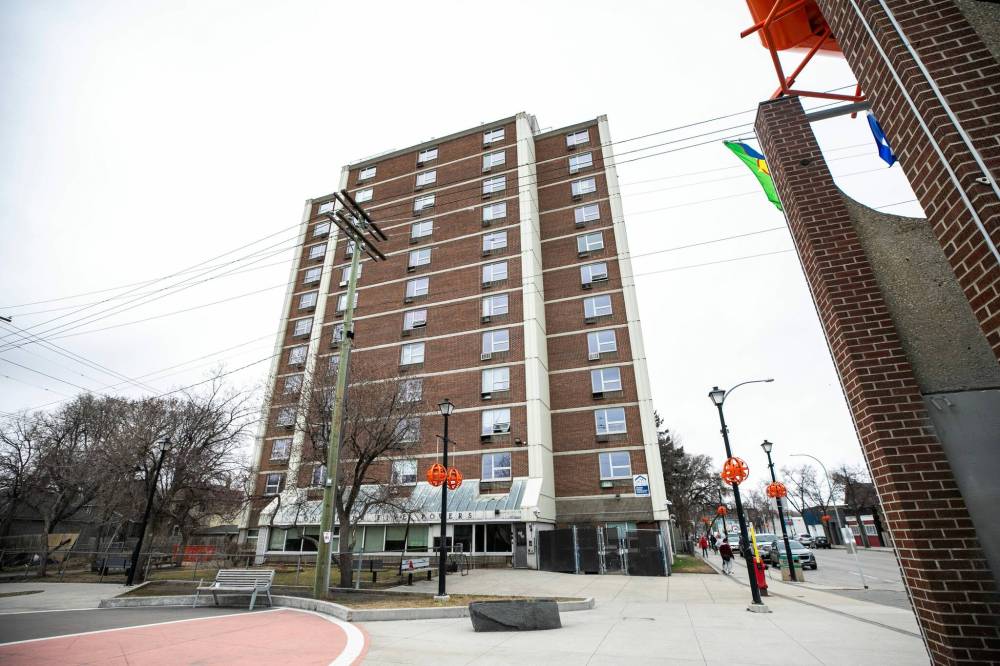
The Winnipeg Regional Health Authority has temporarily stopped providing home-care services in a North End public housing block after deeming the building unsafe.
Residents who receive home care at 145 Powers St. have had to cross the street to the Indigenous Family Centre for their appointments since mid-March amid concerns about violent crime, drug use and possible gang activity.
“Providing safe, compassionate and quality home care is a priority. That not only includes the safety of clients, but of staff as well,” a WRHA spokesperson said in a statement.
MIKAELA MACKENZIE / FREE PRESS
James Heinrichs, executive director of Winnipeg Housing Rehabilitation Corp., said the WRHA removed home care services from 145 Powers St. because of safety and security concerns.
“The WRHA is confident that the agencies managing the building are working to address the current situation. Once the situation has improved at 145 Powers St., the WRHA plans to return to providing home-care services within the building.”
Several tenants declined to comment outside the building at Powers and Selkirk Avenue before a Free Press reporter and photographer left for safety reasons at about noon Monday.
A visitor, who declined to give her name, said the situation inside the building “has gotten pretty bad” recently.
“I don’t know if it’s gang-related stuff, but there’s young kids running around and trashing the halls,” the woman said. “It doesn’t feel safe.”
The 12-storey tower is owned by Manitoba Housing and managed by the non-profit Winnipeg Housing Rehabilitation Corp.
About 50 people live in the building, said James Heinrichs, executive director of Winnipeg Housing Rehabilitation Corp. It was unclear how many tenants receive home care.
Some newer tenants were placed at 145 Powers under the province’s strategy to end chronic homelessness.
Housing, Addictions and Homelessness Minister Bernadette Smith said Manitoba Housing stopped “tenanting” at 145 Powers in January after being alerted to safety issues.
“We wanted to stabilize and ensure that the folks that were living there had the supports and services that they need,” she said.
“The WRHA is confident that the agencies managing the building are working to address the current situation.”
“It has improved… and we’re going to continue to work on ensuring that everyone in that building feels safe and secure.”
Smith said the province is working with police to address crime in the building.
“We have zero tolerance of any of that in any of our buildings,” she said.
Heinrichs said meetings have been held with Manitoba Housing to determine how to mitigate safety and security risks, as well as with N’Dinawemak, which provides “wraparound” supports in the building.
“We’re all working hard to come up with proposed solutions,” Heinrichs said. “First and foremost, the tenants’ safety is paramount.”
Tory MLA Jeff Bereza, the party’s critic for housing, addictions and homelessness, said a situation where safety concerns force residents to walk across the street to access home care shouldn’t be happening.
“Seniors that are living on lower incomes, they shouldn’t be afraid to leave their homes,” Bereza said.
Bereza said he’s heard from Manitoba Housing residents who feel unsafe in buildings in Winnipeg, Portage la Prairie, Souris and other communities.
“There are people being put into these buildings and there are no services for them there,” he said. “A lot of these people are dealing with addictions or have mental health issues as well.”
“Seniors that are living on lower incomes, they shouldn’t be afraid to leave their homes.”
Smith said “wraparound” supports are made available.
The Tories, who oppose the proposed supervised drug consumption site at 366 Henry Ave., want the province to scrap that plan and redirect its funding to addiction recovery services.
The high-rise at 145 Powers already had two security guards per shift and a locked-door policy. Security guards can only do so much, including when visitors are let in through the back door, Heinrichs said.
Tenants use key access fobs or cards to enter the building. The front door has a camera-equipped enterphone system, where visitors dial a tenant to seek access.
Heinrichs said prospective tenants are assessed prior to moving in, but it’s not possible to assess who they are related to or associated with.
Some tenants are accepted based on applications. Some are referred by social services and others via the province’s Your Way Home plan for chronic homelessness after living in encampments, Heinrichs said.
Margaret Schroeder, president of the Canadian Union of Public Employees Local 204, which represents about 2,500 home-care workers in Winnipeg, said she learned of the situation last week via CUPE members.
She said CUPE members who provide home-care services at 145 Powers St. have not submitted complaints to the union.
“They know it’s a safety issue,” she said. “I’m happy that the employer has the safety of our members in mind. However, it is sad when any building gets to the point where they feel they have to change the care to outside.”
“However, it is sad when any building gets to the point where they feel they have to change the care to outside.”
Last week, some elderly and disabled residents of the Canadian Polish Manor, at Selkirk Avenue and Robinson Street, told the Free Press they are living in fear due to crime and unauthorized visitors.
Some said they barricade the entrances to their suites because intoxicated people and gang members roam the hallways banging on doors inside the 55-plus block, which is owned by Winnipeg Housing and Rehabilitation Corp.
A WRHA spokesperson said home-care staff continue to provide care at the Canadian Polish Manor after they raised safety issues.
Employees are using a side door in an attempt to avoid interactions with non-tenants who are trying to get into the building. Security staff have been increased in the evenings, the WRHA spokesperson said.
chris.kitching@freepress.mb.ca


Chris Kitching is a general assignment reporter at the Free Press. He began his newspaper career in 2001, with stops in Winnipeg, Toronto and London, England, along the way. After returning to Winnipeg, he joined the Free Press in 2021, and now covers a little bit of everything for the newspaper. Read more about Chris.
Every piece of reporting Chris produces is reviewed by an editing team before it is posted online or published in print — part of the Free Press‘s tradition, since 1872, of producing reliable independent journalism. Read more about Free Press’s history and mandate, and learn how our newsroom operates.
Our newsroom depends on a growing audience of readers to power our journalism. If you are not a paid reader, please consider becoming a subscriber.
Our newsroom depends on its audience of readers to power our journalism. Thank you for your support.


History
Updated on Monday, May 4, 2026 5:17 PM CDT: Adds details, comments.