

North-south connections — and dirigibles
Advertisement
Read this article for free:
or
Already have an account? Log in here »
To continue reading, please subscribe:
Digital Subscription
One year of digital access for only $1.44 a week*
- Enjoy unlimited reading on winnipegfreepress.com
- Read the E-Edition, our digital replica newspaper
- Access News Break, our award-winning app
- Play interactive puzzles
*Billed as $5.77 plus GST every four weeks. After 52 weeks, price increases to the regular rate of $19.95 plus GST every four weeks. Offer available to new and qualified returning subscribers only. Cancel any time.
To continue reading, please subscribe:
Add Free Press access to your Brandon Sun subscription for only an additional
$1 for the first 4 weeks*
- Enjoy unlimited reading on winnipegfreepress.com
- Read the E-Edition, our digital replica newspaper
- Access News Break, our award-winning app
- Play interactive puzzles
*Your next Brandon Sun subscription payment will increase by $1.00 and you will be charged $17.95 plus GST for four weeks. After four weeks, your payment will increase to $24.95 plus GST every four weeks.
Read unlimited articles for free today:
or
Already have an account? Log in here »
Two headlines appeared in the Free Press on April 22, concerning chronic problems that have no apparent resolution. The topics are high food prices in remote northern communities and the growing population of homeless people in Winnipeg.
Spoiler alert: both issues can be traced to the cost of transportation to the North, and yes, cargo airships are going to be discussed.
Soaring fuel prices driving up shipping costs for northern grocers described the impact that rising fuel prices are having on grocery bills. Grocery prices are two to three times higher in the North, and average incomes are much lower. Food inflation is magnified in the remote communities because they already face chronic food insecurity. As oil prices increase, transport costs must rise accordingly to pay for the small airplanes that deliver food to the North.
Nutrition North Canada provides a subsidy to transport food to the remote communities. The freight subsidy reduces the logistic costs for a list of healthy food and other necessities. Originally operated as the Canada Post Food Mail Program, NNC took over in 2011, with a freight subsidy of $53.9 million. The NNC subsidy now stands at $163 million and is scheduled to increased five per cent annually. Considering current inflation, population growth and a 30 per cent bump in the price of oil, food prices are likely to increase more than the budgeted subsidy.
Treating symptoms relieves pain, but the causes cannot be ignored forever. Rather than pouring money into an escalating freight subsidy, it is time to accept that a different approach is needed.
Airplanes are a mature technology. The short, gravel runways in the North prohibit the use of jet engines and limit aircraft size. Bigger airplanes and longer, paved runways would help, but the infrastructure costs are enormous, and the freight rate reductions are unlikely to be dramatic.
Studies of cargo airships estimate that a 30-ton lifter could operate at the same cost as trucks over the winter roads. Ninety years ago, the giant Zeppelins would carry 100 tons, so this size of airship is well within the envelope of historic achievements. Still, governments of all stripes have dismissed the idea of using cargo airships to serve the North, without ever testing it.
If elected officials had to buy their groceries at Northern food prices, would they be so complacent about living with the status quo?
Residents of southern Manitoba can easily ignore food insecurity in the North, too. They have more pressing concerns, like the shortage of affordable housing. This problem is most acute in downtown Winnipeg, which has a large homeless population. The editorial, Despite efforts, homelessness is growing, hits the point dead-on. Over 2,100 affordable housing units have been renovated or restored since 2023, but the number of homeless people in Winnipeg continues unabated.
The statistics are shocking: 8,248 people without stable housing, of which 4,463 are classified as chronically homeless. Affordable housing demand keeps growing faster than new units can be built. Another important data point is the over-representation of First Nations. They account for 62 per cent to 80 per cent of the homeless population.
So how are the dots connected between these two articles? The problem is transportation costs to the North. Not just food costs are expensive because of transport, so are the costs of obtaining building materials. Housing in the North can cost three to four times more to build than in Winnipeg.
St. Teresa Point First Nation Chief Raymond Flett had enough with the state of northern housing on his reserve to take legal action last year. Descriptors like deplorable, not livable, severe decay, rotting and moldy are used to portray the overcrowded houses of his people. Over half their houses require major repairs.
As Flett is quoted as saying: “Most of the houses only have two or three bedrooms … that is not right for us, a lot of families they have four adults, five children living in a house.” Such overcrowded housing is disguised homelessness.
The homelessness problem in Winnipeg will never be solved until appropriate residences and food security are available in the North. As one Northern friend quipped, “Living on the streets of Winnipeg may be cold and cruel, but at least you can get a hot meal once a day.”
Can cargo airships lead to more livable conditions in the North? Two non-profit organizations, ISO Polar Airships and Wiiche’iwaymagon, are joining forces to find out. They are organizing support for a demonstration flight from Thompson to a remote First Nation reserve using a drone cargo airship.
No one should feel compelled to leave their home community because of disguised homelessness or hunger. Cargo airships could lower food costs and expand housing in the North. Let’s try it!
Dr. Barry E. Prentice is director of the Transport Institute at the Asper School of Business, University of Manitoba.
Related Articles
High fuel prices driving up shipping costs for northern grocers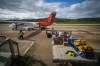

Advertisement Advertise With Us
Advertisement Advertise With Us
History
Updated on Thursday, May 7, 2026 12:09 PM CDT: Adds byline