

Quebec tables bill to increase number of ridings to 127 after Supreme Court decision
Advertisement
Read this article for free:
or
Already have an account? Log in here »
To continue reading, please subscribe:
Digital Subscription
One year of digital access for only $1.44 a week*
- Enjoy unlimited reading on winnipegfreepress.com
- Read the E-Edition, our digital replica newspaper
- Access News Break, our award-winning app
- Play interactive puzzles
*Billed as $5.77 plus GST every four weeks. After 52 weeks, price increases to the regular rate of $19.95 plus GST every four weeks. Offer available to new and qualified returning subscribers only. Cancel any time.
To continue reading, please subscribe:
Add Free Press access to your Brandon Sun subscription for only an additional
$1 for the first 4 weeks*
- Enjoy unlimited reading on winnipegfreepress.com
- Read the E-Edition, our digital replica newspaper
- Access News Break, our award-winning app
- Play interactive puzzles
*Your next Brandon Sun subscription payment will increase by $1.00 and you will be charged $17.95 plus GST for four weeks. After four weeks, your payment will increase to $24.95 plus GST every four weeks.
Read unlimited articles for free today:
or
Already have an account? Log in here »
QUÉBEC – The Quebec government tabled a bill on Thursday to increase the number of ridings in the province to 127 from 125, after the Supreme Court of Canada ruled against its attempt to block a redrawing of the province’s electoral map.
Jean-François Roberge, minister of democratic institutions, said his bill is co-authored by the Liberals, Parti Québécois and Québec solidaire.
“This is the culmination of an important transpartisan collaboration that will lead us to have, I think, a map that truly respects effective representation,” Roberge told reporters at a news conference alongside representatives of the three other parties.
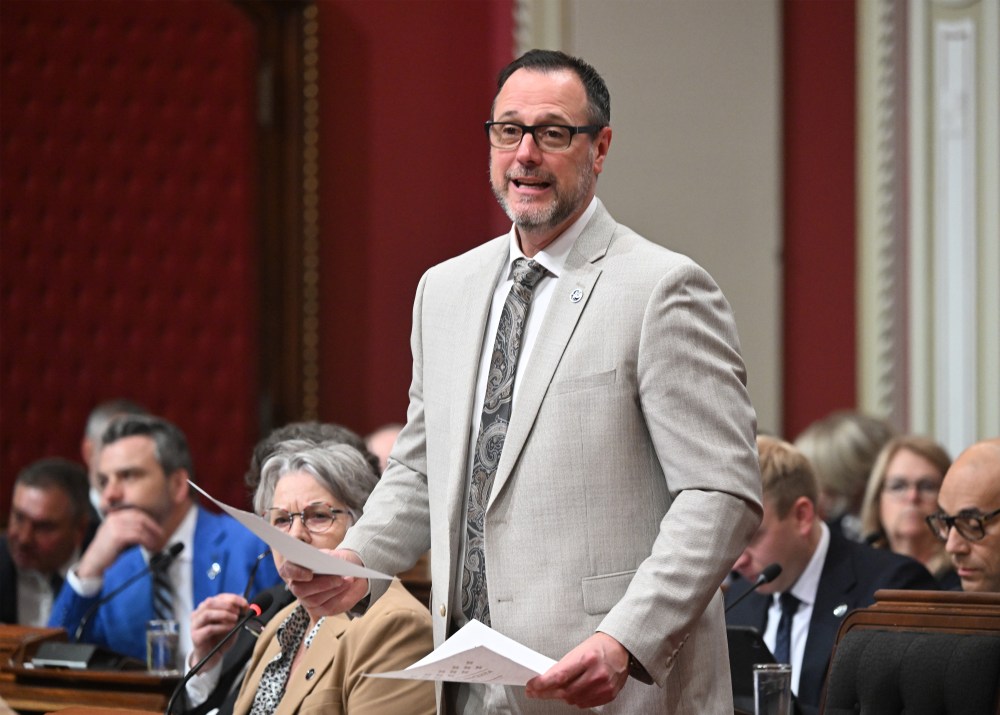
The bill is the government’s latest attempt to prevent Montreal and the Gaspé Peninsula from losing ridings in the redrawn map by the independent electoral boundaries commission. The commission had proposed eliminating one riding in Gaspé and another in Montreal’s east end in favour of two new districts in the growing Laurentians/Lanaudière and Centre-du-Québec regions.
In 2024, the Quebec government passed a law to block the commission’s changes, but it was deemed unconstitutional by the Court of Appeal and eventually by the Supreme Court of Canada. The country’s highest court ruled last month that the legislation violates sections of the Charter that guarantee democratic representation.
Last week, Quebec’s chief electoral officer expressed concern that a new law so close to the October election risked “compromising the quality, even the integrity of the next election.’
On Thursday, Roberge noted that the bill he tabled is not the same law that was struck down by the Supreme Court and that he had worked “hand in hand” with the electoral officer in recent days to assuage concerns.
The bill tabled Thursday would ensure the two ridings that were slated to be eliminated are maintained, while adding two more. It would also create a committee to study electoral representation issues in Quebec.
Chief electoral officer Jean-François Blanchet and commissioner Kevin Bouchard criticized the government Thursday in a news release, accusing politicians of “appropriating a process that must remain neutral and impartial.”
“This would be the first time in 50 years that an election would take place based on an electoral map that wasn’t established through an independent and non-partisan process,” Bouchard said.
Alexandre Leduc of Québec solidaire told reporters that the number of ridings in Quebec hasn’t gone up since 1989, and that the population has grown around 30 per cent since then.
Roberge said the addition of two new ridings will cost the province around $2 million per year.
Quebec’s election law mandates that the election map should be reviewed every two elections to account for population changes and ensure that each of the province’s 125 ridings contain roughly equal numbers of voters.
Members of all parties had expressed concerns that the commission’s map would have taken away political weight from Gaspé and made ridings in eastern Quebec overly large.
While Roberge had hoped the law could be adopted quickly through a unanimous vote, one independent legislature member refused to vote in favour. As a result, the bill will have to follow regular parliamentary procedure.
This report by The Canadian Press was first published May 7, 2026.