Downtown’s heart and soul Community safety partnership’s green-clad foot soldiers hit the street to help — not to harass — whenever, however they can
Read this article for free:
or
Already have an account? Log in here »
To continue reading, please subscribe:
Digital Subscription
One year of digital access for only $1.44 a week*
- Enjoy unlimited reading on winnipegfreepress.com
- Read the E-Edition, our digital replica newspaper
- Access News Break, our award-winning app
- Play interactive puzzles
*Billed as $5.77 plus GST every four weeks. After 52 weeks, price increases to the regular rate of $19.95 plus GST every four weeks. Offer available to new and qualified returning subscribers only. Cancel any time.
To continue reading, please subscribe:
Add Free Press access to your Brandon Sun subscription for only an additional
$1 for the first 4 weeks*
- Enjoy unlimited reading on winnipegfreepress.com
- Read the E-Edition, our digital replica newspaper
- Access News Break, our award-winning app
- Play interactive puzzles
*Your next Brandon Sun subscription payment will increase by $1.00 and you will be charged $17.95 plus GST for four weeks. After four weeks, your payment will increase to $24.95 plus GST every four weeks.
Read unlimited articles for free today:
or
Already have an account? Log in here »
Half a dozen bleary-eyed employees sit around a dark wooden table at the Downtown Community Safety Partnership headquarters.
Members of the overnight patrol munch on breakfast sandwiches as they debrief the morning crew, listing off notable events and encounters with the “regulars” on their beat.
After the hand-off, the morning crew — technically the Mobile Assist and Connect Team — gets ready for the day.
Go to a Jets game, concert or restaurant downtown and you’ve likely seen them: a pair or trio of people clad in moss-green shirts or puffer jackets, carrying bags stuffed with snacks, water and medical supplies, with radios fastened to their belts.
As they log tens of thousands of steps around the clock, patrols interact with the public, provide directions to tourists, notify first responders about medical emergencies, offer resources to the vulnerable and check every lane and parking lot for people in need.
Borne out of a partnership between the province, the city, the Downtown Winnipeg BIZ and True North Sports and Entertainment in 2020, the patrols are the eyes and ears of downtown Winnipeg. They’re also its heart and soul.
The Free Press tagged along with several patrol crews on a recent day.
7 a.m.
Dallas Holden and Bryan Barker fill their bags with medical supplies, including naloxone — a medication that can reverse the effects of opioid overdoses — and gloves before heading to the Hargrave Street garage where the partnership’s fleet of white vans is parked.
A short time later, on Edmonton Street, a woman flags down their van and asks for warmer clothes. Holden offers to go back to HQ and retrieve some, if she’ll stick around.
Spring can be difficult for people who live on the street because they tend to throw away their winter clothing, leaving them vulnerable to the elements when a cold snap returns, Holden says.
Minutes later, they’re back with extra layers of clothing. The woman smiles, thanks them and continues on her way.
MIKE DEAL / FREE PRESS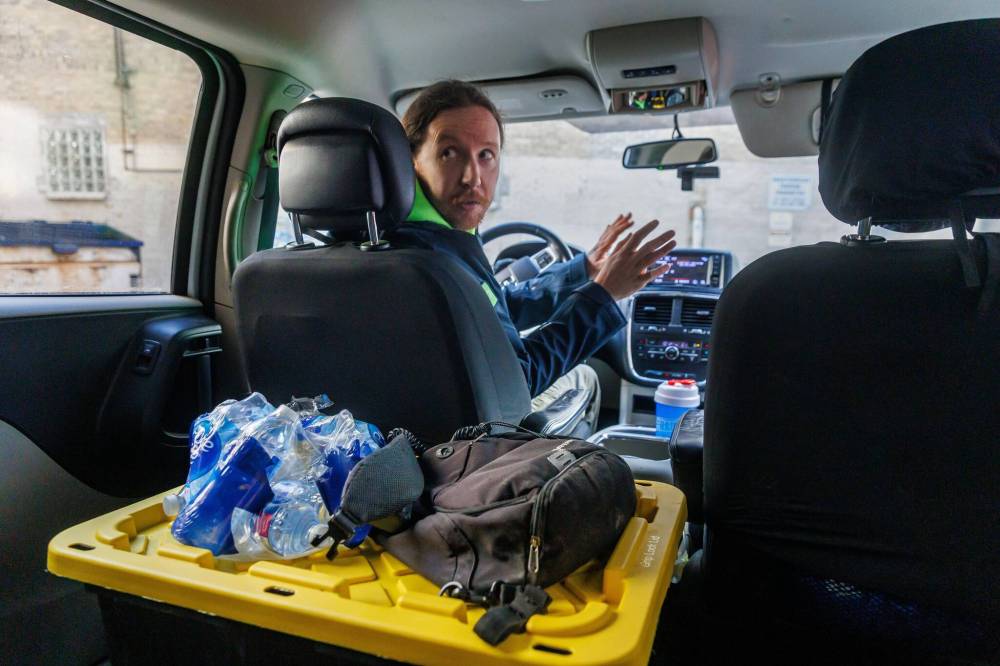
Holden and Barker log the interaction — procedure for every DCSP encounter — which helps guide the organization’s programs. The non-profit can log as many as 300 interactions each week.
Interacting with the public wasn’t always easy, Holden says. Initially, people thought the patrols were an extension of law enforcement and avoided them. They have since learned the patrols are there to help in myriad ways.
“They see the uniform and radio and think we’re enforcement, but that’s not our wheelhouse. We’re just here to help in whatever way we can,” Barker says.
Much of the job involves being on the lookout for people in need, but patrols can also provide transportation to medical appointments and shelters when required.
“We build a lot of rapport. People trust us to drive them where they need to go,” Holden says. “I don’t think a lot of people realize how tough this city can be to get around if you don’t have a vehicle.”
MIKE DEAL / FREE PRESS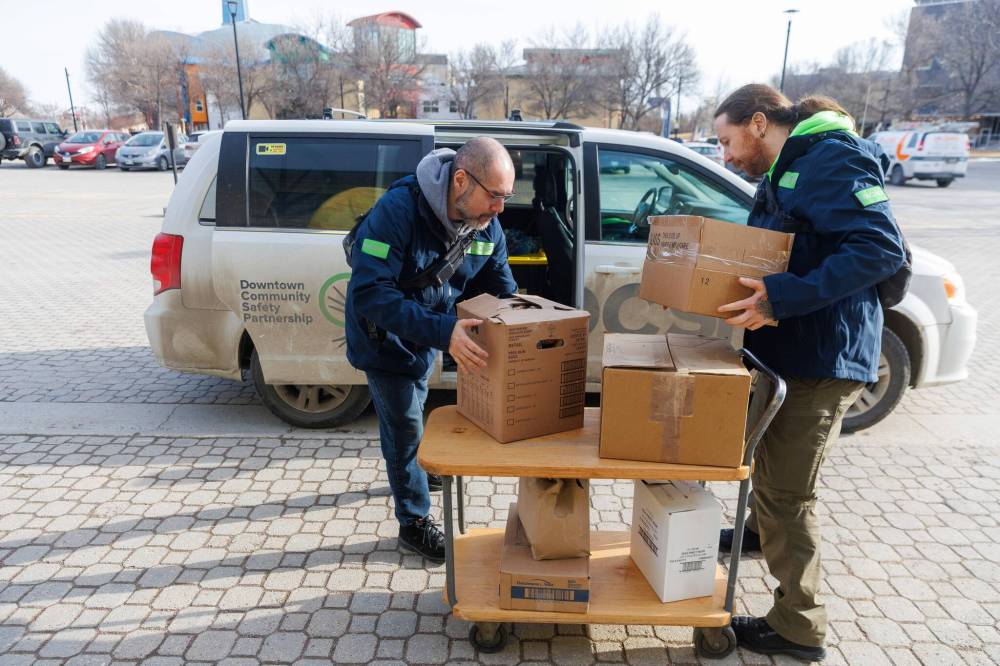
9:30 a.m.
It’s easy to get lost in downtown’s maze-like skywalk and underground network; the Connect Safety Team foot patrols, however, are well-versed in its many twists and turns.
After stocking their bags at HQ, a crew of three begin their 10-hour patrol of the pedestrian network — 14 skywalks and seven tunnels — along with the streets, and attend scheduled assignments in between.
They interact with dozens of people on the street, address them by name and keep an eye out for anyone who might not look like they fit in.
“When you notice somebody who’s new, then we try talking a little bit more, kind of establish that relationship, and see if there’s anything we can do to assist them,” said Mwaniki Mbogo, a supervisor with the Connect team.
MIKE DEAL / FREE PRESS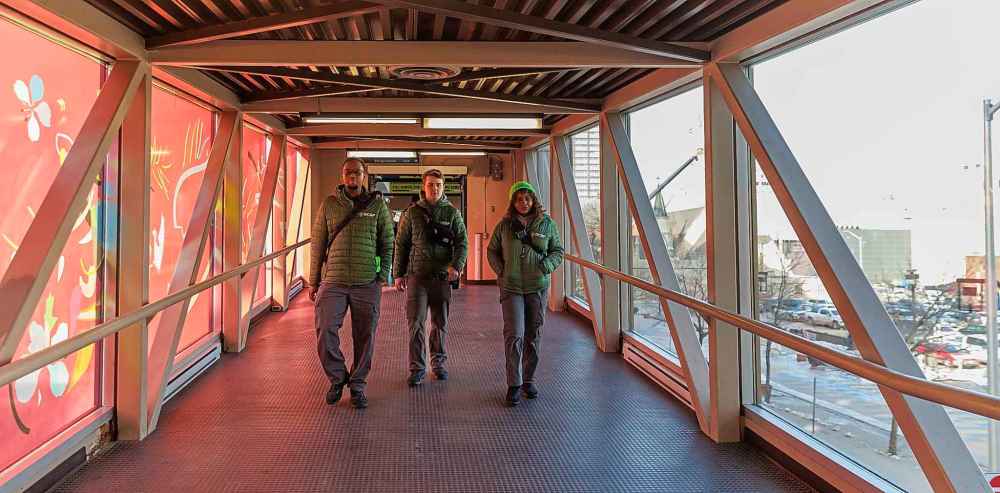
Every day is different. Recently, team members jumped in to help a client who has mobility issues during an appointment at a hair salon in the skywalk.
Moving through Cityplace, a uniformed security guard greets the trio and gives them a rundown of the morning’s events. A group of homeless people were hanging out in a hallway, and one had fallen asleep.
Instead of immediately kicking them out, the guard gave them a 15-minute warning. The less-aggressive approach worked and they eventually left.
Most DCSP employees are trained in crisis counselling, suicide intervention and Criti Care EMS. In the past, they have shared some of their de-escalating techniques with private security workers who interact with homeless people.
“Just slowly educating them on how to interact with people and giving them time rather than kicking them out. I think that approach has worked, and I’ve seen growth in that,” Mbogo says.
10 a.m.
About 50 people gather in the Ogijiita Pimatiswin Kinamatwin office at 605 Main Street. They say a prayer before volunteers wheel out trolleys and bags filled with food, clothing and hygiene items in advance of their twice-weekly walk along Main Street, a gathering spot for the homeless.
DCSP foot patrols are there to monitor the walk and keep the peace in the event a disturbance breaks out. Given their medical training, they can also provide aid when required.
As the walk heads towards Higgins Avenue, dozens of people eagerly grab the hummus, veggie trays, sandwiches and sushi rolls that they hand out. Among those helping to dole out food are four young men wearing lime-green tuques with the DCSP logo.
They belong to the Clean Slate team, which provides paid work opportunities to people who are going through recovery, or might otherwise have trouble gaining work experience.
Jayden Friesen is leading the group, which is responsible for street cleaning, graffiti removal and disposing of biohazard material, such as discarded needles used to inject drugs. He overdosed in 2021 and went through a recovery program, before joining DCSP as a foot patrol and, eventually, the Clean Slate team.
MIKE DEAL / FREE PRESS 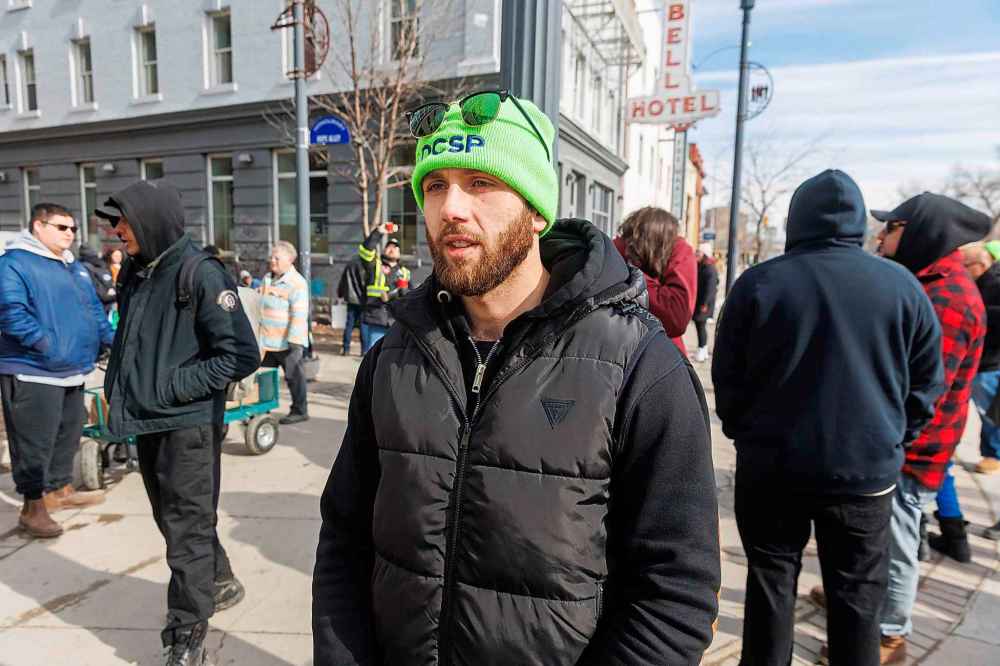
He says he had no real mentorship during the early days of his recovery, which is something he can do for others now that he’s clean.
“I was down bad, too. I was at the bottom. I was smoking drugs, and this happened to me, but now I’m living this kind of life, and these are the choices that got me there,” he says. “I want this kind of life for others.”
“I want this kind of life for others.”
Mid-walk, the foot patrol encounters a man slumped against the ACCESS health and social services building on Main Street. The patrol team rushes to make a preliminary medical assessment. A few moments later, the man signals he’s awake.
The first thing to check is if someone is breathing and alert, Mbogo says. If not, the team would take him inside the ACCESS building to be assessed further, or call paramedics – but since he is with friends and is OK, the patrols let the others in the group take care of one of their own.
“They have a buddy system, and the way I see it, this is these people’s community. So, therefore, they have their own systems. I’m not gonna force my systems on them,” he says.
MIKE DEAL / FREE PRESS 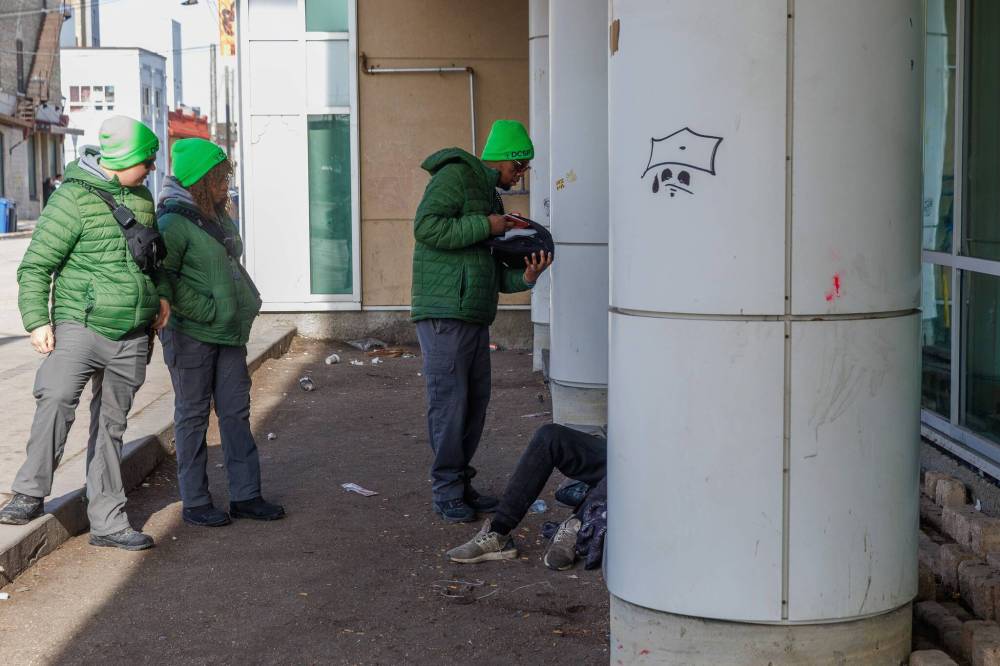
11:15 a.m.
The patrol ducks into Canadian Footwear on Adelaide Street to check in on the business.
The store is bustling with customers, a scene that runs counter to the narrative that downtown has become a wasteland because people are concerned about their safety.
The business’s security cameras feed into the DCSP Beacon system, which monitors the streets from its downtown headquarters to keep a close eye on issues that might need immediate attention. Store owner Brian Scharfstein is also a member of DCSP and volunteers his time to the non-profit.
MIKE DEAL / FREE PRESS 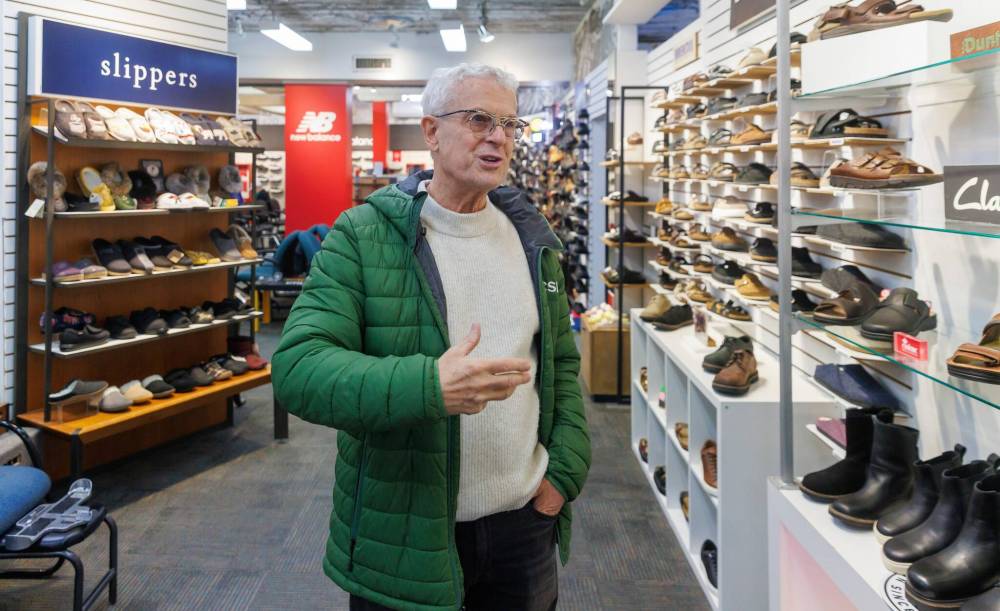
Scharfstein goes as far as saying the DCSP is the best thing to come to downtown. Having served as vice-chair on the Winnipeg Police Board for five years, Scharfstein understands the limitations facing police and how DCSP fills a specific need.
“I say that is because it works. And why would you build on something that doesn’t work? I’m a big believer that if you’ve got something that’s working, focus on it,” he says.
2 p.m.
People trickle in and out of a space in the lobby of the Millennium Library that was once known as Community Connections before the city ended funding and it closed on Dec. 31, 2024. The province offered the space to the DCSP, which runs an outreach advocacy resource there.
Every few minutes someone asks for an application form for a social service or government program, a bottle of water or if they can rest for a few minutes in the lounge chairs.
The 14-person team in the space helps 20 to 30 people in the three hours its open each day. They help them navigate the complicated process of applying for social services, such as employment assistance, the Canadian Pension Plan and social housing.
MIKE DEAL / FREE PRESS 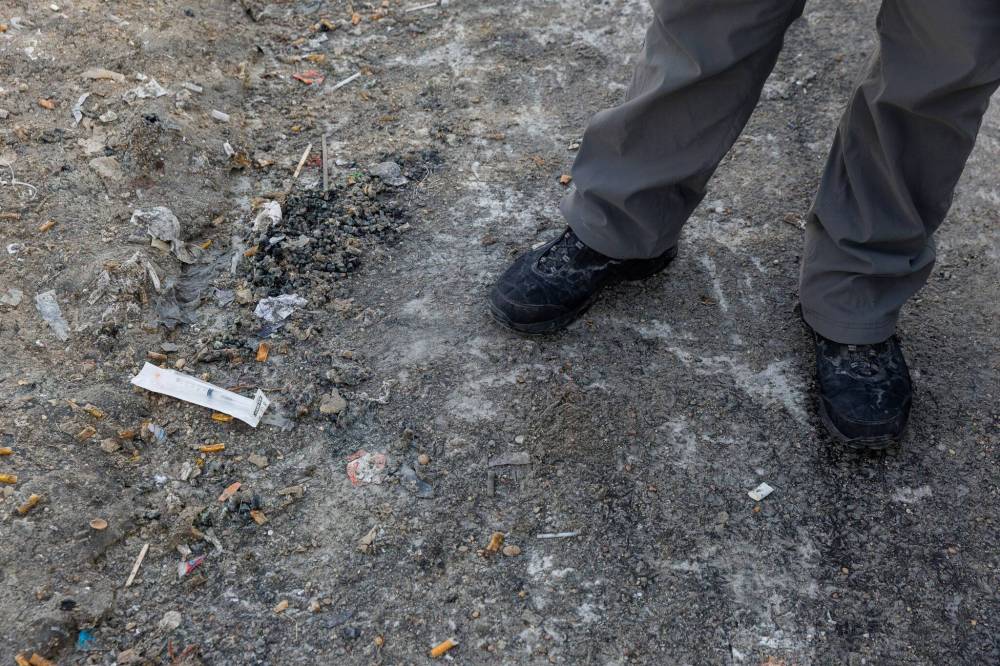
“We call them participants, because we don’t make decisions or plans for them, right? We make it with them. So they tell us how they want the plan to go and we just stay with them, side by side,” says supervisor Stanley Onabor.
Among the employees at the downtown hub, Vincent Lillie stands out, with his shock of blue hair, piercing eyes and the beaded medallion that hangs around his neck.
Lillie was in prison for more than a decade after committing crimes to feed his drug habit. Upon his release, he became a public speaker and mentor. He now works for DCSP in the library corner.
Lillie says his experience has allowed him to build connections with street people, who tend to have abandonment and trust issues.
“Once you build that trust, get in with them and they can actually sit down and relax and start to actually ask you for help,” he says. “Within the population that we do serve, it can make a big difference for someone in the trajectory of their journey.”
2:30 p.m.
The afternoon sun feels warm as crowds mingle outside Portage Place, where construction to transform the outdated mall to a residential and health-care complex is underway. People walk in the alleys behind, talking and laughing while trash blows past their feet.
Jasmine Kole and Barb Beardy are doing a specific kind of patrol: they’re looking out for vulnerable women. They zigzag up and down the lanes, check dumpsters and look for anything that might seem off.
Vulnerable women are not always easy to spot, but Kole and Beardy can recognize the signs of exploitation, such as when a young woman is with a group of older men.
Working alongside the Ikwewag Wiigiwaam Owiiji’in Indinawemaaganag (Women’s Lodge, Helping All People) team has helped identify potentially dangerous situations.
The five-woman team works with Indigenous women, two-spirit and gender-diverse people experiencing domestic violence, exploitation or human trafficking. They co-ordinate resources for women who are leaving abusive situations and help them retrieve personal items.
Beardy says she wishes a program such as this existed when she was in an abusive relationship.
“Because then I probably would have never went back. I stayed for 10 years,” she says.
Having been in that situation has informed how she works.
“Being able to have that within our team, and that ability to connect with authentic empathy makes a huge difference to the connection,” Kole says.
MIKE DEAL / FREE PRESS 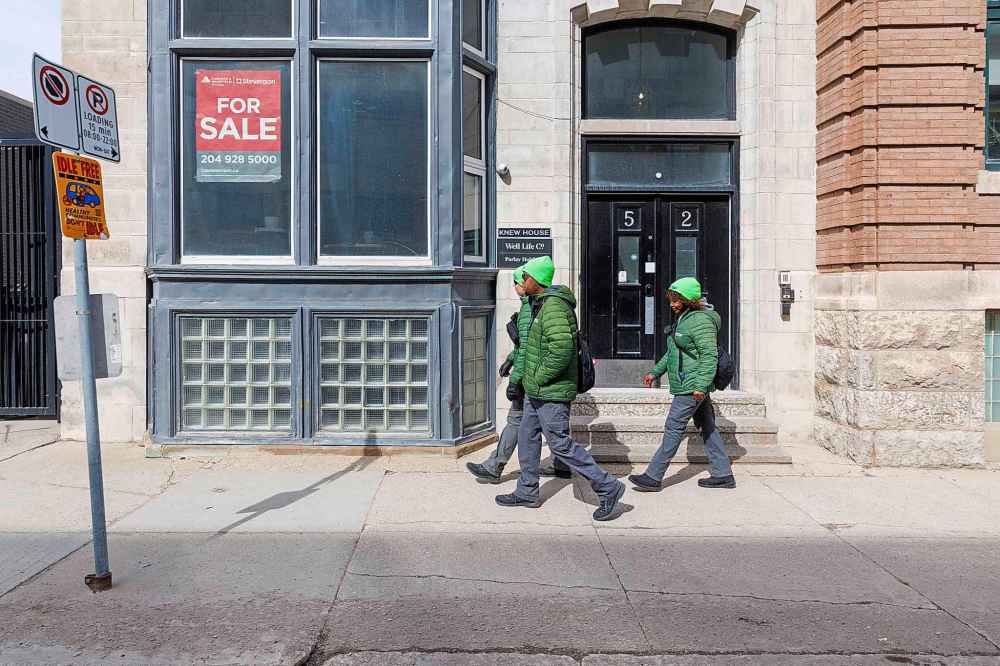
As the afternoon shifts to evening, and after thousands of steps throughout downtown with five types of DCSP patrols, one theme is repeated.
The organization’s success can be attributed to the hard work of executive director Greg Burnett, a former police superintendent.
He, in turn, is quick to pay the compliment back to staff.
“This is just a community-based program that allows people to go out there and use their skills in different ways,” Burnett says. “This is a reflection of them.”
nicole.buffie@freepress.mb.ca

Nicole Buffie
Multimedia producer
Nicole Buffie is a reporter for the Free Press city desk. Born and bred in Winnipeg, Nicole graduated from Red River College’s Creative Communications program in 2020 and worked as a reporter throughout Manitoba before joining the Free Press newsroom as a multimedia producer in 2023. Read more about Nicole.
Every piece of reporting Nicole produces is reviewed by an editing team before it is posted online or published in print — part of the Free Press‘s tradition, since 1872, of producing reliable independent journalism. Read more about Free Press’s history and mandate, and learn how our newsroom operates.
Our newsroom depends on a growing audience of readers to power our journalism. If you are not a paid reader, please consider becoming a subscriber.
Our newsroom depends on its audience of readers to power our journalism. Thank you for your support.