

Churchill project not worth the risk
Advertisement
Read this article for free:
or
Already have an account? Log in here »
To continue reading, please subscribe:

Digital Subscription
One year of digital access for only $205*
- Enjoy unlimited reading on winnipegfreepress.com
- Read the E-Edition, our digital replica newspaper
- Access News Break, our award-winning app
- Play interactive puzzles
*First annual payment billed as $205.00 + GST for one year. This annual subscription will automatically renew at $233.00 + GST every 52 weeks (10% off the regular annual price of $259.35). Offer available to new and qualified returning subscribers only. Cancel any time.
To continue reading, please subscribe:
Add Free Press access to your Brandon Sun subscription for only an additional
$1 for the first 4 weeks*
- Enjoy unlimited reading on winnipegfreepress.com
- Read the E-Edition, our digital replica newspaper
- Access News Break, our award-winning app
- Play interactive puzzles
*Your next Brandon Sun subscription payment will increase by $1.00 and you will be charged $17.95 plus GST for four weeks. After four weeks, your payment will increase to $24.95 plus GST every four weeks.
Read unlimited articles for free today:
or
Already have an account? Log in here »
Last September, the Manitoba government released a new economic development plan aimed at transforming the province into a national economic leader.
Premier Wab Kinew acknowledged at the time that “We’ve set an ambitious target — to make Manitoba a ‘have’ province by 2040,” claiming the goal would be achieved “through strategic investments, growing the private sector, trade expansion at the Port of Churchill and productivity growth.”
Few Manitobans took the premier’s comments seriously, given that politicians have been promising to make us a “have” province for decades and every one of them failed.
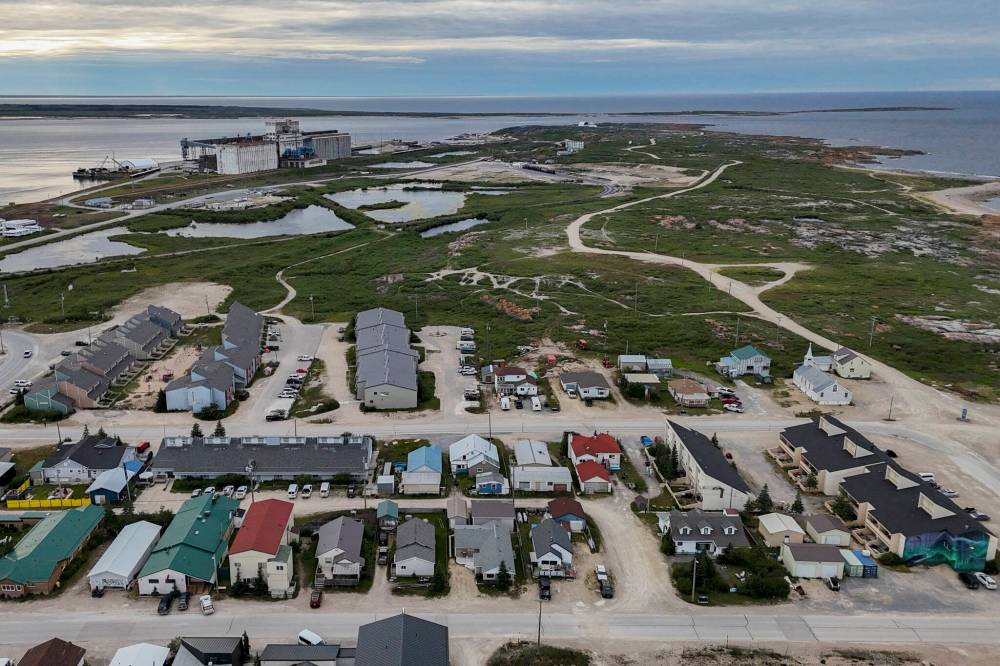
Joshua A. Bickel / The Associated Press
The Port of Churchill remains a focus for Premier Wab Kinew despite questions about its economic viability and ability to operate year-round.
One month later, however, Kinew doubled down on his pledge. He told Toronto’s Empire Club his government was planning three huge energy projects that would create upwards of $30 billion in economic activity.
“One that we’re almost certainly going to do, a second that we’re trying to put the financing piece together and the third which has been very public, which is the Port of Churchill. … If we build the three of those out to the full extent, then Manitoba can become a ‘have’ province — and not, like, 40 years in the future. Like, within the next five, 10 years type of thing,” he said.
With those words, he shortened the target date for when Manitoba would shed its “have not” status to as early as 2031.
Was that “blue-sky bluster” or is the goal genuinely achievable?
There is no evidence that Manitoba has increased its productivity, nor is our private business sector growing at an accelerated pace. The province’s latest budget doesn’t contain any large-scale “strategic investments,” and its lower deficit projection rests largely on the expectation that equalization payments will be even larger than last year.
Regarding those three projects Kinew said would catapult us to “have” status, he said last month that one of the projects is Manitoba Hydro’s $3-billion plan to build a gas-fired electricity generating plant in Brandon by 2029, while another is the construction of several wind farms in western Manitoba by 2035.
Those two items might help address the province’s looming electricity shortage, but the premier admitted to the CBC last month that they won’t deliver the economic impact required to end our reliance on transfer payments. He is now banking on the redevelopment of the Port of Churchill as the game-changing project that will put Manitoba back in the black.
That’s a risky bet for several reasons. First, it is extremely doubtful such a challenging project, which would include constructing an on-site liquefied natural gas terminal and other facilities at the port, along with pipelines and related infrastructure across three provinces and over hundreds of kilometres of permafrost wilderness, can be fully completed by the 2030 deadline set by the federal government.
Second, there are serious doubts about the port’s ability to operate year-round, given Churchill’s blistering winter conditions.
Third, the entire project would likely cost tens of billions of dollars, almost all of which would be contributed by taxpayers. That amplifies concerns about the economic viability of an expanded Churchill port, necessitating the consideration of potential lower-cost options. For example, it was recently reported that it is cheaper to ship cargo to Nunavut via a Quebec port than it is from Churchill.
None of that is new information. A 2025 study by the North American and Arctic Defence and Security Network concluded that “The Port of Churchill shows little promise of emerging as a robust export artery for Canadian grains, critical minerals, oil or natural gas in the foreseeable future.”
It warned that “even substantial upgrades will not make it a prosperous Canadian nation-building infrastructure project” and that “Funding it with taxpayer money to do so is irresponsible and negligent.” Those words are a cold dose of reality for the premier and his plan.

It didn’t have to be this way. The Manitoba government could have focused on established industries such as aerospace, biosciences, mining and/or agrifoods as the foundation for one or more national-scale projects, but it didn’t.
Kinew is betting the province’s economic future on a long shot with a long history of failing to meet expectations. Given that reality, nobody should be surprised if his plan fails, taking our hopes of economic transformation down with it.
Deveryn Ross is a political commentator living in Brandon.
deverynrossletters@gmail.com
X: @deverynross
Related Articles
Infrastructure, military spending, economy dominate talk in federal finance minister’s visit

Advertisement Advertise With Us
Advertisement Advertise With Us