When should you get a mammogram? Conflicting advice makes it hard to know
Advertisement
Read this article for free:
or
Already have an account? Log in here »
To continue reading, please subscribe:

Digital Subscription
One year of digital access for only $205*
- Enjoy unlimited reading on winnipegfreepress.com
- Read the E-Edition, our digital replica newspaper
- Access News Break, our award-winning app
- Play interactive puzzles
*First annual payment billed as $205.00 + GST for one year. This annual subscription will automatically renew at $233.00 + GST every 52 weeks (10% off the regular annual price of $259.35). Offer available to new and qualified returning subscribers only. Cancel any time.
To continue reading, please subscribe:
Add Free Press access to your Brandon Sun subscription for only an additional
$1 for the first 4 weeks*
- Enjoy unlimited reading on winnipegfreepress.com
- Read the E-Edition, our digital replica newspaper
- Access News Break, our award-winning app
- Play interactive puzzles
*Your next Brandon Sun subscription payment will increase by $1.00 and you will be charged $17.95 plus GST for four weeks. After four weeks, your payment will increase to $24.95 plus GST every four weeks.
Read unlimited articles for free today:
or
Already have an account? Log in here »
WASHINGTON (AP) — Deciding when to get routine mammograms is confusing. Some health groups recommend women begin at age 40 or 45 while another recently opted for age 50. They also differ on whether yearly or every other year is best.
The conflicting advice is at least partly because guidelines for breast cancer screening are designed for women at average risk and with no possible cancer symptoms. But breast cancer is so common that it is hard to know who is really “average” and how to balance the pros and cons of screening.
“Breast cancer is not one disease,” said Dr. Laura Esserman of the University of California, San Francisco. “So how in the world does it make sense to screen everybody the same when everyone doesn’t have the same risk?”
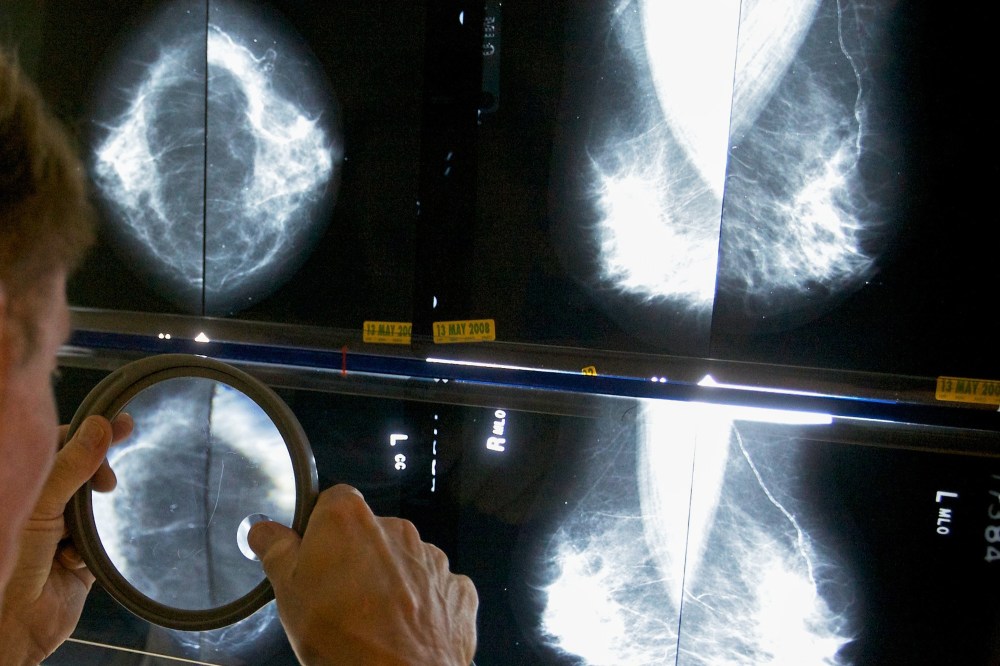
Esserman is leading research to better understand the nuances of who is at low or high risk or somewhere in between and eventually offer more tailored screening advice.
More than 320,000 women in the U.S. will be diagnosed with breast cancer this year, according to the American Cancer Society. Death rates have been dropping for decades, thanks largely to better treatments. But it is still the second-most common cause of cancer death in U.S. women — and diagnoses are inching up.
For now, here are some things to know.
When to get a mammogram
The newest guidance comes from the American College of Physicians, which recommends that average-risk women ages 50 to 74 get an every-other-year mammogram. For those 40 to 49, the guideline says to discuss pros and cons with a doctor and if they choose screening, to go every other year.
That advice, issued last month, was a surprise. Most other U.S. health groups have urged women to start earlier, in their 40s. The influential U.S. Preventive Services Task Force recently switched its guidance to start every-other-year mammograms at age 40 instead of 50.
The American Cancer Society has long recommended yearly mammograms for 45- to 54-year-olds -– but says they can choose to start at 40. For those age 55 and older, the cancer society says women can switch to every other year or choose to keep going for yearly checks.
The new American College of Physicians guidelines also say doctors can ask if women 75 or older wish to stop routine screening. In contrast, the cancer society says there is no reason to stop if they are still healthy.
Why don’t experts agree?
The higher a woman’s risk of eventually developing breast cancer, the more benefit she will derive from more frequent screenings. But beyond some well-known factors like the cancer-causing BRCA1 or BRCA2 genes, it is hard for women to know their true risk. Age has long been a proxy because the risk of breast cancer rises as women get older.
Mammograms aren’t perfect. Sometimes they miss cancer or an aggressive tumor pops up after a routine mammogram. But guidelines seek to balance the benefits of catching cancer early with possible harms, such as stress and pain from investigating suspicious spots that don’t turn out to be cancerous.
“We’re not saying there’s no benefit” from mammograms in the 40s, cautioned Dr. Carolyn Crandall of the University of California, Los Angeles, who chaired the American College of Physicians report. But “there’s a narrower balance between the benefits you could get and the harms in 40- to 49-year-olds.”
The American Cancer Society recommends starting yearly mammograms at 45 because it found breast cancer incidence in 45- to 49-year-olds was higher than in the early 40s – more like what 50- to 54-year-olds experience, said public health researcher Robert Smith, the society’s expert on early cancer detection.
What is missing is a way to tell if someone is more likely to develop an aggressive breast cancer or a slow-growing one, Smith noted.
How dense breasts affect mammogram advice
Nearly half of women over 40 have dense breast tissue, which can make it harder to spot a tumor on a mammogram and can slightly increase the risk of developing cancer.
After a mammogram, women are notified about their breast density. Many experts say it is not yet clear if women with dense breasts would benefit from adding ultrasounds or MRIs to their screening. But the new American College of Physicians guidance advises considering 3D mammography – what doctors call digital breast tomosynthesis or DBT.
What’s next for breast cancer screening
In the future, adding a gene test — one that looks at more than just those well-known BRCA genes — along with broader risk factors may help refine women’s optimal mammogram schedule.
A recent study of nearly 46,000 women, called the WISDOM trial, used age, genetic testing, lifestyle, health history and breast density to classify women as low, average, elevated or high risk. That risk level determined if they waited to start mammograms at 50, went every other year or every year – and the highest-risk group was told to screen twice a year, once with a mammogram and again with an MRI scan. Risk-based scans were compared to standard yearly mammograms.
Risk-based screening worked as well as yearly screening, Esserman’s team reported in the medical journal JAMA. One surprise: About 30% of women whose gene testing indicated increased risk didn’t report relatives with breast cancer. While more research is underway, Esserman hopes the early findings will start influencing guidelines soon.
Also in the pipeline are AI tools being crafted to assess a woman’s risk of developing breast cancer in the next few years based on clues in her mammogram, another possible way to identify who might qualify for more or less frequent screening.
For now, women can talk with their doctors about close relatives who have had cancer, their own overall health and other risk factors such as whether they have had children and at what age.
Whatever mammogram age and interval they choose, the best advice is to stick with it, the cancer society’s Smith said: “Breast screening works best when it’s done regularly.”
___
The Associated Press Health and Science Department receives support from the Howard Hughes Medical Institute’s Department of Science Education and the Robert Wood Johnson Foundation. The AP is solely responsible for all content.
Related Articles
Ottawa fumbling attempts to pull Canada’s health-care system out of the last century
Advertisement Advertise With Us
Advertisement Advertise With Us