Excerpts from Pope Leo XIV’s sweeping manifesto about humanity in the AI era

Advertisement

Advertise with us

VATICAN CITY (AP) — Pope Leo XIV has issued a sweeping manifesto about safeguarding humanity in the era of artificial intelligence, examining the many social areas that the technology is fundamentally reshaping.

Read this article for free:


By clicking the button above, an account will be created and you will begin to receive some of our recommended newsletters. You may opt out of any newsletter by visiting your Email and Communication Preferences page or by clicking "unsubscribe" at the bottom of any email.

or

Already have an account? Log in here »

To continue reading, please subscribe:

Digital Subscription

One year of digital access for only $1.44 a week*

  • Enjoy unlimited reading on winnipegfreepress.com
  • Read the E-Edition, our digital replica newspaper
  • Access News Break, our award-winning app
  • Play interactive puzzles

*Billed as $5.77 plus GST every four weeks. After 52 weeks, price increases to the regular rate of $19.95 plus GST every four weeks. Offer available to new and qualified returning subscribers only. Cancel any time.

To continue reading, please subscribe:

Add Free Press access to your Brandon Sun subscription for only an additional

$1 for the first 4 weeks*

  • Enjoy unlimited reading on winnipegfreepress.com
  • Read the E-Edition, our digital replica newspaper
  • Access News Break, our award-winning app
  • Play interactive puzzles
Start now

*Your next Brandon Sun subscription payment will increase by $1.00 and you will be charged $17.95 plus GST for four weeks. After four weeks, your payment will increase to $24.95 plus GST every four weeks.

VATICAN CITY (AP) — Pope Leo XIV has issued a sweeping manifesto about safeguarding humanity in the era of artificial intelligence, examining the many social areas that the technology is fundamentally reshaping.

Here are some excerpts from the 83-page document “Magnifica Humanitas” (Magnificent Humanity) released on Monday.

Democracy

Pope Leo XIV blesses faithful as he celebrates the Pentecost Mass in St. Peter's Basilica, at the Vatican, Sunday, May 24, 2026. (AP Photo/Gregorio Borgia)

Leo says that disinformation “found a powerful amplifier” with AI through the ability to “manipulate content, images and videos,” which exposes people to “biased or misleading perspectives.” The pontiff said democracy is weakened when pragmatism, that is “what appears useful effective,” substitutes for truth. “Indifference to the truth leads, slowly but surely, to a descent to totalitarianism,” Leo wrote.

Social media

Leo said that those who control digital platforms, including social media, have a power that “should be constantly guided by the pursuit of truth or respect for human dignity.” The internet should be seen as “a setting in which inner freedom and critical thought can mature,’’ and not “an instrument of excessive distraction, homogenization or dominance.” The backdrop is that communication not only transmits information but creates culture.

Labor

Leo said the workplace must be governed by “the protection of employment opportunities and the irreplaceable role of the individual.” He warned that “the pursuit of greater profits cannot justify choices that systematically sacrifice jobs, because the human person is an end, not a means, and the economic order must remain subordinate to human dignity and the common good.” Leo also said governments must foster conditions that favor employment “since it is a primary good for families and for societies.”

War

Leo said that AI “can only bring conflict about more quickly and render it more impersonal.” He called for concrete criteria when making a decision to strike. That includes an identifiable chain of responsibility applying also to “those who design, train, authorize and employ technology,” and measures, so that target selection takes into account the difference between combatants and noncombatants, and the impact on defenseless populations. Non-negotiable requirements include guarantees of accountability and that deployment of lethal force cannot be automated. Leo also called for a shared international framework “to curb the technological arms race and ensure robust protection for civilians.”

Economy

Leo noted that the world’s wealth “is increasingly concentrated in fewer hands, widening inequalities.” In the age of AI and robotics, it is no longer possible to rely solely on the “invisible hand’ of the market,” Leo wrote, urging politicians to orient policies toward “the common good” and to promote “dignified work, social inclusion and an equitable distribution of the benefits of innovation.”
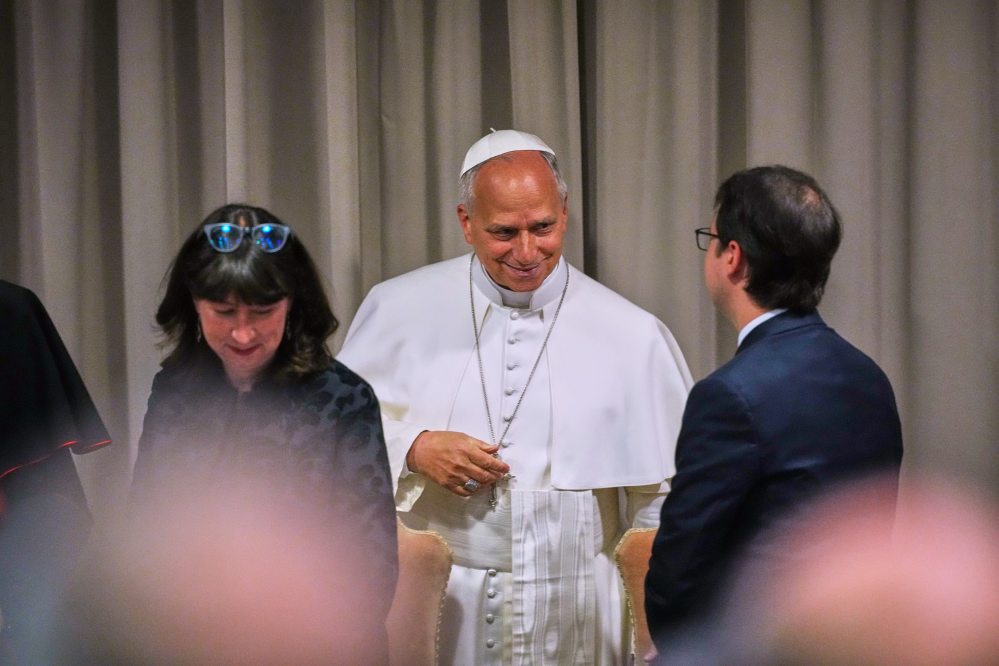
Pope Leo XIV, talks to Anthropic co-founder Christopher Olah, right, and theologian Anna Rowlands, left, during the presentation of his first encyclical,
Pope Leo XIV, talks to Anthropic co-founder Christopher Olah, right, and theologian Anna Rowlands, left, during the presentation of his first encyclical, "Magnifica humanitas: On Safeguarding the Human Person in the Time of Artificial Intelligence," at the Vatican, Monday, May 25, 2026. (AP Photo/Alessandra Tarantino)

Human Trafficking

Leo underlined the role of digital networks — including online platforms, messaging systems, anonymous payment methods — in human trafficking, which he said “must be recognized as a contemporary form of slavery.” He warned that failing to respond to or tolerating these practices risks complicity in “today’s sins, which are akin to those of the past when slavery was being concealed and justified.”

Environment

Leo also addressed the environmental costs of the data centers that are generating AI models, consuming “enormous amounts of energy and water, significantly influencing carbon dioxide emissions.” As demands increase, especially for large language models, Leo called for the development of more sustainable technological solutions.

Youth impact

Leo called for an alliance among policymakers, educational institutions and families to help navigate the “culture of immediacy and hyperstimulation” created by digital media. He also highlighted how AI amplifies the danger of predation on young people, and warned against having personal mobile devices at too young an age. “Online phenomena such as grooming, blackmail and the sexual exploitation of minors are not uncommon, and are made more insidious by the use of fake profiles, algorithms that facilitate dangerous contact, and AI tools capable of manipulating images and videos,” the pope wrote.

Report Error Submit a Tip

The Free Press acknowledges the financial support it receives from members of the city’s faith community, which makes our coverage of religion possible.

More Stories

Building generational equity

Joel Schlesinger 6 minute read Preview

Building generational equity

Joel Schlesinger 6 minute read 2:02 AM CDT

Ayobimpe Omisore is a Winnipeg single mother of four who knows all too well about working just to make the rent.

A little more than a year ago, she was struggling to pay $2,400 a month for a two-bedroom unit in St. Norbert.

She picked up extra shifts whenever she could as a health-care aide to keep up with the costs.

“I was lamenting about it at work one day, and a colleague said, ‘If you’re paying this much on rent, I think you can afford a mortgage,’” says Omisore, who came to Canada four years ago from Nigeria where she worked as a logistics manager.

Read
2:02 AM CDT

Puzzles Palace

1 minute read Friday, Oct. 16, 2026

To solve our puzzles, please subscribe with this special offer: |

Builder beefs up security after string of blazes

Morgan Modjeski 3 minute read Preview

Builder beefs up security after string of blazes

Morgan Modjeski 3 minute read Updated: Yesterday at 9:36 AM CDT

A Winnipeg builder said he’s had to beef up security around his developments after one of his projects sustained significant damage Wednesday in suspected arson cases.

Read
Updated: Yesterday at 9:36 AM CDT

Winnipeg Jets trade Connor Hellebuyck to New Jersey Devils

Free Press staff 1 minute read Preview

Winnipeg Jets trade Connor Hellebuyck to New Jersey Devils

Free Press staff 1 minute read Yesterday at 11:34 AM CDT

Connor Hellebuyck has been traded.

The Winnipeg Jets announced Friday morning they have sent the netminder to the New Jersey Devils for four players and two draft picks.

The Jets are receiving: Dawson Mercer, Alexander Command, Nico Daws and Nick Bjugstad.

More to come.

Read
Yesterday at 11:34 AM CDT

What $4 pumpkin can teach us about workplace culture

Tory McNally 7 minute read Preview

What $4 pumpkin can teach us about workplace culture

Tory McNally 7 minute read 2:02 AM CDT

There are few things more revealing about a workplace than what happens when someone suggests a little fun.

Put a pumpkin on the reception desk, announce a Halloween costume day or suggest that everyone take 20 minutes to enjoy some candy and you may discover that your organization falls into one of two camps.

There are those who embrace the opportunity to do something different and those who immediately begin calculating the cost of lost productivity.

Somewhere, a manager is currently wondering whether the employee who spent 15 minutes decorating their office door could have used that time to answer three emails. Another is worried allowing costumes will somehow lead to a complete collapse of professional standards. A third is quietly trying to figure out whether a bowl of miniature chocolate bars can be claimed as a business expense.

Read
2:02 AM CDT

Opening of Portage and Main shows even seemingly insurmountable impasses can be overcome

Jason Syvixay 10 minute read Preview

Opening of Portage and Main shows even seemingly insurmountable impasses can be overcome

Jason Syvixay 10 minute read 2:00 AM CDT

There are places in a city that become more than places. Portage and Main is one of them. For generations of Winnipeggers, the intersection has represented downtown, traffic, development and civic identity. Its reopening to pedestrians in 2025, after 46 years of closure, was about more than crossing a street. It was a reminder that decisions made by one generation can shape the choices available to another — and that even seemingly permanent decisions can be reconsidered.

I have spent much of my professional life thinking about Winnipeg as a planner, working in public, private and non-profit settings. My PhD research gave me an opportunity to examine Portage and Main differently: not simply as a debate about cars and pedestrians, but as a window into how power operates in a city. I reviewed 569 archival documents spanning the 1960s to the present, interviewed 48 planners with experience in Winnipeg, and mapped the relationships between planners, politicians, developers, engineers, residents, businesses and advocacy groups.

What emerged was a story about how planning decisions become embedded in a city’s institutions, agreements, infrastructure, professional practices and political expectations — shaping not only what gets built, but who gets to influence what gets built.

The closure of Portage and Main in 1979 did not remain a decision confined to a particular political moment. Over time, it was reinforced by development agreements, physical infrastructure, property relationships, traffic-engineering practices, administrative routines, and public narratives about mobility and downtown revitalization. The people who made many of those original decisions eventually left office. The arrangements they created remained. Later planners inherited them.

Read
2:00 AM CDT