

European Union observers reject Petro’s fraud claims, calling Colombia’s vote ‘transparent’
Advertisement
Read this article for free:
or
Already have an account? Log in here »
To continue reading, please subscribe:

Digital Subscription
One year of digital access for only $205*
- Enjoy unlimited reading on winnipegfreepress.com
- Read the E-Edition, our digital replica newspaper
- Access News Break, our award-winning app
- Play interactive puzzles
*First annual payment billed as $205.00 + GST for one year. This annual subscription will automatically renew at $233.00 + GST every 52 weeks (10% off the regular annual price of $259.35). Offer available to new and qualified returning subscribers only. Cancel any time.
To continue reading, please subscribe:
Add Free Press access to your Brandon Sun subscription for only an additional
$1 for the first 4 weeks*
- Enjoy unlimited reading on winnipegfreepress.com
- Read the E-Edition, our digital replica newspaper
- Access News Break, our award-winning app
- Play interactive puzzles
*Your next Brandon Sun subscription payment will increase by $1.00 and you will be charged $17.95 plus GST for four weeks. After four weeks, your payment will increase to $24.95 plus GST every four weeks.
Read unlimited articles for free today:
or
Already have an account? Log in here »
BOGOTA, Colombia (AP) — The European Union’s Electoral Observation Mission to Colombia on Tuesday dismissed President Gustavo’s Petro’s claims of fraud in Sunday’s bitterly contested presidential election, saying the vote count was carried out in a “transparent, orderly and fluid” manner.
The mission’s chief, Esteban González Pons, said none of the 12 candidates in Sunday’s election came to his mission with claims of irregularities. A second round of voting is scheduled for June 21 pitting lawyer Abelardo de la Espriella against Sen. Iván Cepeda, the candidates who garnered the most votes.
Cepeda, the candidate representing Petro’s party, the Historical Pact, refused on Sunday to acknowledge a quick count of the election results, in which he placed second, saying he would wait for a more detailed vote count that is overseen by judges and notaries to comment on the results. Shortly before Cepeda made his statement, Petro published a message on X, where he argued that 800,000 voters had been illegally added to voter rolls. More than 23 million voters participated in Sunday’s election, in which de La Espriella received 43.7% of the votes, followed by Cepeda’s 40.9%, according to official results.
On Monday, Cepeda appeared to soften his tone, saying that election monitors deployed by his party had not found “irregularities of a sufficient dimension to speak of fraud.” The candidate also said he would defeat de La Espriella in a second round of voting, challenging him to a debate.
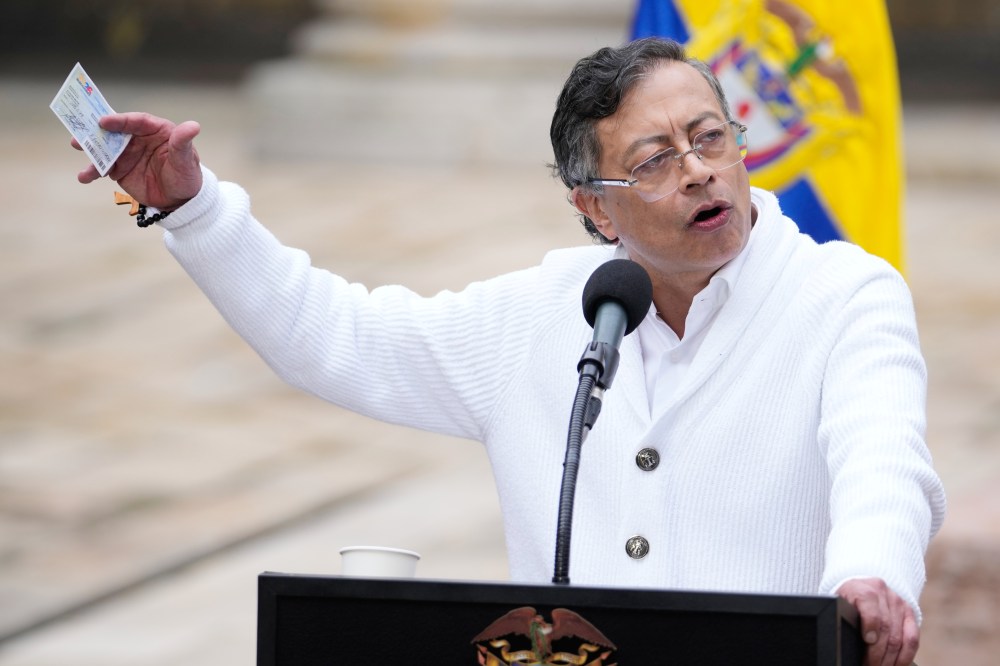
Petro, who cannot run for re-election, doubled down on his fraud accusations Tuesday in an X message saying, without providing any evidence, that 885,000 voters were registered after a March 31 deadline.
The president also said that some voting tables had an unusually large number of ballots cast.
Colombia’s National Registrars Office, which organizes the election, said in a statement that by Monday night, it had finished reviewing 99.98% of voting tables and found there was only a minimal variation of .06% with the quick count of votes that was issued Sunday.
The EU’s electoral mission said in its statement Tuesday that it selected a random sample of tally sheets from around the country and compared them to physical ballots cast, finding no inconsistencies.
“We can discard any manipulation of data in the quick count and in the final count,” González Pons said.
Under Colombian law, election results are verified and certified by judges, not by the nation’s president, typically within two weeks.
However, observers have warned that Petro’s unsubstantiated claims of fraud could polarize the nation’s political climate and stoke political violence in the run-up to the June 21 runoff vote.