

Understanding the police HQ inquiry
Advertisement
Read this article for free:
or
Already have an account? Log in here »
To continue reading, please subscribe:

Digital Subscription
One year of digital access for only $205*
- Enjoy unlimited reading on winnipegfreepress.com
- Read the E-Edition, our digital replica newspaper
- Access News Break, our award-winning app
- Play interactive puzzles
*First annual payment billed as $205.00 + GST for one year. This annual subscription will automatically renew at $233.00 + GST every 52 weeks (10% off the regular annual price of $259.35). Offer available to new and qualified returning subscribers only. Cancel any time.
To continue reading, please subscribe:
Add Free Press access to your Brandon Sun subscription for only an additional
$1 for the first 4 weeks*
- Enjoy unlimited reading on winnipegfreepress.com
- Read the E-Edition, our digital replica newspaper
- Access News Break, our award-winning app
- Play interactive puzzles
*Your next Brandon Sun subscription payment will increase by $1.00 and you will be charged $17.95 plus GST for four weeks. After four weeks, your payment will increase to $24.95 plus GST every four weeks.
Read unlimited articles for free today:
or
Already have an account? Log in here »
Launching a public inquiry is always a political decision, which often happens in response to a scandal or a tragedy. I’d like to examine the inquiry launched by the Kinew government into the bribery and cost overruns involved with the Winnipeg Police Services headquarters. That inquiry just wrapped up its public hearings phase.
The headquarters project, which dates back to 2009, has been dogged with controversy, which has led to two external audits, two civil suits (for construction flaws in 2018 and for fraud in 2022); a five-year RCMP investigation which did not lead to criminal prosecutions, and a request from the city government to the Manitoba government that an inquiry be called.
The NDP promised an inquiry during its successful 2023 election campaign. Embarrassing the former Progressive Conservative government for its unwillingness to order an inquiry, holding former mayor Sam Katz and former chief administrative officer Phil Sheegl accountable for their alleged misconduct, preventing a recurrence of corruption and cost overruns in future infrastructure projects, and restoring lost public trust in city government were all goals of the inquiry.
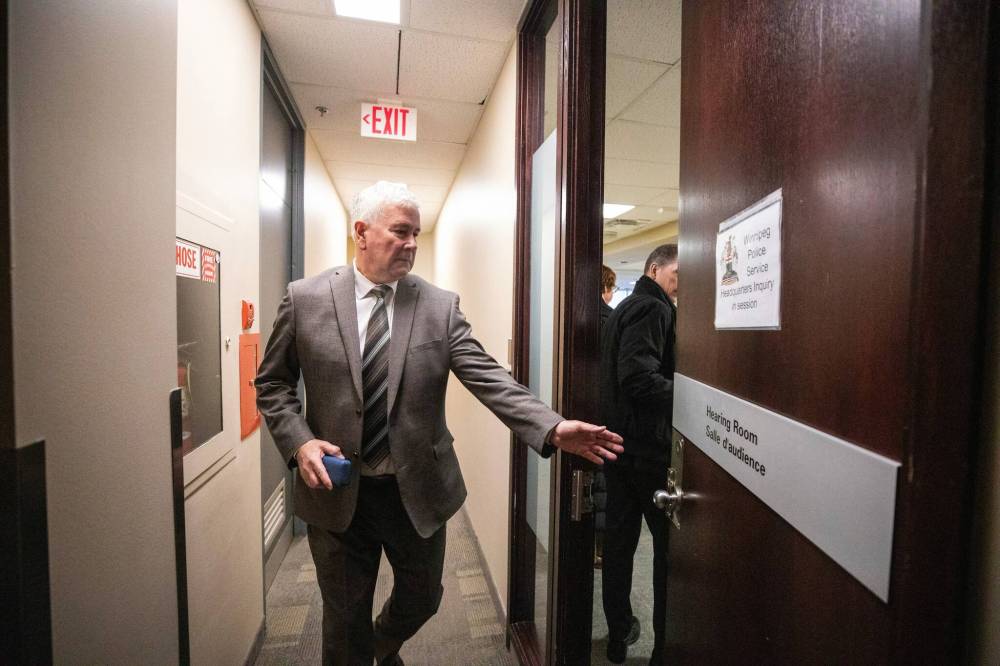
MIKAELA MACKENZIE / FREE PRESS
Commissioner Garth Smorang walks into the Winnipeg Police Service headquarters inquiry hearings at the Public Utility Board offices on Feb. 10.
Anxious to avoid a sprawling, prolonged and costly process, the Kinew government wrote terms of reference which restricted the inquiry to the HQ case (not other questionable development deals), set a total budget of $2 million, required a progress report, and set a deadline of early January 2027 for delivery of the final report.
In February 2025, lawyer Garth Smorang was appointed to lead the inquiry.
The inquiry mandate was still broad: the decision-making, risk management and accountability structures at city hall; whether the planning and management of large projects reflected “best practices”; the conflict of interest and disclosure rules for the mayor, councillors and senior administrators; and any other matters arising that required further study.
The planning and execution of the inquiry process was impressive. Commissioner Smorang recognized the need to balance efficiency, timely completion and staying on budget with the somewhat competing requirements for thoroughness and fairness to all the persons and institutions involved. The inquiry was structured on the basis of various issues and a logical sequence of stages.
A number of expert studies were prepared and over 30 witnesses appeared before the hearings to be questioned carefully by Heather Leonoff, lead counsel to the inquiry. Lawyers for the persons and organizations who had been granted standing by the commissioner also posed questions. At the conclusion of the hearings, lawyers with standing had until June 18 to make written submissions on behalf of their clients.
Katz, Sheegl and Armik Babakhanians, head of Caspian Construction, which did the bulk of the HQ work, were the key witnesses. All denied that their interactions involved bribery, even though Sheegl was found guilty by a court in 2022 of accepting a bribe. At the time, Sheegl claimed that a payment from Babakhanians (split with Katz) was payment for a land transfer, but the judge labelled it a contrived transaction to cover up the bribe.
At one point in the hearings, the son of Armik Babakhanians testified his father said that Katz and Sheegl wanted $4 million from him. A lawyer for Sheegl quickly sought to discredit the revelation by questioning the son’s recollection of the conversation.
Not surprisingly, none of the key players acknowledged wrongdoing. The only gesture in that direction was the admission from Sheegl that it was a mistake to meet privately with Babakhanians during the contract bidding process because it gave rise to an appearance (not real) of a conflict of interest.
Given the inquiry’s mandate to examine the city’s overall governance framework, there was surprisingly little discussion of the role of city council in approving and overseeing the contracting process. Other than Katz, no past or present councillors appeared at the public hearings. The consulting firm KPMG did a presentation on the city’s governing structures, but it did not really capture the informal dynamics of power at city hall.
This gap is worrisome because in 2014, when concerns about cost overruns surfaced in a consultant’s report, the mayor’s office seemed to keep council in the dark. An exchange between Katz and the commission lawyer was revealing in this regard. After Katz disclosed there were regular pre-meetings of the executive policy committee where, as the commission counsel summarized, the “dirty work” was done, and then the decisions were “tied up in a pretty bow” during the official meetings.
The inquiry hearings revealed the usually hidden interactions between the mayor and CAO and senior public servants, several of whom testified that they resisted pressure to break or modify the contracting rules to favour Caspian. At the time, public servants were not covered by a whistleblower law, which would qualify them for protection against retaliation for the good faith disclosure of misconduct or mismanagement.
The delay in creating the inquiry meant there was a need to determine how much had changed at city hall over the preceding decade. On the political side, as a result of provincial legislation passed in 2015, city council adopted a stronger code of conduct for councillors, appointed an integrity commissioner to advise councillors on legal and ethical obligations, placed public servants under the provincial Public Interest Disclosure Protection (whistleblower) law, and established a voluntary lobbyist registry.
On the administrative side of city government, the inquiry commissioned a report from KPMG which reviewed the city’s progress in implementing recommendations the firm had made in 2014 regarding the management of large projects. The main conclusion of the review was that progress had been made, but three recommendations were made to further strengthen oversight of large-scale projects such as the North End sewage treatment plant. A city project manager testified that reforms to improve oversight were underway.

Multiple times, Commissioner Smorang made the crucial point that an inquiry was not like a court proceeding, its purpose was fact-finding, not assigning blame, and none of the evidence gathered could serve directly as the basis for civil or criminal prosecution through the courts.
Both Sheegl and Babakhanians have been forced to pay sizable restitution as the result of legal actions taken by the city.
We won’t know the full value of the inquiry until we see the final report and what actions follow from it.
Hopefully, the report will answer two broad questions: Was the HQ scandal caused mainly by poorly designed structures, procedures and rules, and to what extent will recent reforms prevent a recurrence of corruption and mismanagement? Or was the wrongdoing mainly the result of an unethical culture at the top of city government shaped by a mayor and CAO who brought their wheeling and dealing leadership style from the development industry and refused to accept the constraints of the public sector intended to ensure integrity, transparency and accountability?
Paul G. Thomas is professor emeritus of political studies at the University of Manitoba.
Related Articles
Police HQ contractor pays $28M in city settlement









Advertisement Advertise With Us
Advertisement Advertise With Us