Four years later, life in Winnipeg is worse: poll Most residents don’t want mayor re-elected; have little faith anyone else could make significant changes amid city’s crime, poverty, drug crises
Read this article for free:
or
Already have an account? Log in here »
To continue reading, please subscribe:

Digital Subscription
One year of digital access for only $205*
- Enjoy unlimited reading on winnipegfreepress.com
- Read the E-Edition, our digital replica newspaper
- Access News Break, our award-winning app
- Play interactive puzzles
*First annual payment billed as $205.00 + GST for one year. This annual subscription will automatically renew at $233.00 + GST every 52 weeks (10% off the regular annual price of $259.35). Offer available to new and qualified returning subscribers only. Cancel any time.
To continue reading, please subscribe:
Add Free Press access to your Brandon Sun subscription for only an additional
$1 for the first 4 weeks*
- Enjoy unlimited reading on winnipegfreepress.com
- Read the E-Edition, our digital replica newspaper
- Access News Break, our award-winning app
- Play interactive puzzles
*Your next Brandon Sun subscription payment will increase by $1.00 and you will be charged $17.95 plus GST for four weeks. After four weeks, your payment will increase to $24.95 plus GST every four weeks.
Read unlimited articles for free today:
or
Already have an account? Log in here »
Winnipeg residents feel life has worsened in the city over the past four years — and are largely uninterested in seeing the incumbent mayor be re-elected, new poll data show.
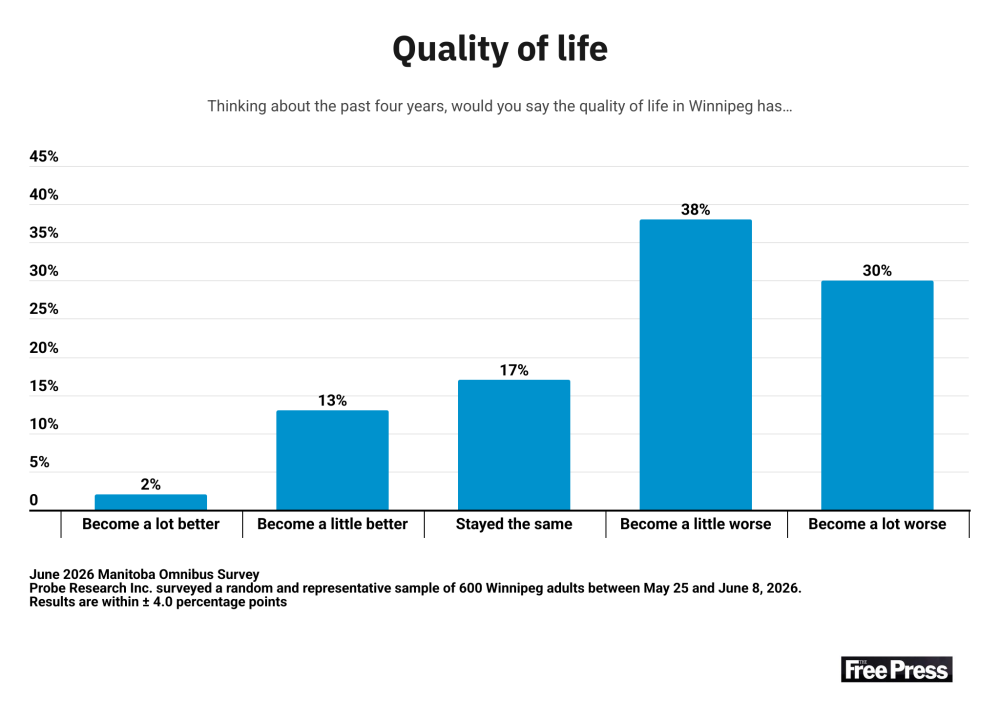
Nearly two-thirds of Winnipeggers surveyed in a Free Press-Probe Research poll released Tuesday said the quality of life in Winnipeg has deteriorated over the past four years. Fifteen per cent of respondents said life had improved and 17 per cent said things had stayed the same.
One in five want to see Mayor Scott Gillingham re-elected in this fall’s municipal election, while nearly half want to see a different person become mayor, and 36 per cent remain unsure.
MIKE DEAL / FREE PRESS FILES One in five Winnipeggers surveyed in a new Free Press-Probe Research poll want to see Mayor Scott Gillingham re-elected in this fall’s municipal election.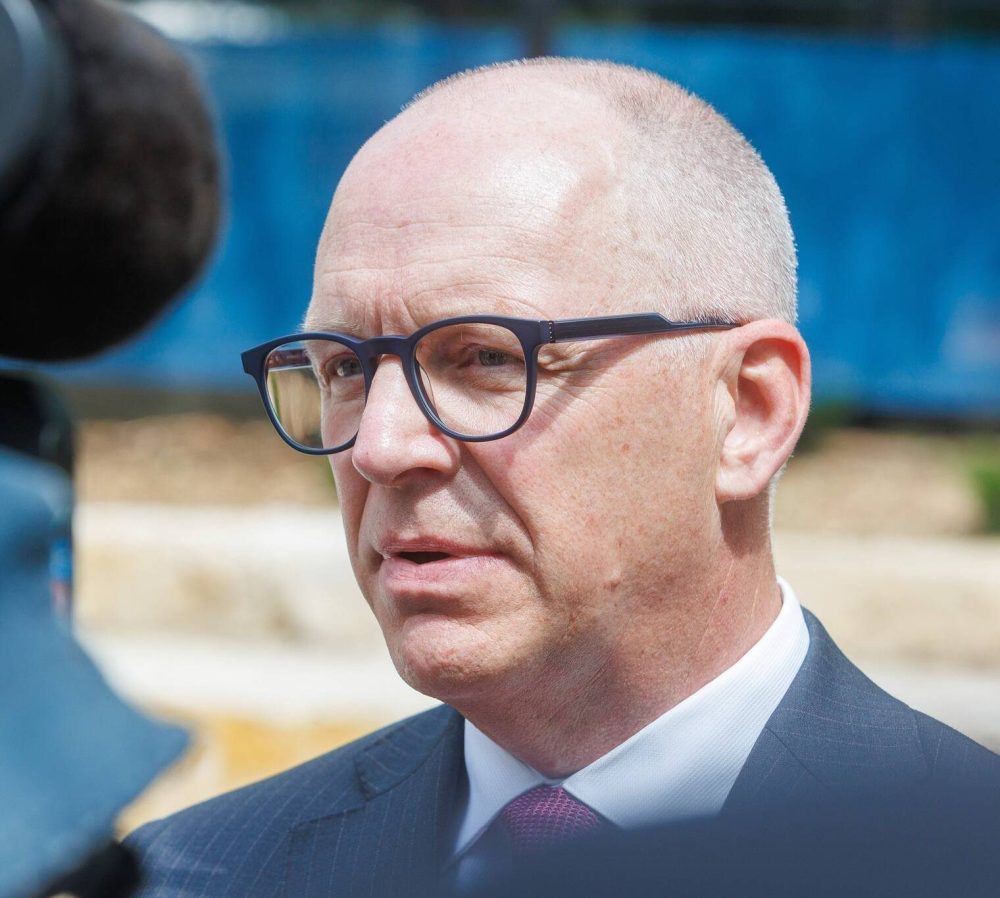
“If I were advising him, or looking at the state of things, I’d be a bit concerned that this is where the electorate sees things right now,” said Curtis Brown, a partner at Probe Research.
There appears to be a lack of optimism regardless of who are filling the seats at city hall: fewer than one in 10 polled said they believed the next mayor and council could make major changes on city issues.
Crime, violence, poverty, homelessness and the impact of the drug crisis topped the list of issues respondents flagged as the most severe. Other issues listed included the cost of living, infrastructure, health care and affordable housing.
Gillingham said he shares the frustrations expressed in the poll’s results.
“Less than 10 per cent of the people polled think a different mayor would make any difference, and so I think that goes back to the frustration people are feeling,” he said Tuesday.
“I’ve been in a few elections, and so I’ve seen polls go up and down, and I appreciate that, but I’ve worked hard on these very issues and have made some progress.”
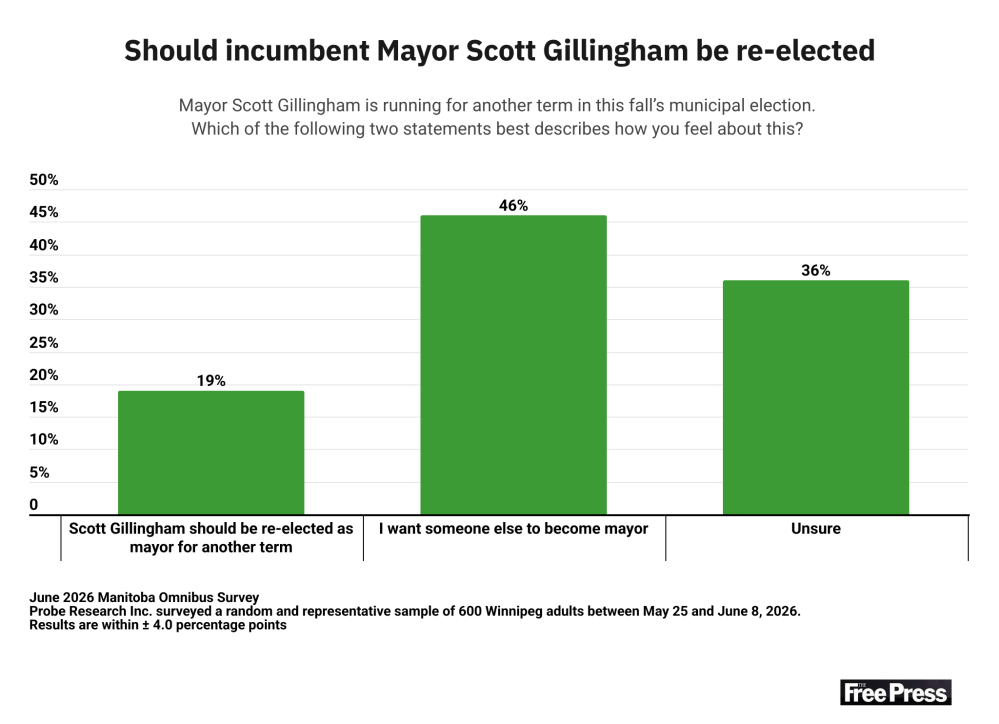
The survey showed Gillingham supporters were more likely to be men, higher-income earners, federal Liberal voters, homeowners, and living in suburban areas.
Gillingham, who first ran for mayor in 2022 after incumbent Brian Bowman decided not to run again, defeated former mayor Glen Murray by 4,391 votes.
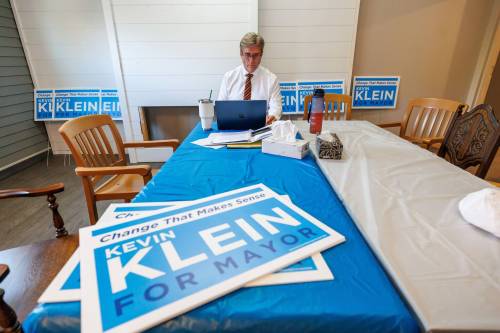
The current mayor is one of eight candidates registered to run. The group includes political newcomers Mazher Alam, Joshua Pagdato, Johnny Calderon, Umar Hayat and Mike Vogiatzakis. Grocery store clerk Christopher Clacio ran unsuccessfully for mayor in 2022, as did Don Woodstock, who also ran in 2018.
“I’d be a bit concerned that this is where the electorate sees things right now.”
Gillingham has yet to release any campaign promises ahead of the Oct. 28 vote. He said Tuesday he plans to continue to focus on public safety, building new housing, and major infrastructure projects.
“The priorities that I have are clear, and I believe they position the city of Winnipeg well for the future,” he said. “And I’ll be speaking about those priorities in greater detail through the campaign over the coming weeks and months ahead.”
Several city councillors told the Free Press the results of the poll were unsurprising.
JOHN WOODS / FREE PRESS FILES Crime, violence, poverty, homelessness and the impact of the drug crisis topped the list of issues respondents flagged as the most severe.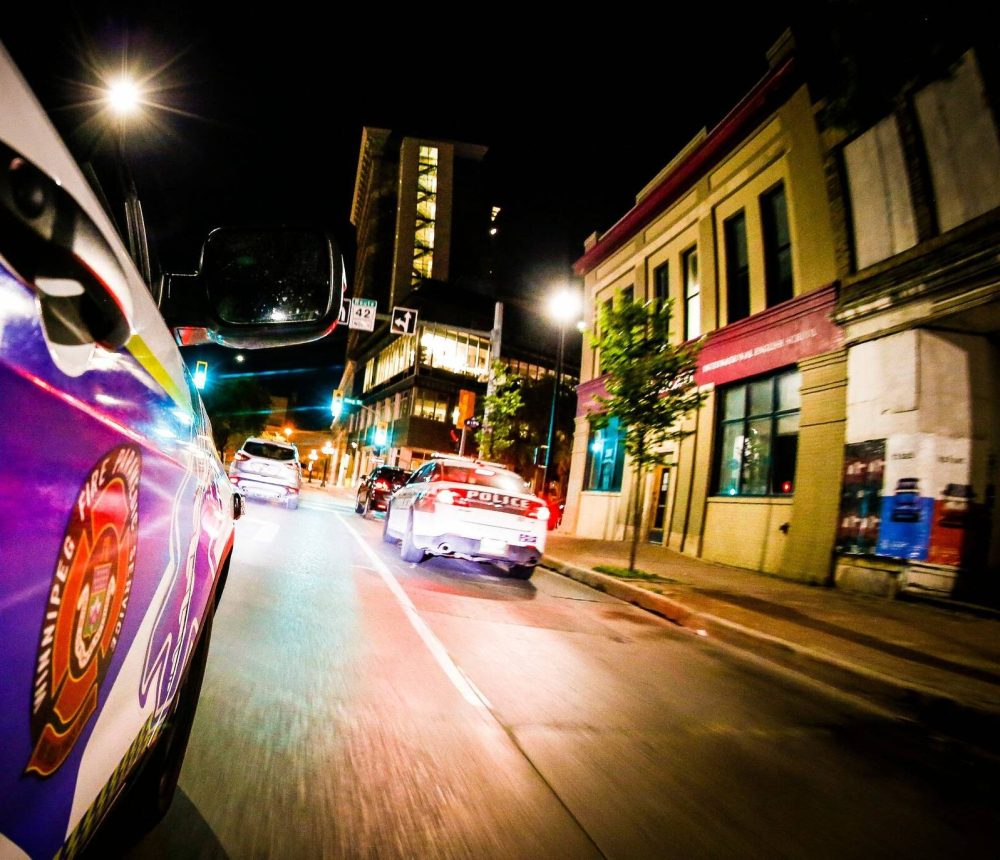
“I’m not shocked that people think it’s worse than four years ago,” said Coun. Brian Mayes (St. Vital).
“I think some of that is economic forces beyond the city’s control but I also think there’s a sense of, it’s more dangerous, there are more encampments, it’s just dirtier, it just seems like there’s more garbage lying around.”
Mayes, who was dropped from council’s executive policy committee by Gillingham in 2024 after 11 years as part of the mayor’s inner circle, lamented an “attitudinal” shift at city hall that has made it difficult for councillors to be heard equally.
“You just start feeling more and more alienated, and I think that’s a shame,” he said.
Mayes has not said if he plans to run again.
Coun. Sherri Rollins noted that there had been attitude shifts outside of city council, too.
“It’s not an easy time to be an elected official,” said Rollins (Fort Rouge-East Fort Garry).
“I don’t think there ever has been an easy time, but definitely, we know how polarized the political arena has been, and will continue to be.”
“I’m not shocked that people think it’s worse than four years ago.”
Rollins said low voter turnout was a concern of hers and it was up to incumbent candidates like her and Gillingham “to say why we need to get back to city hall.”
“I really feel that this should be an election where people do get out, where people ask really difficult questions of candidates, given the social disorder that we’re seeing on city streets, and the humanitarian crisis that we’re seeing that has worsened,” she said.
Voter turnout in 2022 was about 37 per cent, lower than 2018 and 2014, where it sat at around 42 per cent and 50 per cent respectively.
The Social Planning Council of Winnipeg puts together voter guides distributed in inner-city wards, and holds information sessions around key issues and candidates.
Those resources are finding an audience as the organization encounters “a lot of hopelessness” in the face of increasing social struggle, its executive director said.
“It’s also unfortunate, in my mind, that people really don’t understand what the city can do and should be doing, and I would actually look at successive mayors and council for that,” said Kate Kehler.
“Because they tend to put everything of a social nature at the door of the province, so and then the province will respond by saying ‘No, but we’ve done all this,’ and I would say that finger-pointing is also part of the problem … people do get turned off by that sort of politics.”
The city has a role to play in people’s feelings of apathy, Kehler said, describing the city’s newcomer welcome and inclusion policy and poverty reduction strategies as examples of commitments council has made on paper but lack meaningful funding.

“They are making choices to spend money in certain places and not spend it elsewhere. Those are their choices to have made, they were elected, and they get to do that,” she said.
“But from my perspective, it’s up to us as citizens to say, you’ve been doing that for a very long time, and things are getting worse. So, perhaps it’s time to do things differently.”
Probe Research surveyed 600 adults living in Winnipeg between May 25 and June 8.
The poll’s margin of error is plus or minus 4 percentage points 95 times out of 100.
malak.abas@freepress.mb.ca

Malak Abas is a city reporter at the Free Press. Born and raised in Winnipeg’s North End, she led the campus paper at the University of Manitoba before joining the Free Press in 2020. Read more about Malak.
Every piece of reporting Malak produces is reviewed by an editing team before it is posted online or published in print — part of the Free Press‘s tradition, since 1872, of producing reliable independent journalism. Read more about Free Press’s history and mandate, and learn how our newsroom operates.
Our newsroom depends on a growing audience of readers to power our journalism. If you are not a paid reader, please consider becoming a subscriber.
Our newsroom depends on its audience of readers to power our journalism. Thank you for your support.