

Community frustration led to drug sweep: police chief
‘Every day we hear from residents, business owners and community leaders’ about use of illicit substances on city streets

Advertisement
Read this article for free:
or
Already have an account? Log in here »
To continue reading, please subscribe:

Digital Subscription
One year of digital access for only $205*
- Enjoy unlimited reading on winnipegfreepress.com
- Read the E-Edition, our digital replica newspaper
- Access News Break, our award-winning app
- Play interactive puzzles
*First annual payment billed as $205.00 + GST for one year. This annual subscription will automatically renew at $233.00 + GST every 52 weeks (10% off the regular annual price of $259.35). Offer available to new and qualified returning subscribers only. Cancel any time.
To continue reading, please subscribe:
Add Free Press access to your Brandon Sun subscription for only an additional
$1 for the first 4 weeks*
- Enjoy unlimited reading on winnipegfreepress.com
- Read the E-Edition, our digital replica newspaper
- Access News Break, our award-winning app
- Play interactive puzzles
*Your next Brandon Sun subscription payment will increase by $1.00 and you will be charged $17.95 plus GST for four weeks. After four weeks, your payment will increase to $24.95 plus GST every four weeks.
Read unlimited articles for free today:
or
Already have an account? Log in here »
Winnipeg’s police chief took responsibility Friday for not giving front-line social service agencies a heads-up before launching a high-profile crackdown on open drug use and trafficking Wednesday and Thursday in the Main Street strip area.
More than 100 people were estimated to have been detained in the sweep of Main between Logan and Higgins avenues, an area where open drug use is rampant.
The planned 10-day campaign was triggered by months of complaints from residents, business owners and others downtown, in Point Douglas and Maryland and Sherbrook streets, who demanded something be done.
As of Thursday, police had arrested 25 people, with two of the arrests related to drug possession or trafficking, officials said. The other 23 were related to active warrants and breaches of court orders.
An estimated 20 severely intoxicated people were transported to emergency departments. Three of them were then taken to the province’s new 72-hour detox centre on Disraeli Freeway after they were cleared by hospital staff.
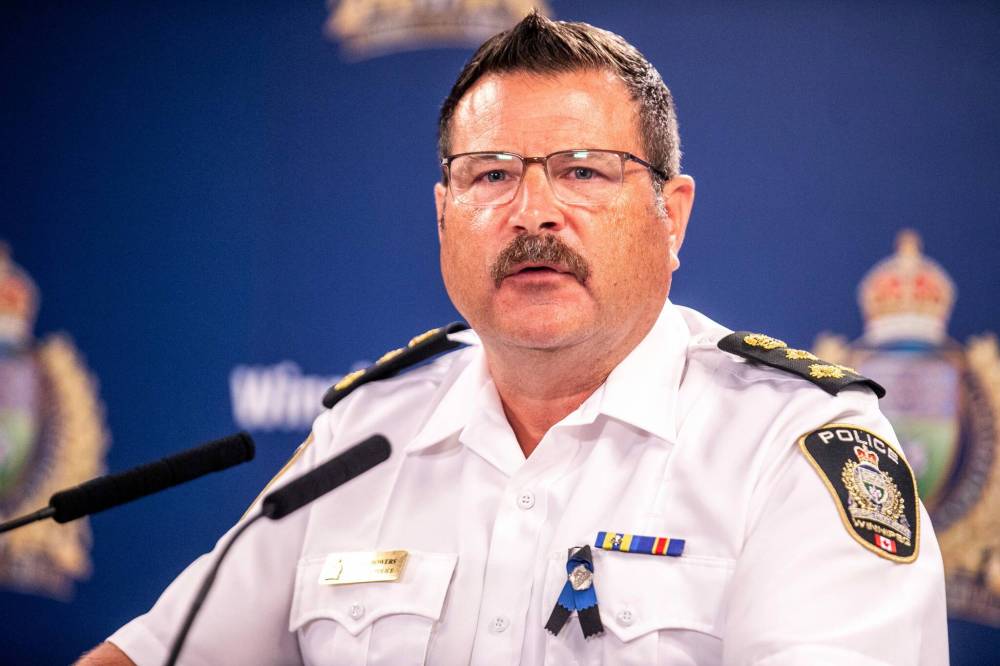
“We are not criminalizing addiction,” Winnipeg Police Chief Gene Bowers said at a Friday news conference after acknowledging the WPS could have done a better job communicating the initiative to front-line agencies before it began.
“These issues are affecting people’s sense of safety, their well-being and their confidence in the community.”
“That’s on me,” Bowers said, adding he would speak with some of them Friday, “So that we can sit down together and work towards helping the people who are being devastated by the drugs that are on our streets.”
Bowers said he cares deeply about Winnipeg and the people who call it home.
“Every day, we hear from residents, business owners and community leaders who care just as much… and are speaking openly about what they’re experiencing in their neighbourhoods. Many are expressing real concern about drug trafficking, about open drug use in public spaces and about discarded needles and paraphernalia,” he said.
“These issues are affecting people’s sense of safety, their well-being and their confidence in the community.”
He said the message he hears most is one of frustration, that not enough is being done.
Mayor Scott Gillingham defended the enforcement effort, saying open, illegal drug use in public spaces cannot become “normal” in Winnipeg.
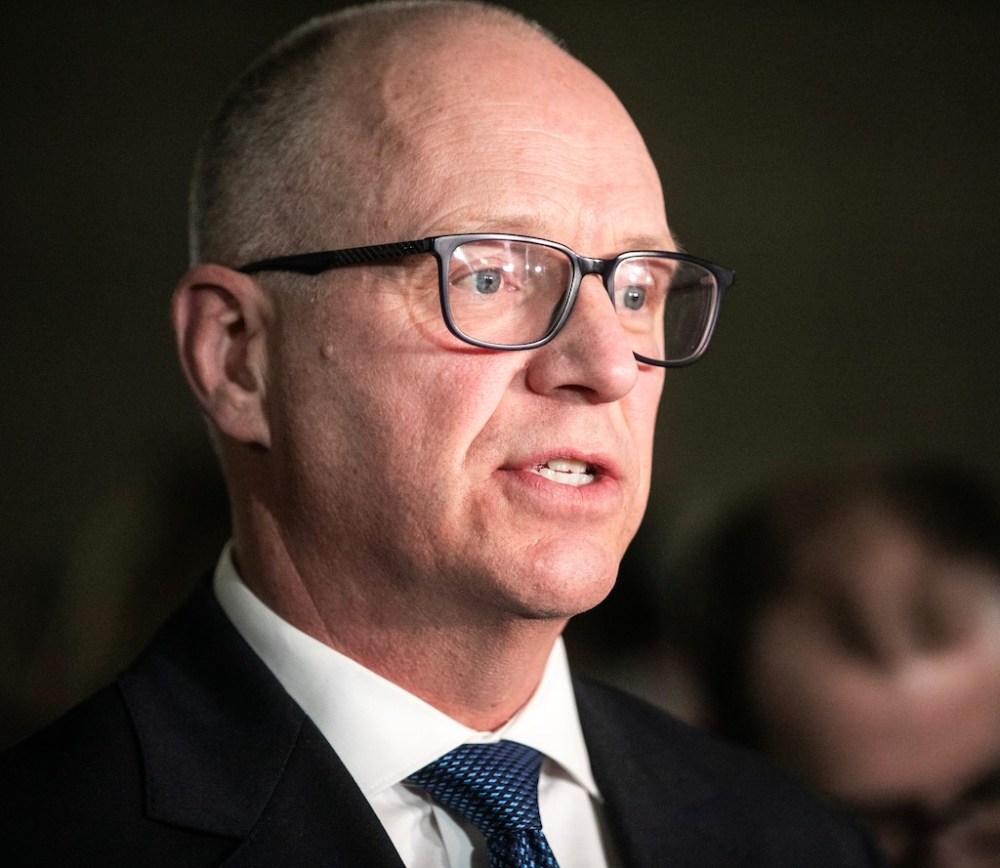
“I stand with the police and I support their efforts to crack down on open, illegal drug use and drug trafficking,” Gillingham said.
Both Gillingham and Bowers acknowledged enforcement alone will not solve the escalating drug crisis.
The mayor said allowing people suffering from addiction to use drugs in public spaces is not compassionate, safe or acceptable. He singled out fentanyl, a powerful synthetic opioid, as particularly harmful.
“The goal has to be to break the cycle,” he said.
The police crackdown is not the way to go about doing that, several social service and outreach agencies said in a collective statement issued Friday that condemned the action.
“This isn’t an approach that is connecting people to community supports and resources, because in order for them to be connecting people to community supports and resources, they would need to be talking to us and they’re not,” Lorie English, executive director of the West Central Women’s Resource Centre, told the Free Press.
“I stand with the police and I support their efforts to crack down on open, illegal drug use and drug trafficking.”
English warned that the approach will push people further out into the margins.
“Dark corners and back alleys where they will use, and where we cannot find people, we cannot support them properly, and where people will die,” she said, adding there is simply no place for people to go.
“There is no path. There is no housing. There is inadequate shelter space. There’s inadequate drop-in space. There’s inadequate treatment beds,” she said. “There is no path.”
Earlier this month, Premier Wab Kinew vowed that the temporary emergency mobile version of the long-promised safe consumption site on Henry Avenue would be open before July, but on Friday the government said it won’t be fully operational until August.
Pedestrian traffic along Main Street close to the intersection with Logan Avenue on Thursday. (Mike Deal / Free Press)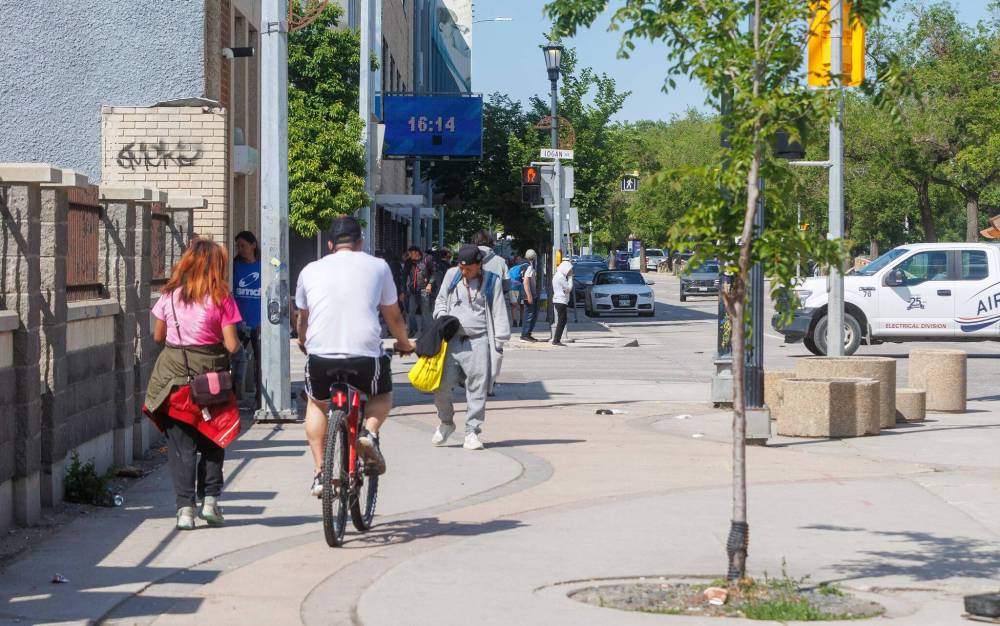
Kate Sjoberg, executive director of Resource Assistance for Youth Inc., said the population being targeted by police is already stressed out, dealing with a poisoned drug supply and lack of spaces to use safely.
“There’s a life safety risk to this (police) initiative,” Sjoberg said, adding the crackdown risks putting addicted substance users in unfamiliar or more dangerous situations, increasing the likelihood of catastrophic outcomes.
“Every day we work to build trust with people who have experienced trauma, discrimination, and barriers to care,” she said. “Actions that create fear around accessing services can undo months or years of relationship-building and place people at greater risk of preventable harm.”
“Dark corners and back alleys where they will use, and where we cannot find people, we cannot support them properly, and where people will die.”
Outreach workers who spoke to the Free Press said police officers had searched people’s belongings and taken away harm-reduction supplies, including pipes commonly used to smoke drugs such as methamphetamine and fentanyl, distributed by agencies that are trying to reduce the spread of communicable diseases from sharing items.
WPS Supt. Brian Miln rejected those claims and said officers have been instructed not to confiscate harm-reduction supplies. He added, however, that syringes containing illegal drugs will be seized as evidence.
Miln said reports he received from officers over the first two days of the sweep have provided an eye-opening picture of the situation.
“We underestimated the scope of this problem,” he said.
One support worker, who the Free Press isn’t naming because he didn’t have permission to speak, said the crackdown is not helping anyone.
“It feels unsafe,” he said. “The cops being around here is just making them more agitated. It’s really stressful.”
He said while he understands police want to address public drug use, this approach causes more harm than good.
“Our relatives don’t have anywhere to go,” he said.

Another community member, who didn’t want to be named, as she didn’t want to be targeted by police, said members of the community “are getting harassed.”
“They should try helping them, letting them know there’s other resources if they’re wanting to get sober,” she said. “Jail’s not going to do nothing… as soon as they get out of jail, they’re going to come right back to the same things.”
In fact, on Friday, people once again lined the sidewalks along Main Street near the Winnipeg Regional Health Authority headquarters across from Main Street Project.
Front-line agencies estimate the drug crisis has claimed an average of 30 lives a month this year, while overdose calls have surged across the city.
Many organizations have urged the Manitoba government to declare a public health emergency, arguing the move would unlock additional funding and resources to respond to the growing number of drug poisonings.
Addictions Minister Bernadette Smith said the province is focused on getting people trapped in addiction the supports they need, including the supervised consumption site and harm-reduction supplies.
“This toxic drug crisis requires immediate action, and we won’t stop working until every Manitoban gets the secure, dignified life they deserve free from addiction,” Smith said in a statement.
— With files from Erik Pindera and Morgan Modjeski
scott.billeck@freepress.mb.ca
Scott Billeck is a general assignment reporter for the Free Press. A Creative Communications graduate from Red River College, Scott has more than a decade’s worth of experience covering hockey, football and global pandemics. He joined the Free Press in 2024. Read more about Scott.
Every piece of reporting Scott produces is reviewed by an editing team before it is posted online or published in print — part of the Free Press‘s tradition, since 1872, of producing reliable independent journalism. Read more about Free Press’s history and mandate, and learn how our newsroom operates.
Our newsroom depends on a growing audience of readers to power our journalism. If you are not a paid reader, please consider becoming a subscriber.
Our newsroom depends on its audience of readers to power our journalism. Thank you for your support.
Scott Billeck is a general assignment reporter for the Free Press. A Creative Communications graduate from Red River College, Scott has more than a decade’s worth of experience covering hockey, football and global pandemics. He joined the Free Press in 2024. Read more about Scott.
Every piece of reporting Scott produces is reviewed by an editing team before it is posted online or published in print — part of the Free Press‘s tradition, since 1872, of producing reliable independent journalism. Read more about Free Press’s history and mandate, and learn how our newsroom operates.
Our newsroom depends on a growing audience of readers to power our journalism. If you are not a paid reader, please consider becoming a subscriber.
Our newsroom depends on its audience of readers to power our journalism. Thank you for your support.
Related Articles
Dozens detained for open drug use during Main Street police blitz
















Advertisement Advertise With Us
Advertisement Advertise With Us
History
Updated on Friday, June 26, 2026 5:04 PM CDT: Adds edits
Updated on Friday, June 26, 2026 6:22 PM CDT: Adds comment from Bernadette Smith