Eastern Washington wildfire forces evacuations and destroys homes

Advertisement

Advertise with us

High winds drove a wildfire into an eastern Washington neighborhood, forcing the evacuation of about 1,500 people and destroying at least 15 homes, officials said Wednesday.

Read this article for free:


or

Already have an account? Log in here »

To continue reading, please subscribe:

Subscribe and receive a limited-edition Free Press branded hat or tote.

Digital Subscription

One year of digital access for only $205*

  • Enjoy unlimited reading on winnipegfreepress.com
  • Read the E-Edition, our digital replica newspaper
  • Access News Break, our award-winning app
  • Play interactive puzzles

*First annual payment billed as $205.00 + GST for one year. This annual subscription will automatically renew at $233.00 + GST every 52 weeks (10% off the regular annual price of $259.35). Offer available to new and qualified returning subscribers only. Cancel any time.

To continue reading, please subscribe:

Add Free Press access to your Brandon Sun subscription for only an additional

$1 for the first 4 weeks*

  • Enjoy unlimited reading on winnipegfreepress.com
  • Read the E-Edition, our digital replica newspaper
  • Access News Break, our award-winning app
  • Play interactive puzzles
Start now

*Your next Brandon Sun subscription payment will increase by $1.00 and you will be charged $17.95 plus GST for four weeks. After four weeks, your payment will increase to $24.95 plus GST every four weeks.

High winds drove a wildfire into an eastern Washington neighborhood, forcing the evacuation of about 1,500 people and destroying at least 15 homes, officials said Wednesday.

The Spokane County Sheriff’s Office announced Wednesday that its forensic unit found what appeared to be human remains inside a home destroyed in the fire. A family member had requested a wellness check at the home because one of the residents had refused to evacuate and could not be reached, officials said in a news release. They were working to confirm whether authorities found human remains, and if so, identify who they were and how they died.

Authorities have not reported any injuries.
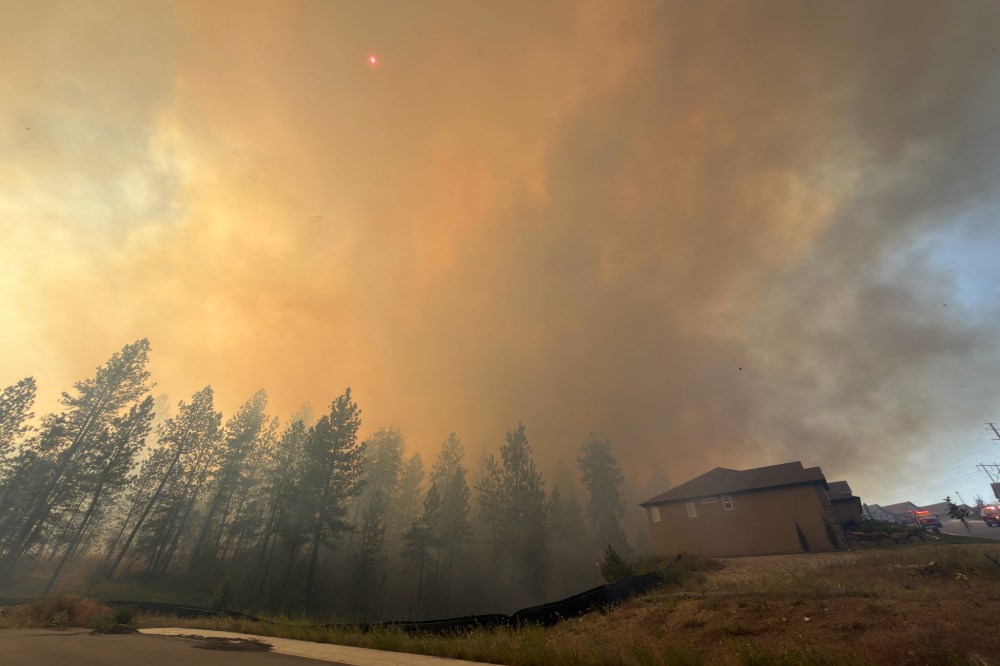
This photo provided by Spokane Fire District 9 shows the Upriver Fire burning northeast of Spokane, Wash., on Tuesday, June 16, 2026. (Robert Gray/Spokane Fire District 9 via AP)

Many people living in the densely populated neighborhoods had to flee on a moment’s notice — sometimes after an officer knocked on their door — leaving behind belongings and in some cases, critical medications, Spokane County Sheriff John Nowels said during a news conference.

People were being escorted Wednesday by an officer to their homes one-by-one to access those essential needs, but then they were taken back out, Nowels said.

The evacuation order for the 1,500 residents remained in effect Wednesday, said Chandra Fox, deputy director for Spokane County Emergency Management.

“Our concern is for increased winds Wednesday afternoon,” Fox said.

The blaze started just after noon on Tuesday and quickly moved up a hill, said fire district spokesman Robert Gray. Winds then shifted, sending flames into a neighborhood, Gray said. Spokane is about 280 miles (450 kilometers) east of Seattle near the border with Idaho.

John Leavell, battalion chief with the Spokane Valley Fire Department, was one of the first people to spot the fire. He said he was driving near Interstate 90 when he saw a column of smoke.

“As I approached it, I thought this is going to be a big event — this is going fast,” he said. “It looked like waves of fire going up the hill.”

He pulled into a driveway and found a house fully engulfed in flames, so he contacted surrounding agencies and the local fire district took over while his crew started building fire lines, he said. Leavell said he didn’t know if they fire began at the house or quickly consumed it. The cause is still under investigation.

Fire crews from Washington state and Idaho attacked the fire from the ground and air, but it quickly grew to 225 acres (.35 square miles). It was 10% contained Wednesday morning, according to the National Interagency Fire Center. Avista turned off power for the area as the fire progressed for the safety of firefighters. It remained off Wednesday in some areas.

The weather was working in the firefighters’ favor.

Winds were lighter on Wednesday and were expected to decrease after sunset, according to Rachael Fewkes, a meteorologist with the National Weather Service in Spokane. The temperature also dropped a few degrees from the mid-80s on Tuesday to a high of 80 on Wednesday, she said.
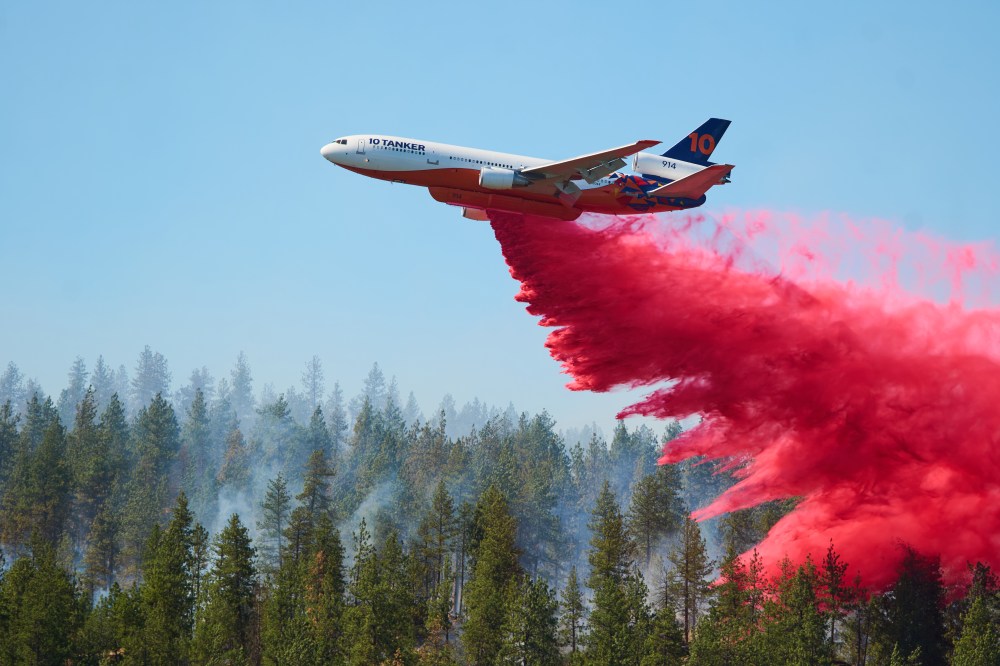
Fire retardant is dropped by air tanker onto the Upriver Fire on Tuesday, June 16, 2026 in Spokane, Wash. (Skyler Geissler via AP)

The Federal Emergency Management Agency said Wednesday that they authorized the use of Fire Management Assistance Grant funds to help with firefighting costs for the Spokane blaze. The regional FEMA director said the fire had the potential to constitute a major disaster. Besides threatening homes, it also threatened a school, power lines, parks, businesses and wildlife.

FEMA said this was the first fire grant awarded this season to fight a Washington wildfire.

More than 32,000 fires have burned more than 3,900 square miles (10,100 square kilometers) so far this year in the United States, according to the fire center, which coordinates the mobilization of large-scale firefighting efforts.

That’s significantly higher than the 10-year average of just under 24,000 fires burning about 2,200 square miles (5,700 square kilometers) by early June, according to the fire center, even though fire activity has been relatively light in recent weeks.

Weather and fuel models that predict conditions like wind, lightning and how likely plants and other materials are to burn also show an increased danger of fires in multiple areas across the U.S. in coming weeks, according to the fire center. Some regions with critical conditions for fire include portions of California, and the Southwest, Great Basin and Rocky Mountain areas.

__

Bellisle reported from Seattle. Associated Press journalists Rebecca Boone in Boise, Idaho, and Hannah Schoenbaum in Salt Lake City contributed reporting.


Report Error Submit a Tip

More Stories

Quilt tradition from Underground Railroad period big part of new exhibition

Conrad Sweatman 6 minute read Preview

Quilt tradition from Underground Railroad period big part of new exhibition

Conrad Sweatman 6 minute read 2:00 AM CDT

Long before she became a professional quilter, Melinda Clayton Patterson used to watch her mother make quilts from clothing scraps and cardboard templates.

“I came from a family of 14 kids, so going to whatever the store was back then, K-Mart or Woolworth, to buy quilts or blankets for 14 kids was just not feasible because the people were not wealthy,” she says.

“Quilts were not viewed as art. But when I came to Winnipeg, I started taking quilting seriously in my 30s … the heritage came later.”

Today, the 61-year-old native of East Preston, N.S., lives in Winnipeg, stitching together stories of her Black Loyalist heritage and Preston’s foundational role in the birth of Canadian Black culture.

Read
2:00 AM CDT

Manitoba abandoning spring, fall clock changes

Carol Sanders 8 minute read Preview

Manitoba abandoning spring, fall clock changes

Carol Sanders 8 minute read Updated: Yesterday at 5:36 PM CDT

Time’s up for the time change in Manitoba.

Manitobans won’t be setting their clocks back an hour in November. The province has decided to permanently stay on daylight time after surveying residents on the twice annual clock adjustment.

“We heard from Manitobans loud and clear — no more changing the clocks in Manitoba,” Premier Wab Kinew said in a news release Thursday.

Most of the 72,000 votes submitted in an online EngageMB survey — 92 per cent — said they would like to see the practice end. The survey asked if they preferred earlier sunrises in winter with standard time or the later sunsets in summer with daylight time. More than half of survey participants (58 per cent) indicated a preference to stay on permanent daylight time; 34 per cent voted to eliminate the time change but stay on standard time.

Read
Updated: Yesterday at 5:36 PM CDT

Finding the balance on short-term rentals

Editorial 4 minute read Preview

Finding the balance on short-term rentals

Editorial 4 minute read 2:00 AM CDT

It’s fair to say the advent of Airbnb in 2008 changed the short-term rental market — it and its competitors gave hotels a run for their money, gave homeowners new ways to make an income and helped customers pay less for accommodations.

Read
2:00 AM CDT

United Way, other charities fight for dollars as donor base shrinks

Scott Billeck 7 minute read Preview

United Way, other charities fight for dollars as donor base shrinks

Scott Billeck 7 minute read 2:00 AM CDT

Winnipeg’s charitable sector is being squeezed from both sides: demand for help is growing while the pool of donors to meet that need is shrinking.

The imbalance is increasingly being carried by a relatively small group of deep-pocketed donors. Last year, 600 people — about three per cent of United Way Winnipeg’s individual donors — accounted for roughly $8 million, or 55 per cent of individual donations.

The fundraising pitch isn’t getting any easier.

Homelessness and public drug use have become increasingly visible, household budgets remain strained and the problems charities are trying to address can seem so entrenched that donors may reasonably wonder what difference another contribution can make.

Read
2:00 AM CDT

Canada-U.S. trade relationship is broken, but the damage can — and will — be repaired

Tom Brodbeck 5 minute read Preview

Canada-U.S. trade relationship is broken, but the damage can — and will — be repaired

Tom Brodbeck 5 minute read Yesterday at 1:35 PM CDT

Canada needs to get serious about diversifying its trade beyond the United States. But at the same time, Canadians should expect relations with the U.S. to normalize after Donald Trump is no longer in the White House.

For generations, Canada-U.S. trade was considered almost a fact of geography. The two countries share the world’s longest undefended border, deeply integrated supply chains and a century of commercial relationships.

Canadian manufacturers depend on American customers. American manufacturers depend on Canadian suppliers. Energy, agriculture, automotive production and countless other industries operate across the border as though it barely exists.

That isn’t going to change dramatically, even in the midst of a bitter trade war unleashed by the U.S. president.

Read
Yesterday at 1:35 PM CDT

Fiddling and a jig mark ceremony to rename Wolseley-area school

Maggie Macintosh 4 minute read Preview

Fiddling and a jig mark ceremony to rename Wolseley-area school

Maggie Macintosh 4 minute read 2:00 AM CDT

Beckoned by a fiddle, students broke out into a jig behind Little Bluestem School on Thursday evening to mark the end of a multi-year renaming process.

“I couldn’t help myself. I just had to dance,” eight-year-old Stevie Morrison said at a ribbon-cutting event to celebrate the new signage at 511 Clifton St., formerly known as Wolseley School.

Stevie and Fallon Lovelace Sharkey, 7, were out of breath after bouncing up and down to the beat, attempting to execute the Red River Métis dance moves they were taught at school.

There were cheers and tears as adults watched jigging on school grounds once named after a man who did not believe in Métis peoples’ right to self-determination.

Read
2:00 AM CDT