Confronting the scourge of polio
Advertisement
Read this article for free:
or
Already have an account? Log in here »
To continue reading, please subscribe:

Digital Subscription
One year of digital access for only $205*
- Enjoy unlimited reading on winnipegfreepress.com
- Read the E-Edition, our digital replica newspaper
- Access News Break, our award-winning app
- Play interactive puzzles
*First annual payment billed as $205.00 + GST for one year. This annual subscription will automatically renew at $233.00 + GST every 52 weeks (10% off the regular annual price of $259.35). Offer available to new and qualified returning subscribers only. Cancel any time.
To continue reading, please subscribe:
Add Free Press access to your Brandon Sun subscription for only an additional
$1 for the first 4 weeks*
- Enjoy unlimited reading on winnipegfreepress.com
- Read the E-Edition, our digital replica newspaper
- Access News Break, our award-winning app
- Play interactive puzzles
*Your next Brandon Sun subscription payment will increase by $1.00 and you will be charged $17.95 plus GST for four weeks. After four weeks, your payment will increase to $24.95 plus GST every four weeks.
Read unlimited articles for free today:
or
Already have an account? Log in here »
Adapted from The University of Manitoba Department of Pediatrics and Child Health: A History. Published by Figure 1 Publishing and the Department of Pediatrics and Child Health, University of Manitoba. Reprinted with permission of the publishers.
Few diseases challenged health care professionals, hospitals, and health institutions across Winnipeg and Manitoba the way polio did. Poliomyelitis, an intestinal infection which “spread from person to person though contact with fecal waste, unwashed hands, shared objects (and) contaminated food and water,” painfully paralyzed its victims, most often in their legs, but also could prevent breathing that necessitated treatment with a respirator or “iron lung” machine.
At one point during the epidemic of 1953, hospitals in Winnipeg had 72 patients in iron lungs. The disease was particularly prevalent among children and young adults.
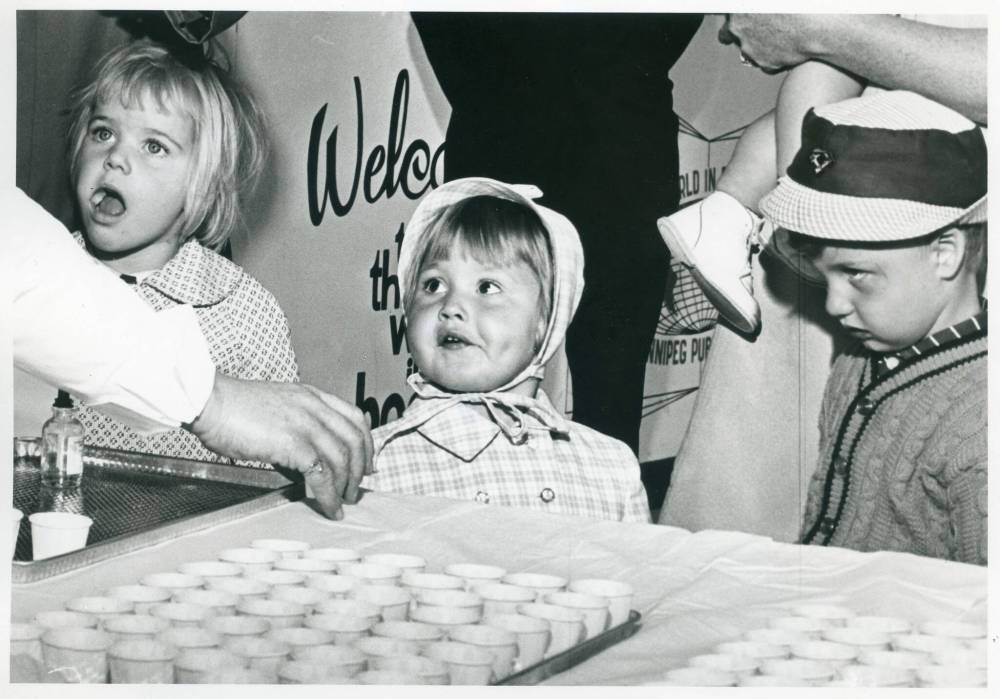
Winnipeg children await getting the polio vaccine in 1964.
Among the notable survivors of polio were Canadian singers Neil Young, who contracted it when he was six years old in 1951, and Joni Mitchell, who contracted it when she was nine in 1952; politician Paul Martin, the prime minister of Canada from 2003 to 2006, who contracted it at the age of eight in 1946; and perhaps most famous of all, Franklin D. Roosevelt, the U.S. president from 1933 to 1945, who became ill with polio in 1921, at the age of 39.
(Recently, some historians have suggested that Roosevelt may have actually had Guillain-Barré syndrome, a “rapid-onset muscle weakness caused by the immune system damaging the peripheral nervous system,” rather than polio.)
In Winnipeg, Percy Barsky, who was to become a well-respected pediatrician and professor of pediatrics in the Faculty of Medicine, was 20 years old in July 1941 when he was struck with polio.
A few months earlier, he had obtained his bachelor’s of science degree from the University of Manitoba with the goal of becoming a doctor. He had applied while still an undergraduate but had been told he was too young, a dubious excuse. He had long believed that his application had been denied because at the time the faculty restricted the number of Jewish applicants as well as those of other selected minorities.
During the summer of 1941, Barsky was working for a local creamery. One day, his back started hurting, and by the end of his shift, he could not lift one of his legs, making it impossible to ride his bicycle the short distance to his home.
Within a short time, his family doctor confirmed that Barsky had polio. He spent the rest of the summer and part of the fall at the King George Hospital in an iron lung.
He was lucky. Slowly, he regained his strength and was able to resume his studies, though he had muscle weakness in one of his legs the rest of his life.
According to Barsky’s daughter Mindy, while convalescing at the hospital, he told his mother, who wanted him to become a lawyer, that if he got out of the iron lung, he was going to become a physician.
And he did. He graduated with a medical degree in May 1949, eventually specializing in pediatrics from 1952 to 1954 at the Children’s Hospital and had a distinguished career.
While it was true that during the period from the 1920s to the mid-1950s, more children in Canada and the U.S. died from car accidents and cancer, polio was nonetheless regarded as a modern-day plague.
“No disease drew as much attention, or struck the same terror, as polio,” writes American medical historian David M. Oshinsky. “And for good reason. Polio hit without warning. There was no way of telling who would get it and who would be spared. It killed some of its victims and marked others for life, leaving behind vivid reminders for all to see: wheelchairs, crutches, leg braces, breathing devices, deformed limbs.”
From 1928 to 1953, polio epidemics occurred in Manitoba every three to five years. The pain for the young victims was often excruciating. The vast majority of children recovered, yet many experienced lifelong disabilities from the disease.
The death rate was low — about one to two per cent — though there were years when it was higher.
In 1936, there were 539 cases in the province with 37 deaths; in the 1941 epidemic, 1,011 cases with 20 deaths; in 1947, 594 cases and eight deaths; and in 1953, the worst year for polio, there were 2,318 cases and 85 deaths.
That last year, about half the patients were treated at the three Winnipeg municipal hospitals — the King Edward Memorial Hospital, the King George Hospital, and the new Princess Elizabeth Hospital (now Riverview Health Centre), which opened in 1950.
As of 1951, all three hospitals were skilfully led by Dr. John “Jack” Hildes, an Ontario-born physiologist and internist who in 1970 established the University of Manitoba’s Northern Medical Unit, first in Churchill and later in other communities as well.
In those years, when a child woke up in the morning complaining about having a fever, rapid pulse, upset stomach, or sore joints, which were all potential symptoms of polio, parents naturally became frightened.
Physicians like Bruce Chown — celebrated for his groundbreaking research of rhesus (Rh) disease factor and his discovery of an Rh immune vaccine — tried not to start a panic.
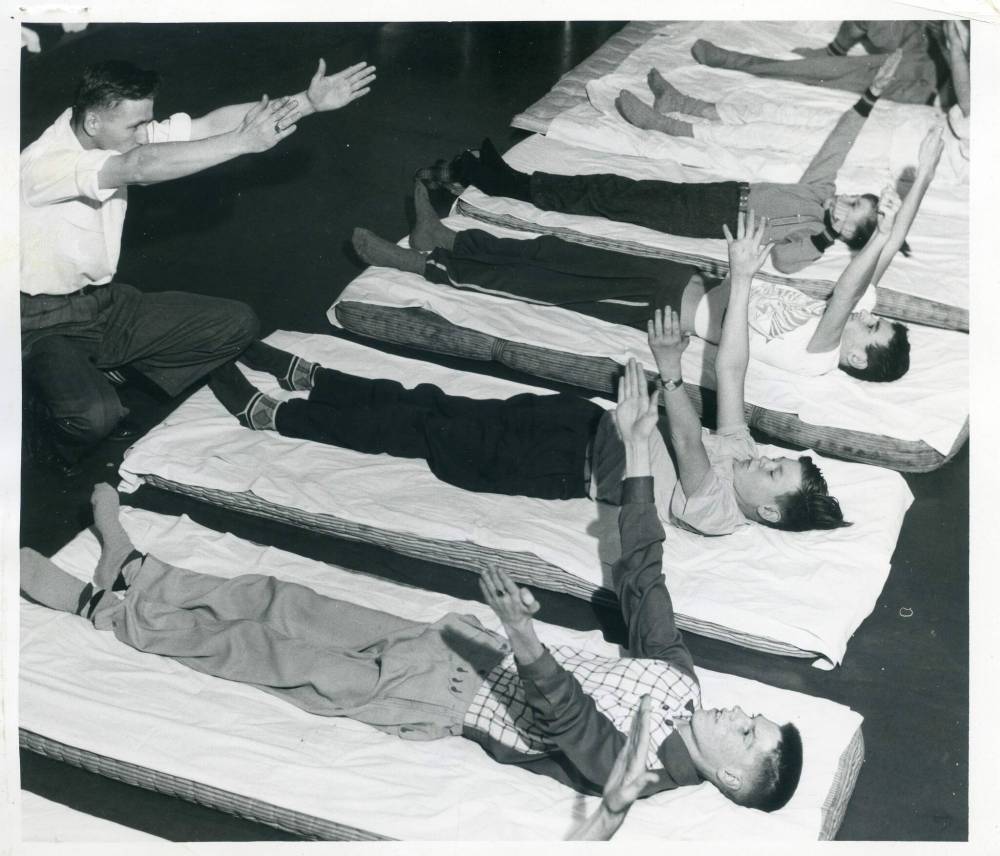
Polio patients in 1953. Between 1928 and 1953, polio epidemics occurred in Manitoba every three to five years. The vast majority of children recovered, yet many experienced lifelong disabilities from the disease.
Polio usually spread in the summer. On July 9, 1947, Chown, who was then the head of the pediatrics department, was calm when he was interviewed by a Free Press reporter. He told the journalist that he expected a “normal year,” emphasizing that there had been up to that point only one case of polio in the province that had been reported in Brandon.
Before the end of the month, however, the situation had become worse: on July 29, Ivan Schultz, the provincial minister of health and public welfare, reported that there were now 39 cases and two deaths, a boy and girl, both 14 years old.
By the end of August, the total had increased to 332 cases, and a month later, the number had reached 551. Schultz and doctors in Winnipeg predicted the worst was over, and they were correct.
The 1947 epidemic took its toll on Manitoba families and on everyone connected with the Children’s Hospital. During the summer, about one-third of the hospital’s capacity was being utilized for polio patients, many of whom required an iron lung.
In order to determine a polio diagnosis, physicians and nurses had to perform a painful spinal tap, or lumbar puncture, to obtain fluid that could be tested; in those months, 20 spinal taps were often done in a day.
By then, children who did have polio were treated hourly with hot packs, which was believed to act as a muscle relaxant and ease a child’s suffering. This was a controversial treatment, passionately advocated by Sister Elizabeth Kenny, an Australian physical therapist (she falsely claimed she was a trained nurse) who received much attention in the press during the 1930s and 1940s.
She was spurned by most members of the medical establishment, who firmly maintained that polio patients should remain immobile. Still, the hot packs seemed to make the children feel better, and more and more doctors were willing to follow her advice.
While she was temporarily working in Minneapolis, Bruce Chown and Alf Deacon, an orthopedic surgeon who had polio as a child, arranged for Sister Kenny to visit Children’s Hospital. Harry Medovy (who succeeded Chown as department head in 1954), for one, was impressed.
“I was present at the ward rounds she conducted… and it was difficult not to be persuaded by this energetic woman,” he recalled.
Like most everyone else in North America and other parts of the world, the members of the department celebrated the research, massive field trials, and ultimate success of Dr. Jonas Salk. A virologist at the University of Pittsburgh, Salk and his team developed a viable inactivated vaccine, which was proclaimed safe and ready to inject on April 12, 1955.

Almost overnight, Salk, somewhat publicity shy, became one of the most famous people in world. Officials at Children’s Hospital in Winnipeg sent him a 208-foot telegram of congratulations with the name of each survivor of the 1953 epidemic on it.
Six years later, and following much research and testing, Salk’s chief rival, Dr. Albert Sabin, head of pediatric research at the University of Cincinnati, created a live-attenuated oral vaccine that eventually proved as or more effective than the Salk vaccine.
In September 1962, there was a temporary halt in giving the Sabin vaccine in Canada for a few months, when four children who received it allegedly became ill with polio. Winnipeg doctors did not report any problems with the vaccine, though they, too, were caught up in a dispute over which of the vaccines, Salk or Sabin, was the more effective one.
Sabin’s vaccine was put on sugar cubes to mask its bitter taste, and young children during the early 1960s and after (the author included) were herded into school gymnasiums, lined up, and fed a sugar cube with the vaccine.
It was easy, painless, and helped nearly eradicate polio in Manitoba and elsewhere.