

‘Historic milestone’ as city, union agree to arbitration if negotiations stall
Workers have been without contract since February 2025

Advertisement
Read this article for free:
or
Already have an account? Log in here »
To continue reading, please subscribe:

Digital Subscription
One year of digital access for only $205*
- Enjoy unlimited reading on winnipegfreepress.com
- Read the E-Edition, our digital replica newspaper
- Access News Break, our award-winning app
- Play interactive puzzles
*First annual payment billed as $205.00 + GST for one year. This annual subscription will automatically renew at $233.00 + GST every 52 weeks (10% off the regular annual price of $259.35). Offer available to new and qualified returning subscribers only. Cancel any time.
To continue reading, please subscribe:
Add Free Press access to your Brandon Sun subscription for only an additional
$1 for the first 4 weeks*
- Enjoy unlimited reading on winnipegfreepress.com
- Read the E-Edition, our digital replica newspaper
- Access News Break, our award-winning app
- Play interactive puzzles
*Your next Brandon Sun subscription payment will increase by $1.00 and you will be charged $17.95 plus GST for four weeks. After four weeks, your payment will increase to $24.95 plus GST every four weeks.
Read unlimited articles for free today:
or
Already have an account? Log in here »
The City of Winnipeg and its largest union will give an arbitrator the final say on their next collective agreement, if negotiations don’t produce a deal.
The arrangement rules out a strike or lockout, but only for the current round of bargaining, amid some concern the binding process could result in a deal that costs the city more.
In a bargaining update posted online, the Canadian Union of Public Employees Local 500 calls the one-time agreement a “historic milestone” and “major breakthrough.”
MIKAELA MACKENZIE / FREE PRESS FILES
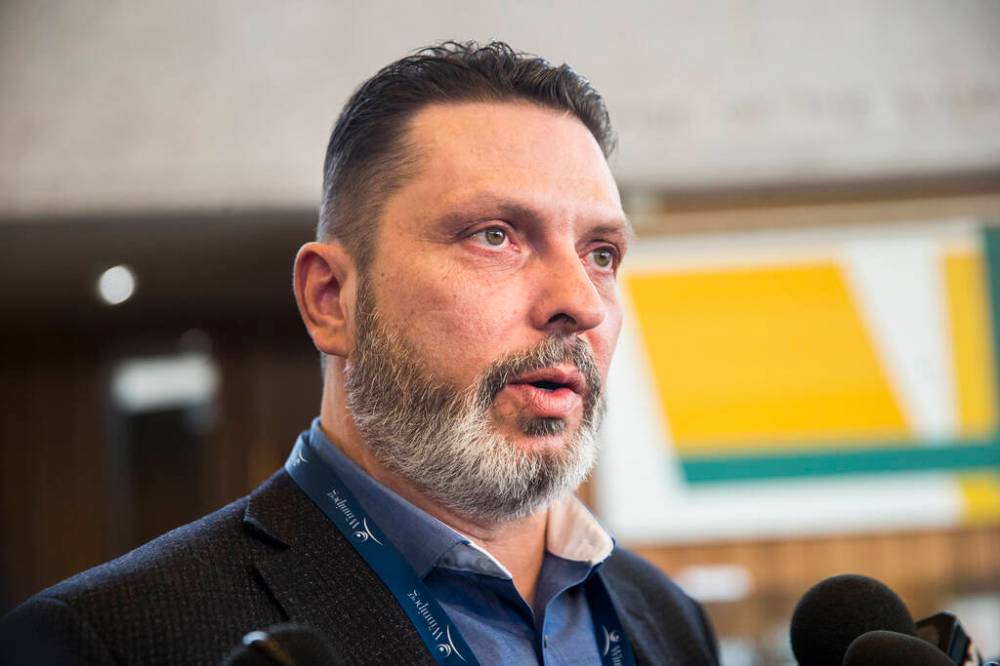
Gord Delbridge, president of the CUPE Local 500, says the deal is a win for Winnipeggers.
“Most importantly, this process means there will be no strike and no lockout during this round of bargaining. Members will continue to provide services to the public while receiving their regular wages and benefits,” the post states.
Gord Delbridge, CUPE local 500’s president, said he believes the deal brings substantial benefits for the city, its residents and union members.
“It’s a win for Winnipeggers, (who won’t see) services lost … if a strike were to occur. It’s a win for our members, knowing they don’t have to be out on a picket line and they can immediately go to arbitration in the event we can’t work out a deal,” said Delbridge. “Our members have been without a wage increase for about 1.5 years now and they most certainly deserve to see a wage increase sooner than later.”
The union represents about 5,000 city staff, including some 911 operators, as well as employees at water and waste, pools, libraries, 311, public works and more.
The union’s last contract with the city expired in February 2025.
Delbridge declined to state the average wage hike CUPE will seek, while suggesting arbitration could help ensure a fair deal.
“I do believe arbitrators have a tendency to be fair and take all aspects into consideration, such as a rate of inflation and (consumer price index),” he said.
Delbridge said negotiations with the city have already been productive, though some sticking points remain.
Coun. Brian Mayes, who previously worked as a labour lawyer, agreed avoiding job disruptions would help ensure city services aren’t interrupted by a labour dispute.
However, the St. Vital councillor noted city officials have often aimed to avoid arbitrated agreements in the past, over fears they could cost millions of dollars more to implement than negotiated deals.
“The cost implications, that’s out of your hands. You’re arguing it in front of a third party … The risk is you might get an award where you’re giving a much bigger wage increase than you planned,” said Mayes.
He said he was also “a bit surprised” municipal and CUPE leaders agreed to the deal, suggesting a strike before Winnipeg’s Oct. 28 election might have appeared “a pretty powerful” option for the union.
Mayes said arbitration is not expected to begin before November.
The decision also removes the need for the city and union to complete an essential services agreement during this round of collective bargaining (since the risk of job disruption is removed).
The two sides have been trying to hammer those rules out since the spring of 2025, after the province approved legislation that requires critical services to be maintained during a strike or lockout. Specifically, employers and unions are required to ensure some essential service workers can continue doing their jobs during any labour action, to avoid disruptions that could create health, safety or environmental risks.
The lack of an essential services agreement between the city and CUPE sparked concerns in October 2022, when the union came within a few hours of a strike with no agreement to keep critical services in place.
At the time, multiple sources feared the absence of municipal employees would increase the risk of sewage spills, boil-water advisories and delays in answering emergency calls.
A tentative labour deal alleviated that risk about four hours before that strike deadline.

A request to speak with Mayor Scott Gillingham about the arbitration agreement was not granted Monday.
In a brief written statement, the mayor said he’s pleased “both parties have agreed on a process that keeps services running for Winnipeggers and avoids the disruption of a strike or job action.”
A request to interview city labour officials was also not granted. In a statement, spokeswoman Julie Dooley said “significant progress” has been made in the negotiations so far.
joyanne.pursaga@freepress.mb.ca
X: @joyanne_pursaga
Joyanne is city hall reporter for the Winnipeg Free Press. A reporter since 2004, she began covering politics exclusively in 2012, writing on city hall and the Manitoba Legislature for the Winnipeg Sun before joining the Free Press in early 2020. Read more about Joyanne.
Every piece of reporting Joyanne produces is reviewed by an editing team before it is posted online or published in print — part of the Free Press‘s tradition, since 1872, of producing reliable independent journalism. Read more about Free Press’s history and mandate, and learn how our newsroom operates.
Our newsroom depends on a growing audience of readers to power our journalism. If you are not a paid reader, please consider becoming a subscriber.
Our newsroom depends on its audience of readers to power our journalism. Thank you for your support.
Joyanne is city hall reporter for the Winnipeg Free Press. A reporter since 2004, she began covering politics exclusively in 2012, writing on city hall and the Manitoba Legislature for the Winnipeg Sun before joining the Free Press in early 2020. Read more about Joyanne.
Every piece of reporting Joyanne produces is reviewed by an editing team before it is posted online or published in print — part of the Free Press‘s tradition, since 1872, of producing reliable independent journalism. Read more about Free Press’s history and mandate, and learn how our newsroom operates.
Our newsroom depends on a growing audience of readers to power our journalism. If you are not a paid reader, please consider becoming a subscriber.
Our newsroom depends on its audience of readers to power our journalism. Thank you for your support.
Related Articles
CUPE leader Delbridge dies
Advertisement Advertise With Us
Advertisement Advertise With Us