

Rubio arrives in UAE with aim to head off Gulf Arab unease over tentative Iran deal
Advertisement
Read this article for free:
or
Already have an account? Log in here »
To continue reading, please subscribe:

Digital Subscription
One year of digital access for only $205*
- Enjoy unlimited reading on winnipegfreepress.com
- Read the E-Edition, our digital replica newspaper
- Access News Break, our award-winning app
- Play interactive puzzles
*First annual payment billed as $205.00 + GST for one year. This annual subscription will automatically renew at $233.00 + GST every 52 weeks (10% off the regular annual price of $259.35). Offer available to new and qualified returning subscribers only. Cancel any time.
To continue reading, please subscribe:
Add Free Press access to your Brandon Sun subscription for only an additional
$1 for the first 4 weeks*
- Enjoy unlimited reading on winnipegfreepress.com
- Read the E-Edition, our digital replica newspaper
- Access News Break, our award-winning app
- Play interactive puzzles
*Your next Brandon Sun subscription payment will increase by $1.00 and you will be charged $17.95 plus GST for four weeks. After four weeks, your payment will increase to $24.95 plus GST every four weeks.
Read unlimited articles for free today:
or
Already have an account? Log in here »
ABU DHABI, United Arab Emirates (AP) — U.S. Secretary of State Marco Rubio is in the United Arab Emirates on the first leg of a three-nation tour of Gulf countries aimed at easing their concerns about the result of an agreement intended to end the war with Iran.
Rubio arrived in Abu Dhabi late Tuesday following a two-day flurry of diplomatic activity between the U.S. and Iran in Switzerland led by Vice President JD Vance that resulted in what Vance says is a significant agreement to end all hostilities in the region, reopen the Strait of Hormuz and provide sanctions relief with negotiations on its nuclear program to be concluded in 60 days.
In the UAE, Kuwait and Bahrain — all nations that Iran hit with missiles and drones in retaliation for U.S.-Israeli airstrikes — Rubio will be holding meetings starting Wednesday with leaders who, in some cases, have taken a harder line on Iran recently than has the Trump administration.
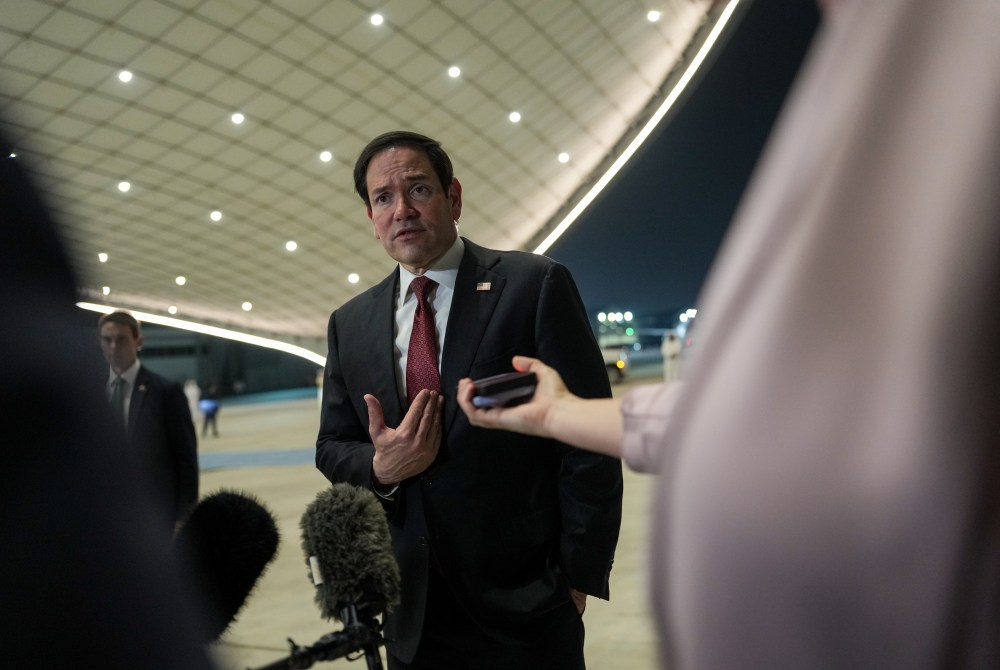
In brief comments to reporters on his arrival, Rubio said he would explain the benefits of the agreement to the skeptical Gulf states if it is implemented. He said that a proposed $300 billion investment fund for Iran would not become a reality unless “its leadership makes a decision that they want to be a country instead of a revolutionary movement that exports terror.”
Another complaint is that the agreement does not cover Iran’s missile program, its support for proxies and pushes off the nuclear question until later.
Rubio argued, however, that the memorandum of understanding signed last week calls for the “complete end of hostilities and conflicts in the region,” which he said will require Iran to halt its funding of proxies like Hamas in Gaza, Hezbollah in Lebanon and the Houthis in Yemen.
“You can’t have the end of hostilities and conflicts in a region as long as Iranian proxies are launching missiles and drones from Iraq, and are participating in terrorism, like Hamas did, and like Hezbollah did,” Rubio said. “So, I do think it’s covered by the MOU, and it is an issue that will be gotten to at the appropriate time in these negotiations.”
The Emiratis, in particular, have been at the forefront of calls for tough action notably to ensure the reopening of the Strait of Hormuz. There have been conflicting accounts of what the Memorandum of Understanding signed last week will mean for the strait, which the rest of the world wants open free of charge for all shipping.
The U.S. has been firm on that point, but the Iranians are moving ahead with a scheme that could charge service fees for passage that many believe would amount to a toll. Rubio said under no circumstances would the U.S. accept that.
“It’s an international waterway,” he said. “No country is allowed to charge tolls or fees on an international waterway. That’s existing international law. That’s the way it is.”
“I don’t think we have anybody to convince around here in that regard. I think all the countries in this region would agree with us,” he said.