

City crosses out scramble crossing

Advertisement
Read this article for free:
or
Already have an account? Log in here »
To continue reading, please subscribe:

Digital Subscription
One year of digital access for only $205*
- Enjoy unlimited reading on winnipegfreepress.com
- Read the E-Edition, our digital replica newspaper
- Access News Break, our award-winning app
- Play interactive puzzles
*First annual payment billed as $205.00 + GST for one year. This annual subscription will automatically renew at $233.00 + GST every 52 weeks (10% off the regular annual price of $259.35). Offer available to new and qualified returning subscribers only. Cancel any time.
To continue reading, please subscribe:
Add Free Press access to your Brandon Sun subscription for only an additional
$1 for the first 4 weeks*
- Enjoy unlimited reading on winnipegfreepress.com
- Read the E-Edition, our digital replica newspaper
- Access News Break, our award-winning app
- Play interactive puzzles
*Your next Brandon Sun subscription payment will increase by $1.00 and you will be charged $17.95 plus GST for four weeks. After four weeks, your payment will increase to $24.95 plus GST every four weeks.
Read unlimited articles for free today:
or
Already have an account? Log in here »
Winnipeg’s experiment with a pedestrian scramble crossing is coming to an end.
In June 2025, the city began a pedestrian scramble pilot project, which gave all motor vehicles a red light to let pedestrians cross the street in both directions at the same time at one intersection. While some scrambles also let pedestrians cross diagonally, Winnipeg’s did not.
The test of the intersection at King Street and Bannatyne Avenue will soon end, however, and return signals to standard operations, a city report notes.
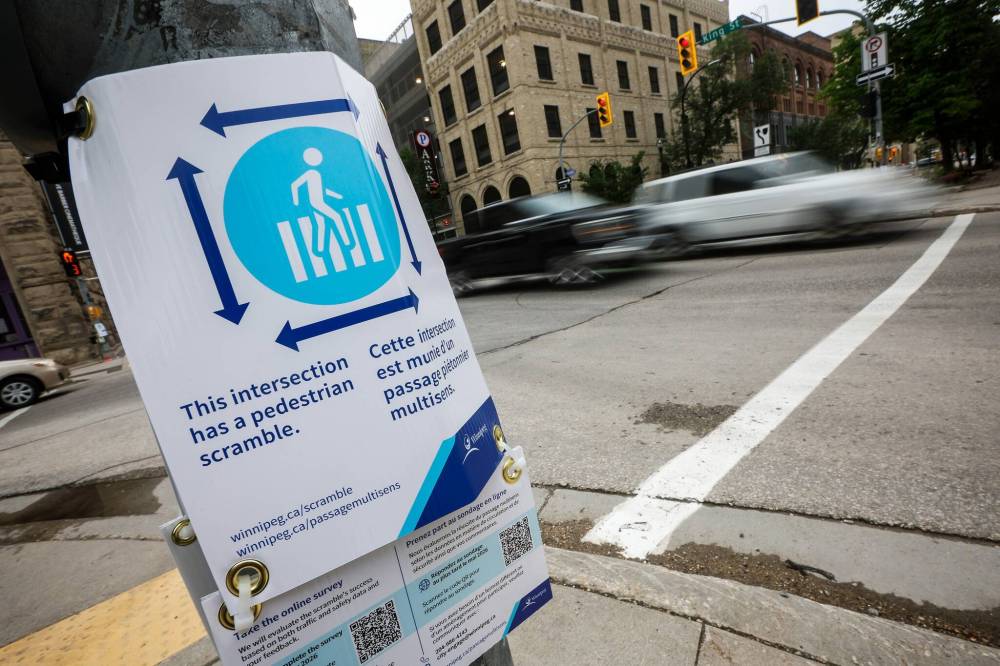
JOHN WOODS / FREE PRESS FILES
The city began a pedestrian scramble pilot project at the intersection of King Street and Bannatyne Avenue last year, but the project won’t go forward.
“It was only moderately effective at this location because it was not used often enough. Pedestrian scrambles work best in places with much higher pedestrian traffic,” a city report notes.
No other pedestrian scrambles, which aim to improve pedestrian safety, are planned at this point.
Coun. Janice Lukes, chairwoman of public works, said it makes sense to move on from the idea for now.
“There is no intersection in the City of Winnipeg that would optimize what a pedestrian scramble is meant to do. When you’ve got a city with a population far greater than Winnipeg, they work,” said Lukes (Waverley West). “There’s no intersection in Winnipeg that has 2,000 people an hour and that’s what pedestrian scrambles are supposed to support.”
The intersection in question had about 2,000 pedestrians over 12 hours during the study.

The city report notes using pedestrian scrambles at intersections without very high pedestrian traffic can “increase delay for all users, reduce compliance, and limit the intended safety benefits.”
While the report found some pedestrians felt safer with the scramble, others felt the intersection had been safe prior to the pilot project.
City staff also found the intersection had a good safety record before the pilot, noting it had only one pedestrian collision in the last 10 years.
joyanne.pursaga@freepress.mb.ca
X: @joyanne_pursaga
Joyanne is city hall reporter for the Winnipeg Free Press. A reporter since 2004, she began covering politics exclusively in 2012, writing on city hall and the Manitoba Legislature for the Winnipeg Sun before joining the Free Press in early 2020. Read more about Joyanne.
Every piece of reporting Joyanne produces is reviewed by an editing team before it is posted online or published in print — part of the Free Press‘s tradition, since 1872, of producing reliable independent journalism. Read more about Free Press’s history and mandate, and learn how our newsroom operates.
Our newsroom depends on a growing audience of readers to power our journalism. If you are not a paid reader, please consider becoming a subscriber.
Our newsroom depends on its audience of readers to power our journalism. Thank you for your support.
Joyanne is city hall reporter for the Winnipeg Free Press. A reporter since 2004, she began covering politics exclusively in 2012, writing on city hall and the Manitoba Legislature for the Winnipeg Sun before joining the Free Press in early 2020. Read more about Joyanne.
Every piece of reporting Joyanne produces is reviewed by an editing team before it is posted online or published in print — part of the Free Press‘s tradition, since 1872, of producing reliable independent journalism. Read more about Free Press’s history and mandate, and learn how our newsroom operates.
Our newsroom depends on a growing audience of readers to power our journalism. If you are not a paid reader, please consider becoming a subscriber.
Our newsroom depends on its audience of readers to power our journalism. Thank you for your support.
Related Articles
After 12 years at city hall, Lukes hangs up her hat
Advertisement Advertise With Us
Advertisement Advertise With Us