When a rip current sucks you out to sea, try not to panic

Advertisement

Advertise with us

SAN DIEGO (AP) — To someone who is getting sucked out to sea by a rip current, “Don’t panic!” may be difficult to heed, even if that’s exactly what you should do. But lifeguards say to not only relax but flip over and float out of the danger.

Read this article for free:


or

Already have an account? Log in here »

To continue reading, please subscribe:

Subscribe and receive a limited-edition Free Press branded hat or tote.

Digital Subscription

One year of digital access for only $205*

  • Enjoy unlimited reading on winnipegfreepress.com
  • Read the E-Edition, our digital replica newspaper
  • Access News Break, our award-winning app
  • Play interactive puzzles

*First annual payment billed as $205.00 + GST for one year. This annual subscription will automatically renew at $233.00 + GST every 52 weeks (10% off the regular annual price of $259.35). Offer available to new and qualified returning subscribers only. Cancel any time.

To continue reading, please subscribe:

Add Free Press access to your Brandon Sun subscription for only an additional

$1 for the first 4 weeks*

  • Enjoy unlimited reading on winnipegfreepress.com
  • Read the E-Edition, our digital replica newspaper
  • Access News Break, our award-winning app
  • Play interactive puzzles
Start now

*Your next Brandon Sun subscription payment will increase by $1.00 and you will be charged $17.95 plus GST for four weeks. After four weeks, your payment will increase to $24.95 plus GST every four weeks.

SAN DIEGO (AP) — To someone who is getting sucked out to sea by a rip current, “Don’t panic!” may be difficult to heed, even if that’s exactly what you should do. But lifeguards say to not only relax but flip over and float out of the danger.

Rip currents are one of the coast’s greatest dangers and account for the most beach rescues every year. About 100 people drown from rip currents along U.S. beaches each year, according to the United States Lifesaving Association. And more than 80% of beach rescues annually involve rip currents.

Already this year, there have been at least 21 people killed from rip currents in U.S. waters, according to the National Weather Service.
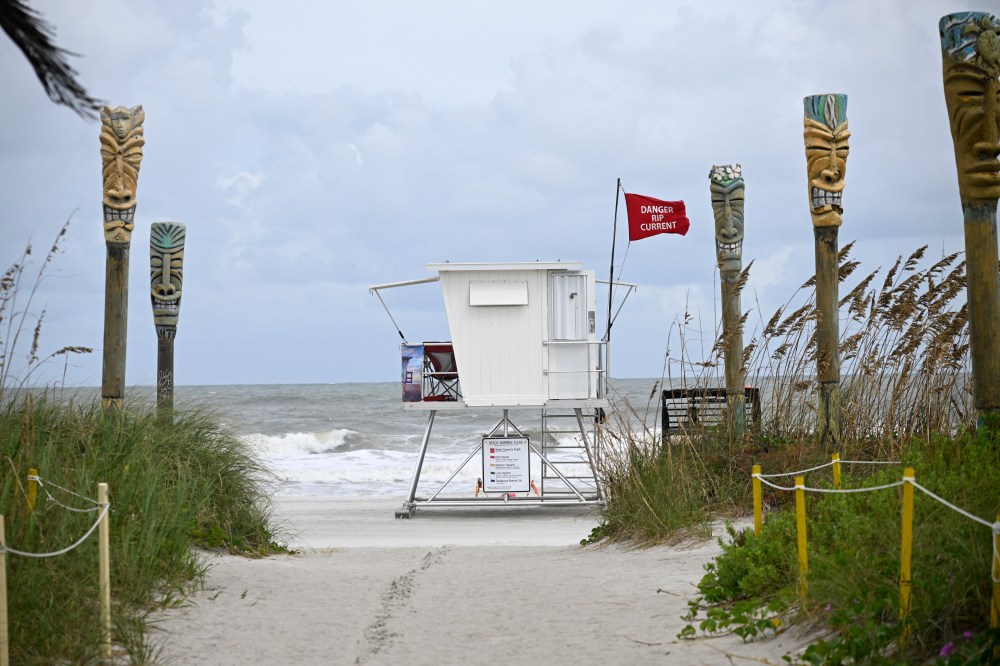
FILE - A
FILE - A "Danger Rip Current" flag flies as Tropical Storm Imelda passes offshore Sept. 29, 2025, in Cocoa Beach, Fla. (AP Photo/Phelan M. Ebenhack, File)

Here are some things to know about rip currents:

Rip currents can be hard to spot

Rip currents are narrow columns of water flowing rapidly away from the beach. They don’t pull swimmers under water, but can carry them out a fair distance from shore.

“A rip current is like a river that pulls out to sea,” said San Diego Lifeguard Marine Safety Lt. Charlie Knight. “So when the waves come into the beach, it needs somewhere to go. And so it takes these little channels out that we call rip currents to put all that water back into the ocean.”

Low spots along the beach, or areas near jetties or piers, are often where rip currents form. They can be connected to stormy weather but also sometimes occur during sunny days. They can be hard to detect because the surface water often appears calm.

The current can flow as fast as 8 feet (3.2 meters) per second, faster than even a strong swimmer can overcome, according to the National Oceanic and Atmospheric Administration.

It’s nearly impossible to fight rip currents

The most frequent advice from beach rescue teams and weather forecasters is to “’flip, float and follow.” Flipping over to float makes it easier to stay calm, conserves energy and keeps the airways open while the swimmer is in the rip current’s grip.

It’s nearly impossible to fight the current directly. Many swimmers who get in trouble tire themselves out trying to get back to the beach, lifeguards say.

“People tend to panic when they can’t get into the beach, and that’s when we have problems,” Knight said. “So if you are caught in a rip current, the biggest thing is don’t panic, stay calm, flip over onto your back, float and allow the rip current to take you out.”

Once the rip current dissipates, it might leave the swimmer out in deeper water. Lifeguards recommend raising an arm to signal for help.

Look for flags warning of rip current conditions

Flags with different colors are used to warn beachgoers of various hazards.

Red means a high hazard, yellow means a moderate threat and green means low danger. There’s also purple for dangerous sea life, such as jellyfish, and double red when a beach is closed for any reason.

The National Weather Service posts rip current risks on its websites around the coasts and has developed a computer model that can predict when conditions exist that may lead to their formation up to six days in advance for the U.S. East and Gulf Coasts, Puerto Rico, Hawaii and Guam.

If possible, it’s best to swim near a lifeguard station.

What to do when swimmer is spotted in a rip current

It can be dangerous to try to rescue someone caught in a rip current, officials say. Often the people trying to perform the rescue can get into trouble themselves.

It’s best to find a lifeguard, if there is one, or call 911 if a struggling swimmer is spotted.

___

The Associated Press Health and Science Department receives support from the Howard Hughes Medical Institute’s Department of Science Education and the Robert Wood Johnson Foundation. The AP is solely responsible for all content.
Report Error Submit a Tip

More Stories

What's Up: Brew at the Zoo, Neighbour x Neighbour fest, Fiver, Exploration of Contentment, Mangofest

5 minute read Preview

What's Up: Brew at the Zoo, Neighbour x Neighbour fest, Fiver, Exploration of Contentment, Mangofest

5 minute read Updated: 9:53 AM CDT

Brew at the ZooAssiniboine Park Zoo, 2595 Roblin Ave.Friday, 7-10 p.m.Tickets $68 hereIn July, Winnipeg beer drinkers flocked to Blue Cross Park for the return of Ballpark Brewfest; in August, they convened at Le Patio 340 for the Winnipeg Beer Festival.

And on Friday, lager lovers and hop heads will descend on the Assiniboine Park Zoo for the annual Brew at the Zoo, which sees local breweries pouring their wares alongside a range of national and international products. (Note: the zoo proper is not open to Brew at the Zoo guests.)

Among the locals taking part at this year’s Brew at the Zoo are Kilter Brewing Co., Heritage Farms Brewing Co., Dastardly Villain Ale Works, One Great City Brewing Co. and Barn Hammer Brewing Co. Locals pouring non-beer options include Brat Cat Mead Co., Shrugging Doctor Beverage Company and Patent 5 Distillery.

Brew at the Zoo, then, offers much more than beer, with a range of ready-to-drink cocktails, coolers, cider, wine and spirits being poured throughout the event; non-alcoholic options include kombucha and non-alcoholic beer.

Read
Updated: 9:53 AM CDT

Supportive housing operator sued after man with dementia walks away

Erik Pindera 4 minute read Preview

Supportive housing operator sued after man with dementia walks away

Erik Pindera 4 minute read 6:00 AM CDT

The Public Guardian and Trustee of Manitoba is suing a health services company after a man with dementia under its care allegedly wandered away from an apartment it operates for vulnerable people and was later found face down in a puddle — unresponsive, hypothermic and severely injured.

The public trustee — a provincial government agency that, among other duties, makes financial and personal care decisions for vulnerable adults who cannot do so themselves — filed the lawsuit against Cambridge Health Inc. and a related numbered company in the Court of King’s Bench earlier this month.

The agency did so on behalf of a now-38-year-old man, who has been under its care since 2018, as a result of his frontotemporal dementia. The disease often starts in mid-life, rather than old age, as is the case with most other forms of dementia.

The lawsuit alleges the man, who resided at a Henderson Highway apartment complex where Cambridge Health operated a supportive residence for people with complex behavioural health issues, was in a common area of the home at about 4:30 p.m. on April 3 last year.

Read
6:00 AM CDT

South Winnipeg neighbourhood will be first to go geothermal

Chris Kitching 4 minute read Preview

South Winnipeg neighbourhood will be first to go geothermal

Chris Kitching 4 minute read Updated: Yesterday at 7:28 PM CDT

A new neighbourhood in south Winnipeg will be Manitoba’s first to use a shared, large-scale geothermal system to heat and cool hundreds of homes over coming decades.

The province is giving up to $4 million to the developers of Southwood Circle, just north of the University of Manitoba’s Fort Garry campus, for a district geothermal system as part of the NDP’s goal to reach net-zero greenhouse gas emissions by 2050.

“It means a whole neighbourhood can tap into geothermal, which means low-carbon heating and cooling for at least 1,000 homes,” Premier Wab Kinew said at a news conference Wednesday.

Geothermal systems, equipped with pumps and pipes, use underground temperatures to heat and cool one or more buildings. Proponents point to long-term energy and cost savings compared with conventional heating and cooling systems.

Read
Updated: Yesterday at 7:28 PM CDT

Puzzles Palace

1 minute read Monday, Jul. 27, 2026

To solve our puzzles, please subscribe with this special offer: |

Manitoba gains doctors for third straight year, but loses at pandemic-level rate: report

Scott Billeck 5 minute read Preview

Manitoba gains doctors for third straight year, but loses at pandemic-level rate: report

Scott Billeck 5 minute read Updated: Yesterday at 7:44 PM CDT

Manitoba is adding doctors at a record clip — but it’s also losing them at a rate not seen since the depths of the COVID-19 pandemic, a physicians advocacy organization cautioned Wednesday.

Read
Updated: Yesterday at 7:44 PM CDT

The plane truth about a dangerous president

Editorial 4 minute read Preview

The plane truth about a dangerous president

Editorial 4 minute read 2:01 AM CDT

U.S. President Donald Trump has crossed firmly into cutting-off-your-nose-to-spite-your-face territory.

Read
2:01 AM CDT