

Why do we consult?

Advertisement
Read this article for free:
or
Already have an account? Log in here »
To continue reading, please subscribe:
Digital Subscription
One year of digital access for only $1.44 a week*
- Enjoy unlimited reading on winnipegfreepress.com
- Read the E-Edition, our digital replica newspaper
- Access News Break, our award-winning app
- Play interactive puzzles
*Billed as $5.77 plus GST every four weeks. After 52 weeks, price increases to the regular rate of $19.95 plus GST every four weeks. Offer available to new and qualified returning subscribers only. Cancel any time.
To continue reading, please subscribe:
Add Free Press access to your Brandon Sun subscription for only an additional
$1 for the first 4 weeks*
- Enjoy unlimited reading on winnipegfreepress.com
- Read the E-Edition, our digital replica newspaper
- Access News Break, our award-winning app
- Play interactive puzzles
*Your next Brandon Sun subscription payment will increase by $1.00 and you will be charged $17.95 plus GST for four weeks. After four weeks, your payment will increase to $24.95 plus GST every four weeks.
Read unlimited articles for free today:
or
Already have an account? Log in here »
Over the past several months, I have found myself using two phrases with increasing frequency: community consultation and stakeholder engagement.
I have used them in meetings, proposals and discussions about the future of Holy Trinity Church in downtown Winnipeg. Some people nod in agreement. Others wonder whether these are simply consultant buzzwords.
Which raises a question: What do we actually mean when we talk about community consultation and stakeholder engagement?
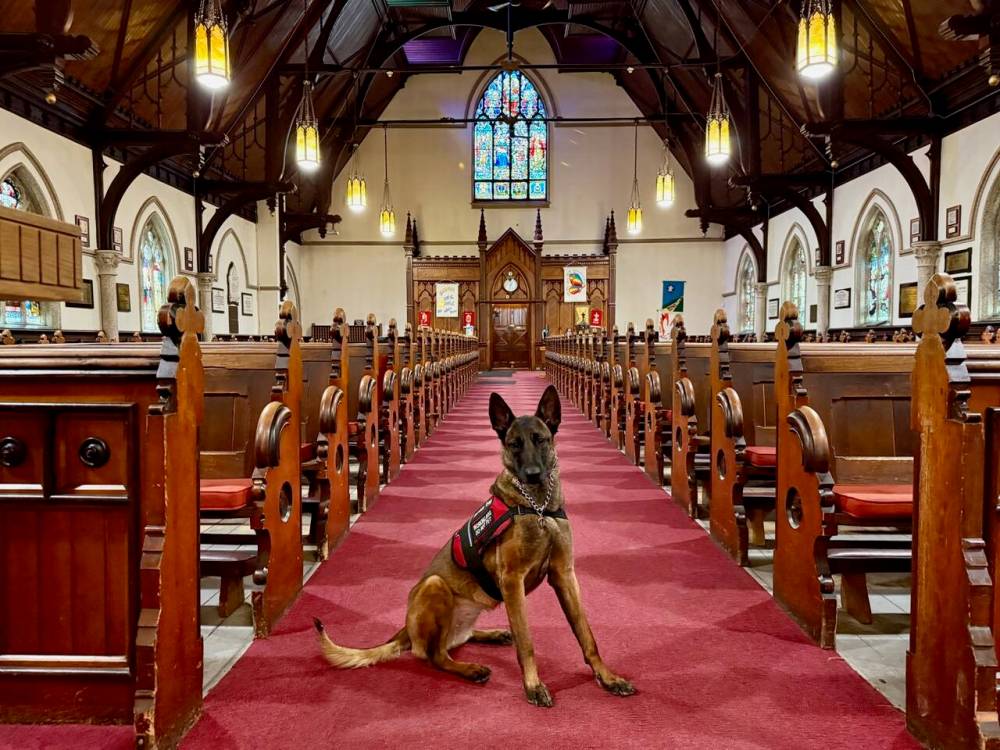
STEPHEN BORYS PHOTO
Bliss watches over the sanctuary of Holy Trinity Church.
The question feels especially timely because Holy Trinity Church is about to begin one of the most significant listening and engagement processes in its recent history — one that could help shape its future role in downtown Winnipeg for years to come. Over the coming months, parishioners, community organizations, downtown stakeholders, heritage advocates, businesses, governments and potential partners will be invited into that conversation.
The question has also been on my mind while spending time at Holy Trinity, where I serve as building project manager for the redevelopment initiative. Sometimes accompanying me is Bliss, a young Belgian malinois and recent addition to our family. As a service dog, she has joined me in my office at Holy Trinity on a few occasions.
Admittedly, if you asked Bliss to define community consultation, she would probably offer a simple explanation: find something interesting, investigate it thoroughly, meet everyone nearby, and only then decide what to do next.
Come to think of it, that’s not a bad definition of consulting.
While I am often focused on meetings and reports, Bliss approaches the church differently. Watching her explore the building, I sometimes think she sets out the way a good consultant considers a new project: assume nothing, investigate everything and never ignore something that seems out of place.
Perhaps that is where meaningful listening begins.
At its worst, consultation can feel like a box to check, a requirement to satisfy funders or a process undertaken after key decisions have already been made. Many people have attended public meetings or completed surveys only to leave wondering whether anyone was truly listening. That skepticism is understandable.
But genuine engagement is something very different.
It is not about confirming what we already believe, validating predetermined decisions or producing a report that sits on a shelf. At its best, this work is an act of curiosity, humility and openness. It begins with recognizing that no individual, board, consultant, architect, rector or funding agency possesses all the answers.
The future is not something we design alone. It is something we build together.
The most valuable outcome is not consensus. It is clarity.
Some people question whether all this engagement is necessary. Others assume the answers are already obvious and that further discussion simply delays action.
Bliss approaches every room as though there is something new to discover. Humans often walk into situations convinced they already know the answers.
The process asks us to do the opposite.
The work challenges assumptions and often reveals opportunities that might otherwise remain unseen.
Stakeholder engagement is often mistaken for a technical exercise. In reality it’s about relationships.
A place of worship does not belong only to its congregation. A museum does not belong only to its members or board. A community organization does not belong only to its leadership. Each exists within a larger network of people and communities whose lives intersect with its work.
Many people assume the church is closed. It isn’t.
Worship services continue. Music fills the sanctuary. Community groups use the building. Meals are prepared and served each week. Volunteers care for the property. Yet Holy Trinity stands at a crossroads, facing questions about sustainability, relevance, partnerships, programming and the role it can play in a changing downtown.
Those questions deserve more than quick answers. They deserve conversation.
This work would not be possible without the support of CentreVenture, whose mandate is to foster development, partnerships and investment in downtown Winnipeg. For more than two decades, CentreVenture has helped bring together public, private and community partners to strengthen the downtown core. Their support of Holy Trinity recognizes that the future of individual buildings and organizations is inseparable from the future of downtown itself.
Over the coming months, we will meet with parishioners, neighbours, government representatives, businesses, social service agencies and developers. Through interviews, public forums and community gatherings, we will ask: What role should Holy Trinity play in the future of downtown Winnipeg?
That is why Holy Trinity, with the support of CentreVenture, the Anglican Foundation of Canada, the Diocese of Rupert’s Land, the parish itself and Civic Muse, is launching a broad community listening and engagement process grounded in a simple belief: the strongest futures are built with communities, not merely for them.
Not because a grant application required it. Not because a consultant recommended it. But because important questions remain unanswered.
How can Holy Trinity’s spaces better serve the community? What partnerships should be explored? What needs exist that the church might help address?
No consultant, parish council, bishop, architect or funding agency can answer those questions alone.
The answers will emerge from the collective wisdom, experience and aspirations of the community itself.

The best engagement processes build relationships, create trust, uncover opportunities and help communities see themselves more clearly. At its heart, this work is about listening, learning, and imagining what might be possible.
As Holy Trinity begins this work, I find myself appreciating curiosity a little more. Good engagement begins not with answers, but with questions — and with the humility to admit that no one person has all of them. Watching Bliss explore the church, I am reminded how much can be discovered simply by paying attention.
Perhaps that is what community consultation and stakeholder engagement are really about. Not checking a box, completing a task or fulfilling a requirement, but asking questions with enough honesty and creativity that the answers can help shape a better future.
After all, we ask questions not because we are lost, but because we are trying to find a better way forward.
Stephen Borys is president and CEO of Civic Muse, an arts and cultural consulting practice based in Winnipeg.
Our newsroom depends on a growing audience of readers to power our journalism. If you are not a paid reader, please consider becoming a subscriber.
Our newsroom depends on its audience of readers to power our journalism. Thank you for your support.
Our newsroom depends on a growing audience of readers to power our journalism. If you are not a paid reader, please consider becoming a subscriber.
Our newsroom depends on its audience of readers to power our journalism. Thank you for your support.
Advertisement Advertise With Us
Advertisement Advertise With Us