How Toronto-area innovators are helping a deafblind woman summit Mount Everest
Advertisement
Read this article for free:
or
Already have an account? Log in here »
To continue reading, please subscribe:

Digital Subscription
One year of digital access for only $205*
- Enjoy unlimited reading on winnipegfreepress.com
- Read the E-Edition, our digital replica newspaper
- Access News Break, our award-winning app
- Play interactive puzzles
*First annual payment billed as $205.00 + GST for one year. This annual subscription will automatically renew at $233.00 + GST every 52 weeks (10% off the regular annual price of $259.35). Offer available to new and qualified returning subscribers only. Cancel any time.
To continue reading, please subscribe:
Add Free Press access to your Brandon Sun subscription for only an additional
$1 for the first 4 weeks*
- Enjoy unlimited reading on winnipegfreepress.com
- Read the E-Edition, our digital replica newspaper
- Access News Break, our award-winning app
- Play interactive puzzles
*Your next Brandon Sun subscription payment will increase by $1.00 and you will be charged $17.95 plus GST for four weeks. After four weeks, your payment will increase to $24.95 plus GST every four weeks.
Read unlimited articles for free today:
or
Already have an account? Log in here »
MISSISSAUGA, ONT. – As her deafness and blindness worsen, Karolina Pakenaite is endeavouring to see the summit of Mount Everest with what remains of her vision — and help from a sensory vest designed by two Toronto-area innovators.
Pakenaite, who is from the United Kingdom, was diagnosed at 19 with Usher syndrome, a rare genetic condition that affects both hearing and vision.
Pakenaite’s original bucket-list goal was to hike to Everest base camp, and she accomplished that three years ago. But while she was there, she met a group trying to become the first deaf climbers to summit the world’s highest mountain above sea level, and she realized no deafblind person had ever made it to the top.
“This question, ‘What if?’ started to linger in my mind, and it never left me,” said Pakenaite, now 29. “I’m still trying to make it happen.”
As she dreamed about reaching the peak, Pakenaite thought back to Leon Lu, a University of Toronto Mississauga human-computer interaction researcher she met five years ago at an accessibility conference in Greece. Lu’s work on a device allowing blind musicians to communicate with their teachers through vibrations had caught her attention, and they reconnected when she was planning her Everest ascent.
Because her vision and hearing are limited, Pakenaite relies on her sense of touch as she hikes, craving the feeling of her fingers on rough terrain.
“I’m always touching things,” she said in an interview, as her hands toyed with a piece of paper. “I think it keeps me grounded in the mountains.”
Typically, a climbing guide might communicate with Pakenaite by tapping her arm, but her normal strategies could be impossible while she is heavily bundled up on Everest in extremely windy conditions, Lu explained.
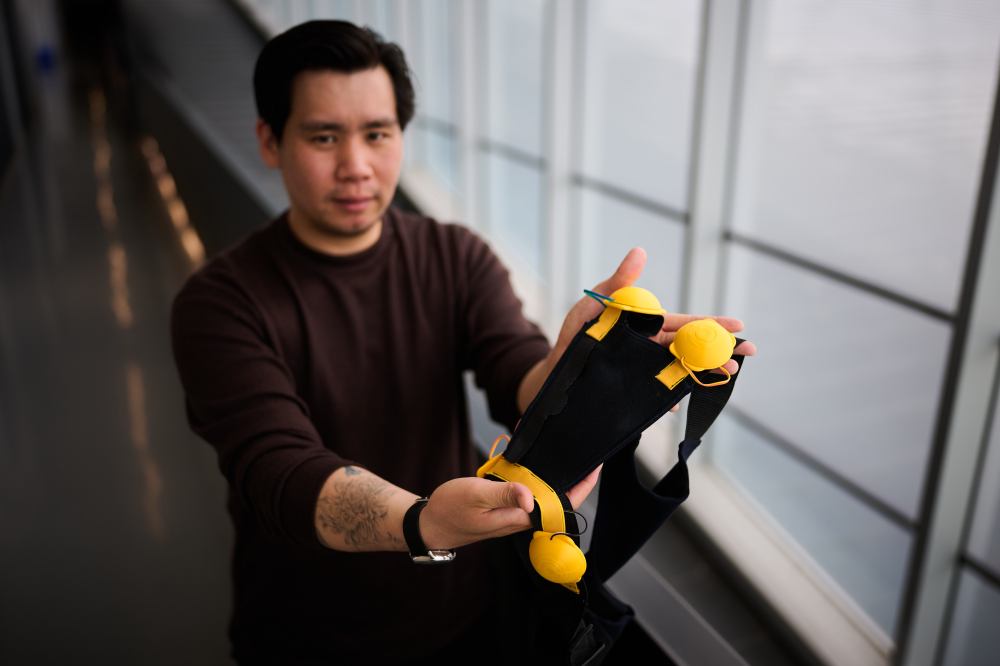
So they devised a sensory vest, a piece of wearable technology that will allow Pakenaite to receive messages from her guides through vibrations similar to those from a cellphone or video game controller. Using a custom remote, Pakenaite’s guides can give her directions and warn her if she is approaching a hazard.
The vest’s motors include signals to move up, down, left and right, and Pakenaite and her guides can come up with patterns to communicate more complex messages.
Lu enlisted the help of several other researchers around the world, as well as Hayley Stolee-Smith, a fashion designer from Hamilton who has worked on designing exoskeleton suits and costumes for performances.
When she learned about Pakenaite’s journey, Stolee-Smith was hooked on the idea of the haptic vest, too. She designed the vest’s buttons to ensure the vibrations could be felt strongly under layers of hiking gear.
“This is a rare opportunity to provide a benefit immediately” to someone who needs it, Stolee-Smith said.
“That’s really special. I really hope we built something for her that is reliable and assists her in all the incredible things that she wants to do.”
The process has been one of trial and error, and Stolee-Smith fondly recalled the energy in the room when she and Lu got a “janky” prototype to vibrate the way they intended for the first time.
Researching accessible technology feels like “a very meaningful use of your time and resources,” Lu said in his lab at the UofT Mississauga campus.
“You realize you can do very little, and you can impact a lot of people.”
Over the course of the project, Lu and Pakenaite have become friends. She is a surprisingly reserved person for someone so ambitious, he said.
“She has this really strong drive to make it happen,” Lu said. “I think without trying, she’s really inspirational.”
Pakenaite has been training aggressively for the summit with a regimen that includes ultramarathons, rock climbing and sleeping in an altitude chamber to help her body acclimatize to low-oxygen conditions.
She has postponed her climb from this year to the spring of 2027 due to the high costs associated with summiting Everest as a deafblind person.
Pakenaite wants to do a “flash-style” expedition — which is completed in just three weeks but is significantly more expensive than longer climbs because they demand greater support from Sherpa guides, more complex gear and are more logistically complicated. Plus, Pakenaite needs individualized support from guides who understand her condition, so she is attempting to fundraise about $281,000.
Despite the high price tag, she maintains a fast expedition is her best bet at reaching the summit.
Her tunnel vision makes it especially difficult to navigate steep, rugged terrain, and she wants to avoid having to make many exhausting trips up and down the face of Everest.
Plus, Pakenaite’s deafness makes it hard for her to participate in conversations with other climbers, and feeling shut out could sap her mental fortitude during an expedition that already demands extraordinary grit.
“I get really isolated in groups,” she said. “So the less time, the better for me.”
Pakenaite said she has struggled with impostor syndrome since her diagnosis. Because she is able to read lips and make eye contact in spite of her tunnel vision, people might not believe she is actually deafblind, she said.
She initially struggled to accept support and accommodations at university, but then went on to attend nine years of lectures with support from her guide dog, Bosley. The golden retriever-Labrador was at her side when she graduated, and she completed her PhD at the University of Bath, studying tactile pictures.
Pakenaite hopes that her story will challenge people’s ideas about deafblindness and make others diagnosed with Usher syndrome feel less alone.
“People had valid concerns, valid questions,” she said. “But after seeing my journey, they can see how much it means to me.”
This report by The Canadian Press was first published July 2, 2026.