

Magnificent moment
Canada’s footballers have made beautiful noise on the global stage

Advertisement
Read this article for free:
or
Already have an account? Log in here »
To continue reading, please subscribe:
Digital Subscription
One year of digital access for only $1.44 a week*
- Enjoy unlimited reading on winnipegfreepress.com
- Read the E-Edition, our digital replica newspaper
- Access News Break, our award-winning app
- Play interactive puzzles
*Billed as $5.77 plus GST every four weeks. After 52 weeks, price increases to the regular rate of $19.95 plus GST every four weeks. Offer available to new and qualified returning subscribers only. Cancel any time.
To continue reading, please subscribe:
Add Free Press access to your Brandon Sun subscription for only an additional
$1 for the first 4 weeks*
- Enjoy unlimited reading on winnipegfreepress.com
- Read the E-Edition, our digital replica newspaper
- Access News Break, our award-winning app
- Play interactive puzzles
*Your next Brandon Sun subscription payment will increase by $1.00 and you will be charged $17.95 plus GST for four weeks. After four weeks, your payment will increase to $24.95 plus GST every four weeks.
Read unlimited articles for free today:
or
Already have an account? Log in here »
In Europe and most of the rest of the world, football — by which I mean the sport North Americans stubbornly call soccer — is everything. Football is life. The chants, the gatherings, the intensity of fans’ loyalty and pride.
There’s no exact equivalent in either Canada or the United States to the cultural place the sport holds in most countries beyond.
So over the last four years, while I was living in Ukraine, the topic of soccer in Canada came up often. Europeans were often puzzled when I explained that it hasn’t traditionally been the most popular high-performance sport in Canada. Beloved for children, yes; but at the elite level, hockey and gridiron football command far more attention.
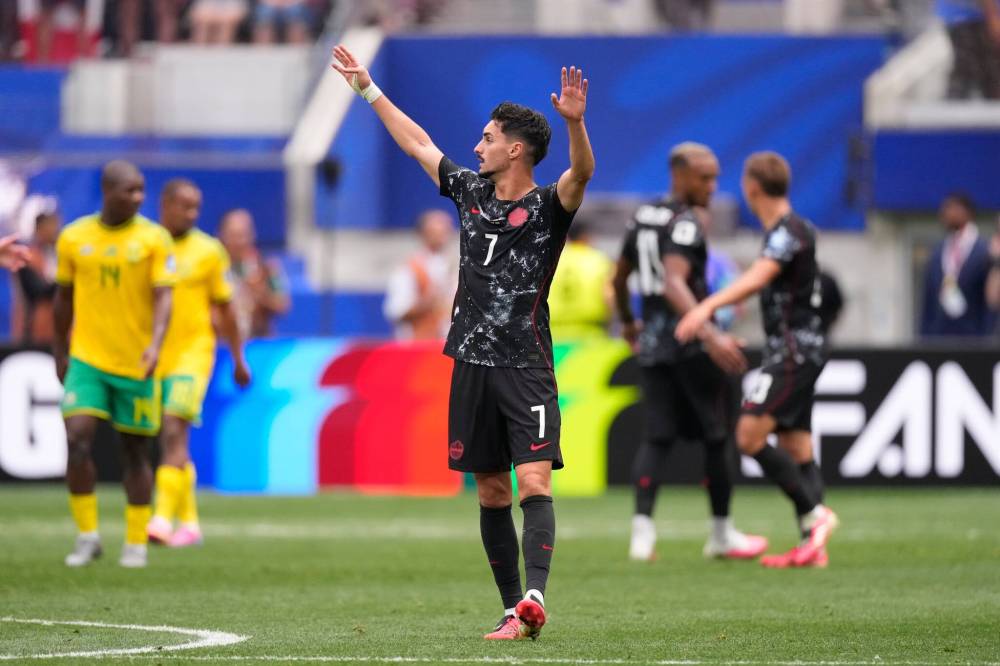
Mark Terrill / The Associated Press Files
Stephen Eustaquio was the hero, scoring the lone goal in Canada’s history-making Round of 32 knockout win over South Africa.
They were even more surprised to learn that, on the occasions many Canadians did tune in to watch international soccer, it was most often to cheer on our national women’s team.
The skepticism was understandable. In team sports, there are very few cases where the fame of a women’s team surpasses that of the equivalent men. In most cases and in most places, the popularity of the women’s game trails a distant second at best, and is virtually non-existent at worst.
But the difference isn’t set in stone. It often comes down to how we fall in love with a sport, or a team.
Sport is about balls and pucks, points and penalties, athleticism and performance. It’s even more about stories. The arcs of hope and heartbreak, struggle and redemption; they are what keep us tuned to our screens, willing the athletes to succeed by the force of our own hope.
And in Canada, the women’s side was first to author a story that seized our attention.
It happened at the semifinal of the 2012 Olympic Games in London, when more than 10 million Canadians tuned in to watch the Canadians battle the American titans. It was a stunning match, beautiful and devastating and intense. Iconic striker Christine Sinclair flew over the field like a woman possessed.
When they lost, Canada’s hearts shattered with them. Yet in giving it their all, they’d made us unforgettably proud.
After that moment, everything changed. Overnight, Sinclair rocketed to become a Canadian superstar and household name. The members of that team were heroes for an entire generation of Canadian girls. It was the sort of game that, in years to come, you’d reminisce about where you watched it — and the sort of cultural tipping point that long eluded the national men’s team.
Until now.
On Saturday, the Canadian national men’s soccer team will face Morocco in a do-or-die Round of 16 game at the 2026 FIFA World Cup. The match, which will be played in Houston, is not just the new high-water mark for the squad, but also carries the seeds of a deeper transformation.
Coming into the tournament, Canada had made just two prior FIFA World Cup appearances in 1986 and 2022, never made it out of the group stage, and had never won or even drawn a match. This time around, they held Bosnia-Herzegovina to a draw, trounced Qatar and lost to Switzerland to move onto the knockout rounds for the first time.
Hope builds fast on that sort of momentum. And Canadians are watching.
Last Sunday, nearly 12 million people tuned in to see Canada eke out a 1-0 victory over South Africa in the Round of 32. That was double the viewership of the recent Stanley Cup final. Across Canada, news outlets report that Team Canada jerseys are flying off the shelves. Stores can’t keep the kit in stock. Sports pubs are filling up with fans.
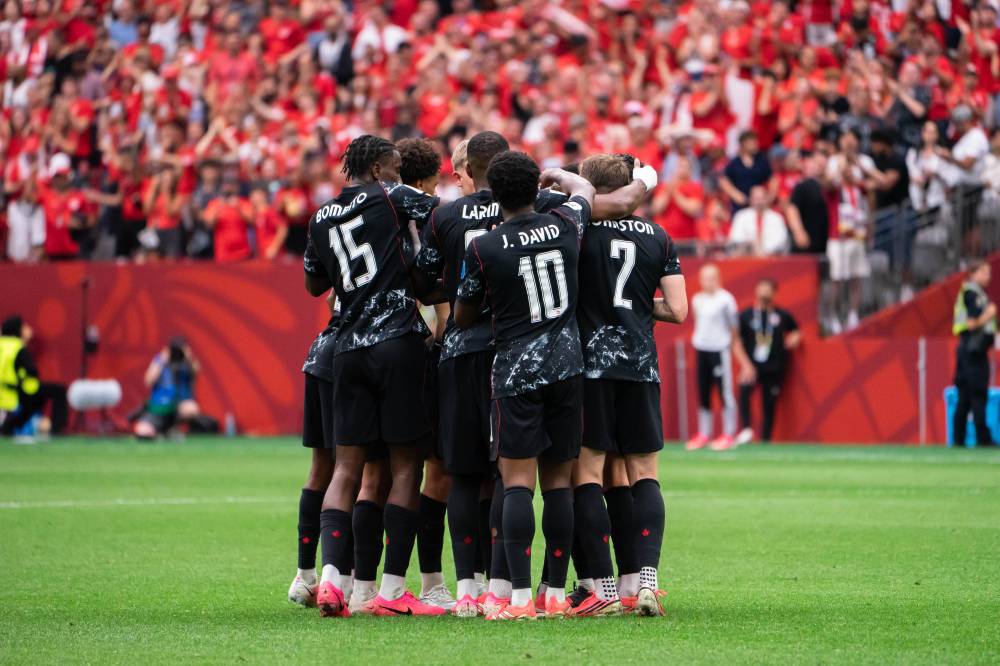
XAMYXELLE / SPP/ THE CANADIAN PRESS
On Saturday, the Canadian national men’s soccer team will face Morocco in a do-or-die Round of 16 game at the 2026 FIFA World Cup.
It will be tough for the team to make it past Morocco, which is ranked seventh in the world, to Canada’s 30th. Still, wilder things have happened in Canadian sport and, as the women’s team proved at the 2012 Olympics, a magnificent loss can ignite a country’s excitement and pride as much, and sometimes even more, than a win.
That this moment has arrived now, feels fitting. For the last year and a half, Canada has been wrestling with big questions about how to expand our place in the world. How to globally diversify our economy. How to work closer with our allies in Europe. How to ensure that, as the balance of world power shifts, we’re carving out a place for ourselves.
Sports is not geopolitics, but it isn’t entirely divorced from it, either. The World Cup is, along with the Olympics, one of just two truly global cultural experiences. It unites people from every continent. Its popularity is immune to disparities of wealth or population or language.
It’s the rare event where a tiny nation such as Curaçao, where just 150,000 people live, can stand in an equal global spotlight with Ecuador (population: 17.5 million), and delight fans everywhere when they hold them to a draw. The 39-day tournament is an event where only some of the 48 teams are favoured to win, but through the love of the game, all are understood to belong.

So it feels right that this should be the year that Canada’s men’s team makes noise at the World Cup for the first time. Our geography and proximity to the American culture juggernaut has long seen us slightly set apart from the rest of the planet; it’s time for us to get closer. To share more moments with the world and build more culture in common.
Nor will this process end with the World Cup: next year, for the first time, Canada will send a competitor to Eurovision, the zany annual song contest that annually takes Europe by storm. Australia has been included since 2015, so it’s about time we joined in on the fun.
On Saturday, the Canadian men could write an incredible new chapter in their team’s story, and in Canada’s. It isn’t so much about whether they win or lose — it’s that, by making it this far, they’ve brought not only Canadians along with their journey, but hundreds of millions of global viewers.
Wherever their path takes them from here, we’ll be there to cheer them on.
melissa.martin@freepress.mb.ca
Melissa Martin
Reporter-at-large
Melissa Martin reports and opines for the Winnipeg Free Press.
Every piece of reporting Melissa produces is reviewed by an editing team before it is posted online or published in print — part of the Free Press‘s tradition, since 1872, of producing reliable independent journalism. Read more about Free Press’s history and mandate, and learn how our newsroom operates.
Our newsroom depends on a growing audience of readers to power our journalism. If you are not a paid reader, please consider becoming a subscriber.
Our newsroom depends on its audience of readers to power our journalism. Thank you for your support.
Melissa Martin
Reporter-at-large
Melissa Martin reports and opines for the Winnipeg Free Press.
Every piece of reporting Melissa produces is reviewed by an editing team before it is posted online or published in print — part of the Free Press‘s tradition, since 1872, of producing reliable independent journalism. Read more about Free Press’s history and mandate, and learn how our newsroom operates.
Our newsroom depends on a growing audience of readers to power our journalism. If you are not a paid reader, please consider becoming a subscriber.
Our newsroom depends on its audience of readers to power our journalism. Thank you for your support.
Related Articles
NSL-leading Ottawa Rapid FC stay hot with 3-1 win over Calgary Wild FC










Advertisement Advertise With Us
Advertisement Advertise With Us