

Islandwide blackout hits Cuba as its fuel reserve dwindles and aging grid crumbles
Advertisement
Read this article for free:
or
Already have an account? Log in here »
To continue reading, please subscribe:

Digital Subscription
One year of digital access for only $205*
- Enjoy unlimited reading on winnipegfreepress.com
- Read the E-Edition, our digital replica newspaper
- Access News Break, our award-winning app
- Play interactive puzzles
*First annual payment billed as $205.00 + GST for one year. This annual subscription will automatically renew at $233.00 + GST every 52 weeks (10% off the regular annual price of $259.35). Offer available to new and qualified returning subscribers only. Cancel any time.
To continue reading, please subscribe:
Add Free Press access to your Brandon Sun subscription for only an additional
$1 for the first 4 weeks*
- Enjoy unlimited reading on winnipegfreepress.com
- Read the E-Edition, our digital replica newspaper
- Access News Break, our award-winning app
- Play interactive puzzles
*Your next Brandon Sun subscription payment will increase by $1.00 and you will be charged $17.95 plus GST for four weeks. After four weeks, your payment will increase to $24.95 plus GST every four weeks.
Read unlimited articles for free today:
or
Already have an account? Log in here »
HAVANA, Cuba (AP) — An islandwide blackout hit Cuba on Monday as the country’s fuel reserves dwindle and its electric grid continues to crumble.
The blackout in the country of nearly 10 million people was reported by the state-run Electric Union, which said on X that the cause is under investigation. The Ministry of Energy and Mines wrote on X that it has activated protocols to restore electricity.
Fuel has been running out across Cuba since January, when U.S. President Donald Trump threatened tariffs on any country that sells or provides oil to the island, deepening the island’s ongoing economic and financial crisis. Public transportation has largely been halted, and officials have canceled tens of thousands of surgeries.
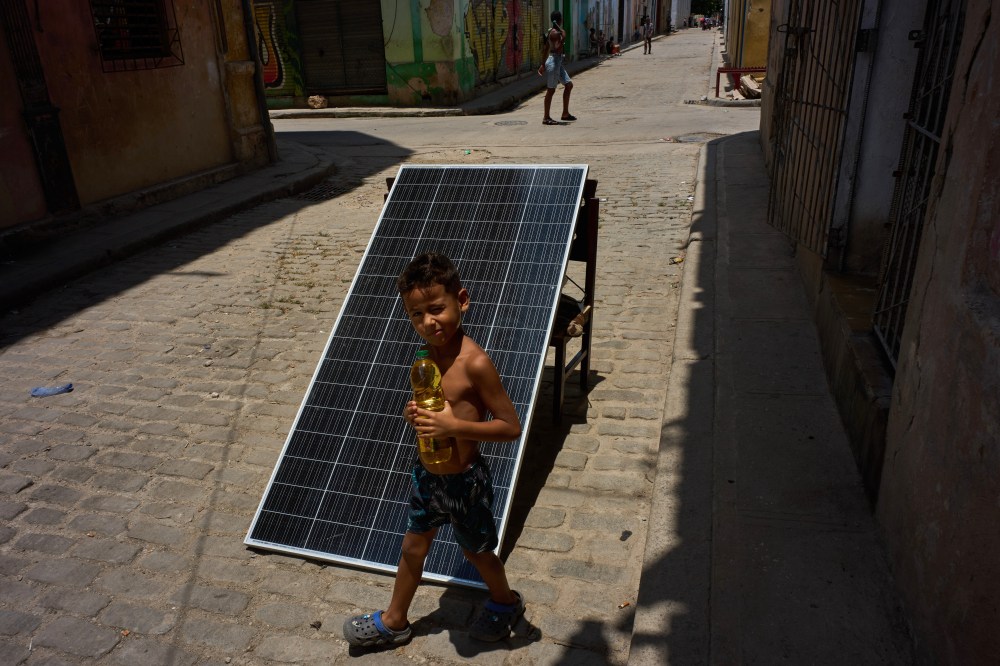
Energy Minister Vicente de la O Levy said microsystems were already operating throughout Cuba a couple of hours after the outage: “Vital services continue to be protected, amidst this complex situation exacerbated by the energy blockade we face.”
Meanwhile, Cuban President Miguel Díaz-Canel accused the U.S. of trying to “incite social unrest by strangling Cuba’s fuel supply.”
“The actions of electrical workers in the midst of a genocidal energy blockade are heroic,” he wrote on X.
The outage sparked concern across Havana, with 36-year-old Lina May wondering when the power would come back on so she could cook some rice.
“I just told my dad that we have to buy charcoal because otherwise we won’t eat and we’ll starve,” she said.
Richard Valdés, 40, said the outage is just the latest hit of many. “We’re without power again,” he said. “Now we have no water, no gas, nothing until they restore it.”
Cuba produces only 40% of the fuel it needs, while the 730,000 barrels of oil delivered by a Russian tanker in late March ran out by the end of April.
The government also has been rationing power with intentional outages that can stretch to more than 24 consecutive hours.
A blackout in mid-May affected the island’s eastern provinces, while a blackout in mid-March struck the entire island.
Like many Cubans, Mario Pedroso, a 33-year-old Havana resident, was resigned about Monday’s total blackout.
“Oil hasn’t come in here for a while, and we have no way to solve the problem,” he said. “We have to resist, as we Cubans say. That’s all.”
___
Associated Press writer Dánica Coto in San Juan, Puerto Rico contributed.
___
Follow AP’s coverage of Latin America and the Caribbean at https://apnews.com/hub/latin-america