Keeping cool: How Meta plans to cut down on water use at its Alberta data centre

Advertisement

Advertise with us

CALGARY - A Meta Platforms Inc. executive garnered applause at a news conference this week after he boasted that a gargantuan data centre planned for north of Edmonton would use less water annually than a typical Alberta golf course.

Read this article for free:

or

Already have an account? Log in here »

To continue reading, please subscribe:

Subscribe and receive a limited-edition Free Press branded hat or tote.

Digital Subscription

One year of digital access for only $205*

  • Enjoy unlimited reading on winnipegfreepress.com
  • Read the E-Edition, our digital replica newspaper
  • Access News Break, our award-winning app
  • Play interactive puzzles

*First annual payment billed as $205.00 + GST for one year. This annual subscription will automatically renew at $233.00 + GST every 52 weeks (10% off the regular annual price of $259.35). Offer available to new and qualified returning subscribers only. Cancel any time.

To continue reading, please subscribe:

Add Free Press access to your Brandon Sun subscription for only an additional

$1 for the first 4 weeks*

  • Enjoy unlimited reading on winnipegfreepress.com
  • Read the E-Edition, our digital replica newspaper
  • Access News Break, our award-winning app
  • Play interactive puzzles
Start now

*Your next Brandon Sun subscription payment will increase by $1.00 and you will be charged $17.95 plus GST for four weeks. After four weeks, your payment will increase to $24.95 plus GST every four weeks.

CALGARY – A Meta Platforms Inc. executive garnered applause at a news conference this week after he boasted that a gargantuan data centre planned for north of Edmonton would use less water annually than a typical Alberta golf course.

The tech behemoth was announcing a $13-billion-plus investment in a complex the size of 33 Canadian Football League fields. It will be powered by a new natural gas plant that could eventually produce more electricity than what the City of Edmonton uses.

The data centre in Sturgeon County, like other hyperscale proposals in Canada, is to use what’s known as a closed-loop cooling system to keep servers from overheating. That differs from an evaporative cooling system, which requires enormous amounts of cool water that is not reused.
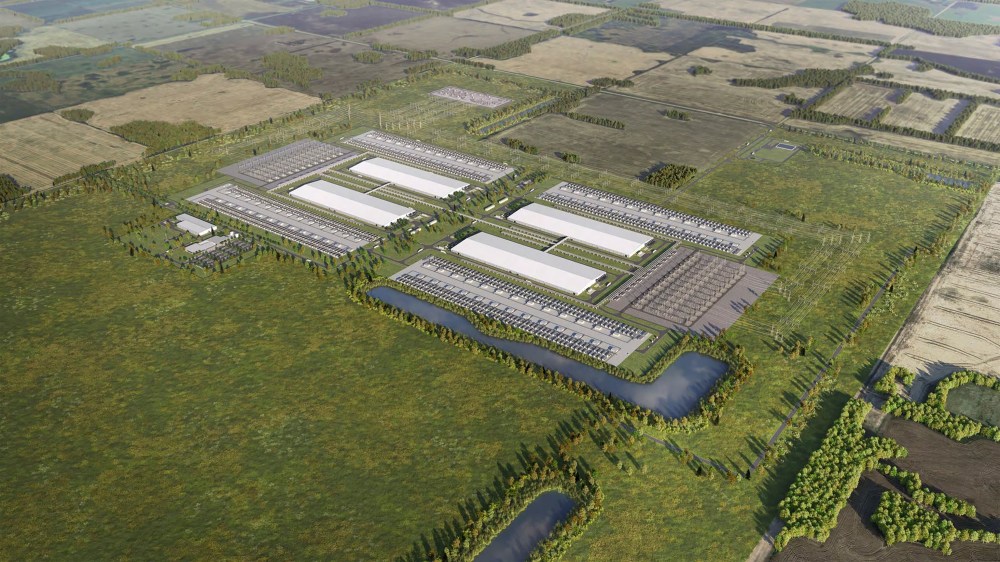
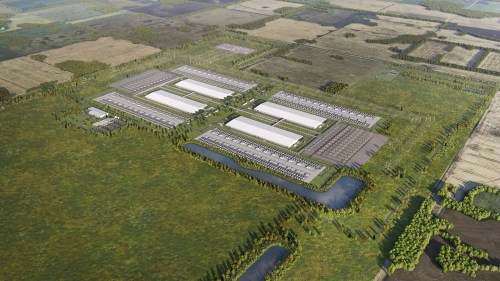
Meta, the tech giant behind Facebook and Instagram, says it's building a new AI date centre in Sturgeon County, Alta. The facility, shown in this rendered image, will be a one-gigawatt, nearly 270,000-square-metre data centre powered by a natural gas-fired plant. THE CANADIAN PRESS/Handout - Sturgeon Data Centre (Mandatory Credit)

Gary Demasi, vice-president of data centre strategy and development at Meta, told a news conference Wednesday that no water will be needed for regular cooling operations.

“The onsite water use is limited to domestic uses, fire protection systems and some equipment maintenance applications,” he said.

Marina Freire-Gormaly, an associate professor of mechanical engineering at York University, said the closed-loop technique works well in cooler climates like Alberta’s. Data centres in hotter places tend to use evaporative cooling because there’s not as much of a temperature difference between the equipment inside and the air outside.

Meta would likely use a coolant similar to the fluids used in vehicles, which would run through pipes overtop of the hottest parts of the chips and absorb the heat, she said. The loop would then run to the outside of the building, where the air is cooler, and a series of fans would move the heat away. The cooled-down fluid would head back to the servers.

Freire-Gormaly said the closed-loop system would work best in the winter and she’s curious how Meta’s designs would account for how hot it can sometimes get in the Edmonton area during the summer.

A recent blog post from AI chipmaker Nvidia, one of Wall Street’s most valuable names, said its latest servers can use coolant that’s not so cool at all: up to 45 C, which is more sweltering than a hot tub. The fluid exits the server rack at 55 C.

Nvidia said that cooling alone has historically accounted for up to 40 per cent of a data centre’s electricity consumption, so its ability to use higher-temperature coolant marks a great efficiency leap. The coolant Nvidia uses is three-quarters water, one-quarter propylene glycol.

“These newer data centres, they should always use closed-loop cooling,” Freire-Gormaly said.

“These evaporative cooling approaches are really harmful to the environment. And the reason they’re relying on it is because they don’t have that natural temperature difference between the environment and the temperature that they’re trying to cool from.”

For that reason, she sees how Canada can be an attractive location for hyperscalers like Meta to set up shop.

“But I think it’s also important that we realize what power source we’re using.”

It’s not clear what kind of cooling system the adjacent power plant will have and if that component will have its own hefty water footprint, Freire-Gormaly said.

Freire-Gormaly also wonders if the companies might consider ways to use the data centre’s waste heat.

“Why not use that waste heat for things like warming buildings or having a secondary heat transfer loop?”

A study led by University of Cambridge researchers earlier this year looked at what they call the “heat island effect” in areas surrounding AI data centres. The study estimates the land surface temperature increases by an average of 2 C after the start of operations. It found that some increase in temperature could be detected up to 10 kilometres away.

Researchers at York University’s Schulich School of Business have been mapping Canada’s emerging data centre landscape. In paper, currently under review at a peer reviewed journal, they say that as of June of this year, there were 194 data centres operating with a combined capacity of 1.6 gigawatts.

That’s dwarfed by those announced or under construction — 213 planned, accounting for more than 22 gigawatts.

And Alberta is at the epicentre.

That province accounts for 92 per cent of planned new capacity, while it represents 10 per cent of facilities currently active.

“Clearly there is something going on there that’s attracting that development,” said Lyndsey Rolheiser, an assistant professor of urban and real estate economics who co-authored the paper with Alexander Carlo.

“Alberta is not pursuing big taxpayer-funded incentives. They’re relying on their deregulated self-generation energy market to really bring these providers in and that seems to be working.”

Because there’s currently insufficient grid capacity, Alberta is prioritizing projects that contract or build their own power sources, which have virtually all been from natural gas.

Many residents are operating in “information vacuums” so the province needs to be prepared to encounter some backlash and communicate exactly what it’s doing to ensure the appropriate environmental and safety protections are in place, Rolheiser said.

Ali Bayat, a professor of civil and environmental engineering at the University of Alberta, said the province is well-positioned to meet data centre demand from a workforce perspective. Meta has said it expects 3,000 jobs during construction.

“We have an industrial province,” he said. “There is capacity in this province for that line of construction work. Alberta is unique in that regard.”

This report by The Canadian Press was first published July 9, 2026.

Report Error Submit a Tip

More Stories

Student of the Prairie

Melissa Martin 7 minute read Preview

Student of the Prairie

Melissa Martin 7 minute read 2:01 AM CDT

In Andrian Makhnachov’s first nine days as a Winnipegger, he immersed himself in the city’s most distinctive delights. He went to the Goldeyes’ Ukrainian Night, toured the Manitoba Museum and cheered the Sea Bears at Canada Life Centre.

He sampled boxes of treats from local institutions such as Baked Expectations and Oh Doughnuts. He tried pickerel for the first time, and even a Jeanne’s Cake. (His diplomatic verdict on the city’s most intensely debated dessert: “I think it’s a very interesting experience … maybe there’s some special way I should eat it and it’s going to be better.”)

Still, the rising social media star encountered a few challenges. When Makhnachov first planned his move here from Regina, he’d picked an apartment in the Exchange District, not realizing there were few grocery stores within walking distance. For now, he’s making do with Giant Tiger.

For all the ups and downs, there is no doubt in the Ukrainian-Canadian’s mind that he made the right decision to move his life, and his burgeoning influencer career, to Winnipeg.

Read
2:01 AM CDT

Plan being developed to tackle drug use, homelessness near church

Scott Billeck 4 minute read Preview

Plan being developed to tackle drug use, homelessness near church

Scott Billeck 4 minute read Yesterday at 6:12 PM CDT

Winnipeg Mayor Scott Gillingham says a plan is in the works to address growing concerns over drug use and homelessness around an Osborne Village church after complaints from a nearby daycare, residents and businesses.

Gillingham said his senior adviser on homelessness, Jarred Baker, met with people in the area on Friday and was expected to provide a report later Monday outlining what was discussed and potential next steps.

Craig Wynands, executive director of 1JustCity, confirmed someone from the city met with Oak Table’s site lead, Thomas van der Krogt. Wynands also said he met Monday with officials from Augustine Centre and SPLASH Child Care.

“We discussed safety measures and increasing staff presence around the premises of the building,” he said. “1JustCity will be hiring additional staff to patrol the property regularly during the day.”

Read
Yesterday at 6:12 PM CDT

Forever avoid ex who lied about pregnancy

Maureen Scurfield 4 minute read 2:01 AM CDT

Dear Miss Lonelyhearts: I was feeling smothered by my girlfriend — she wanted to be together 24-7 and that was just too much. I told her that. Her reaction was to tell me a month later that she was pregnant.

I was trapped. That just stressed me out and made me worry about what would happen in my life if I married her. I was in hell.

Then she broke up with me. I told one of her friends at the bar, and she took pity on me. She told me that she was not supposed to tell me the secret, but my girlfriend was never really pregnant. She was faking early symptoms to put me through some hell.

I still kind of love that girlfriend, but I want out for good because she’s crazy enough that she would do anything to trap me and keep me around. Still, I dream about her. How can I get over her?

Search continues for brothers feared drowned at Nutimik Lake

Zoe Pierce 5 minute read Preview

Search continues for brothers feared drowned at Nutimik Lake

Zoe Pierce 5 minute read Updated: Yesterday at 6:39 PM CDT

Search-and-rescue crews continued efforts Monday to locate two boys who are presumed drowned after falling into fast-moving rapids at Nutimik Lake on the weekend, as community members and Manitoba Parks begin conversations about preventing future tragedies.

The boys, identified as brothers Aaron Au Ramirez, 13, and Maximo Au Ramirez, 10, were visiting Whiteshell Provincial Park with their father and some friends when they entered the water near the Sturgeon Falls Trail Saturday afternoon.

Lac du Bonnet RCMP received a report of a possible drowning at about 12:40 p.m. Police, along with local emergency responders, searched the shoreline and waterways but were unable to find the boys, RCMP said in a news release.

The Manitoba RCMP Underwater Recovery Team and the Hutterian Emergency Aquatic Response Team were later deployed to assist with the search.

Read
Updated: Yesterday at 6:39 PM CDT

Teacher disciplinary panel will make history today

Maggie Macintosh 4 minute read Preview

Teacher disciplinary panel will make history today

Maggie Macintosh 4 minute read 6:27 AM CDT

A professional disciplinary panel will assemble today to hear serious allegations against a Manitoba teacher.

The public hearing — a first-of-its-kind videoconference scheduled for 10 a.m. — will take place more than 18 months after the province launched a professional disciplinary system and teacher registry.

“In a hearing, it’s the teacher against me, basically,” said Noni Classen, Manitoba’s independent commissioner of teacher professional conduct.

Both parties are expected to make their respective arguments in front of a three-person panel consisting of one teacher, one non-teacher and one individual nominated by the Manitoba School Boards Association.

Read
6:27 AM CDT

‘Heartbreaking loss’: Sandy Bay First Nation offers condolences after apparent dog attack

Morgan Modjeski 3 minute read Preview

‘Heartbreaking loss’: Sandy Bay First Nation offers condolences after apparent dog attack

Morgan Modjeski 3 minute read Sunday, Jul. 19, 2026

Leaders with the Sandy Bay Ojibway First Nation are offering their condolences after an animal rescue worker died following an apparent dog attack in the community and say the “stray and aggressive” animals are a longstanding issue.

Amanda Nobiss, 37, was volunteering in the community on the shores of Lake Manitoba with K9 Advocacy. Her remains were discovered on Friday morning.

The Manitoba First Nations Police Service said in a news release that it had been contacted by a friend of Amanda’s who was trying to locate her, around 12:45 a.m.

Using her cellphone location, police determined she appeared to be in Sandy Bay, said the release. Resources were dispatched to the area, including a drone, but due to the large radius of the cellphone “ping,” no one was located until 6 a.m.

Read
Sunday, Jul. 19, 2026