In any language: English speakers are tuning into World Cup broadcasts in Spanish
Advertisement
Read this article for free:
or
Already have an account? Log in here »
To continue reading, please subscribe:

Digital Subscription
One year of digital access for only $205*
- Enjoy unlimited reading on winnipegfreepress.com
- Read the E-Edition, our digital replica newspaper
- Access News Break, our award-winning app
- Play interactive puzzles
*First annual payment billed as $205.00 + GST for one year. This annual subscription will automatically renew at $233.00 + GST every 52 weeks (10% off the regular annual price of $259.35). Offer available to new and qualified returning subscribers only. Cancel any time.
To continue reading, please subscribe:
Add Free Press access to your Brandon Sun subscription for only an additional
$1 for the first 4 weeks*
- Enjoy unlimited reading on winnipegfreepress.com
- Read the E-Edition, our digital replica newspaper
- Access News Break, our award-winning app
- Play interactive puzzles
*Your next Brandon Sun subscription payment will increase by $1.00 and you will be charged $17.95 plus GST for four weeks. After four weeks, your payment will increase to $24.95 plus GST every four weeks.
Read unlimited articles for free today:
or
Already have an account? Log in here »
MIAMI (AP) — Ashleigh Hallam teaches English as a second language at her local library in Indiana. Soccer is now teaching her Spanish as a second language.
For her, this World Cup couldn’t make more sense.
Hallam is among a sizable number of English-speaking people in the U.S. who are doing something these days that might be considered a bit surprising: They’re watching broadcasts of World Cup matches in Spanish on Telemundo, even though they have little idea — or in some cases, no idea — what the announcers are saying.
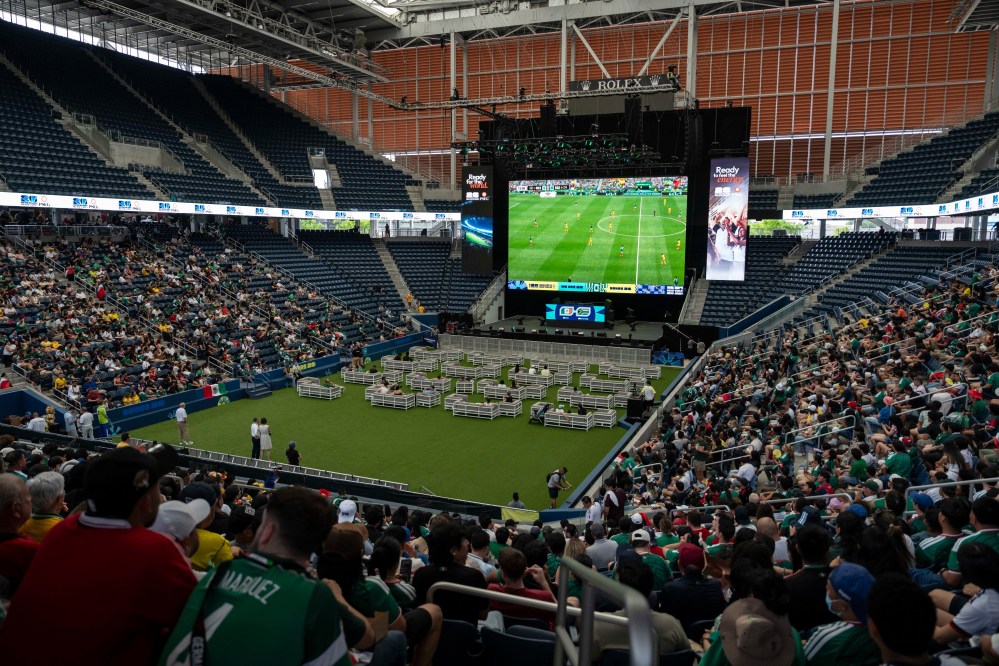
“I can’t really understand everything they’re saying on Telemundo because they’re speaking in Spanish,” Hallam said. “But you understand what’s going on.”
The math is simple. Census figures show that about 20% of the U.S. is Hispanic, yet Telemundo points to Nielsen ratings to show that roughly half the World Cup viewers in the U.S. have watched at least some portion of some matches in Spanish. Every match of the tournament has been available for U.S. viewers in English on Fox or FS1, on Telemundo or Universo in Spanish, and there are streaming options such as Fox One or Peacock.
Among the reasons commonly cited by viewers who spoke with The Associated Press in recent days: A fascination with famed broadcaster Andrés Cantor’s “¡goooooool!” call. Telemundo doesn’t cut away for commercials (as Fox does) during the much-maligned hydration breaks. The broadcasts, some simply find, are more entertaining. And in other cases, it’s a cost-based decision: Peacock, which includes Telemundo, is lower-priced than Fox One.
Soccer as a global language, transcending a limited vocabulary
Jackson Braunius is a Michigan native who watched a U.S. game last week from a bar seat at a steakhouse in Miami Lakes, Florida. He said he speaks almost no Spanish — “I know ‘cerveza,’” he said, tapping his beer glass — but didn’t mind watching on Telemundo whatsoever.
“I figured out the science here,” Braunius said. “When they’re not talking too loud, nothing is happening. When they get loud, there’s a chance. When they get real loud, it’s probably going to be a goal.”
Comedian Trevor Noah has been hosting World Cup watch parties on YouTube. He’s made the switch to Spanish-language feeds, and the hydration break issue was a huge part of that decision.
“We’re seeing the players on the pitch discussing what’s happening. You see which coach is more stressed. Some players are tapping each other on the back. This is part of the game,” Noah said on one of his YouTube streams. “I feel like when you cut to ads, you lose this — you lose the stress, you lose the joy, the anticipation. So, shout out again, Telemundo: Really, really amazing coverage.”
Telemundo is hearing the praise, and has thanked English-speakers — as well as Noah directly — for lauding its coverage.
The good news for everyone is this: There seems to be more than enough viewers to go around right now. And the success of this tournament could lead to a bidding war for the 2030 World Cup, with some reporting the rights for English-speaking and Spanish-speaking television will be packaged together in that deal. That wasn’t the case for this World Cup.
Fox Sports said that Monday night’s Belgium-U.S. match saw a peak viewership total of around 41 million at one point, making it the “most-watched soccer telecast in U.S. history,” the network said. In other words, the final U.S. game in this World Cup had more viewers than anything in this country since the Super Bowl — with at least 45 million viewers, on average, between Fox (33 million) and Telemundo (an estimated 12 million). The most recent Super Bowl drew an average of about 125 million viewers, according to Nielsen data.
Anglophones become hooked on Telemundo
William Kennedy of Miami is married to a Colombian woman, whose native language is Spanish. He says he knows only enough Spanish to be able to order meals in restaurants. And yet, he finds himself often watching World Cup matches on Telemundo.
If Colombia was on, the Kennedy house was watching Telemundo. If Colombia — which was ousted in penalty kicks by Switzerland on Tuesday — isn’t on, Kennedy finds himself usually making his way to Telemundo anyway.
“When the American commentators are doing the game, I don’t know what game they’re watching. I just don’t,” Kennedy said. “I’d rather get the excitement in Spanish because essentially what happens is they’re talking, and then they’re talking really, really fast, and then they’re getting loud and your brain is just like, ‘Oh, something’s happening — even if I don’t know what’s happening.’”
Hallam — who finds the World Cup has been a great way to bond further with her Spanish-speaking students — only became a big soccer fan a few years ago, when her daughter decided she wanted to play in a recreational league for elementary kids. The league needed coaches, so Hallam literally checked out a “coaching for dummies” book and began teaching herself the game.
She kept coaching her daughter all the way through high school. Now, she’s hooked on soccer and hooked on Spanish-speaking broadcasts — and plans to keep watching, even when the World Cup ends.

“It’s just very comforting,” Hallam said. “We’re really enjoyed it and I hope we get to continue. The next World Cup, we’re going to watch it just like this.”
___
Lamy reported from Indianapolis.
___
See more of AP’s World Cup coverage here
Related Articles
Lionel Messi’s World Cup scoring streak ends, but his assist sparks Argentina’s win over Switzerland










Advertisement Advertise With Us
Advertisement Advertise With Us