Tai chi practitioners seek balance and well-being in fast-paced Beijing
Advertisement
Read this article for free:
or
Already have an account? Log in here »
To continue reading, please subscribe:

Digital Subscription
One year of digital access for only $205*
- Enjoy unlimited reading on winnipegfreepress.com
- Read the E-Edition, our digital replica newspaper
- Access News Break, our award-winning app
- Play interactive puzzles
*First annual payment billed as $205.00 + GST for one year. This annual subscription will automatically renew at $233.00 + GST every 52 weeks (10% off the regular annual price of $259.35). Offer available to new and qualified returning subscribers only. Cancel any time.
To continue reading, please subscribe:
Add Free Press access to your Brandon Sun subscription for only an additional
$1 for the first 4 weeks*
- Enjoy unlimited reading on winnipegfreepress.com
- Read the E-Edition, our digital replica newspaper
- Access News Break, our award-winning app
- Play interactive puzzles
*Your next Brandon Sun subscription payment will increase by $1.00 and you will be charged $17.95 plus GST for four weeks. After four weeks, your payment will increase to $24.95 plus GST every four weeks.
Read unlimited articles for free today:
or
Already have an account? Log in here »
BEIJING (AP) — One arm raised and the other lowered, hundreds of people move every morning like birds spreading their wings at the heart of Beijing’s Temple of Heaven.
It’s a movement in tai chi, a physical and philosophical practice developed more than 300 years ago that continues to resonate in China today.
“The environment is great and the air is good too,” said Ye Guirong, 64. “You can see we’re surrounded by trees.”
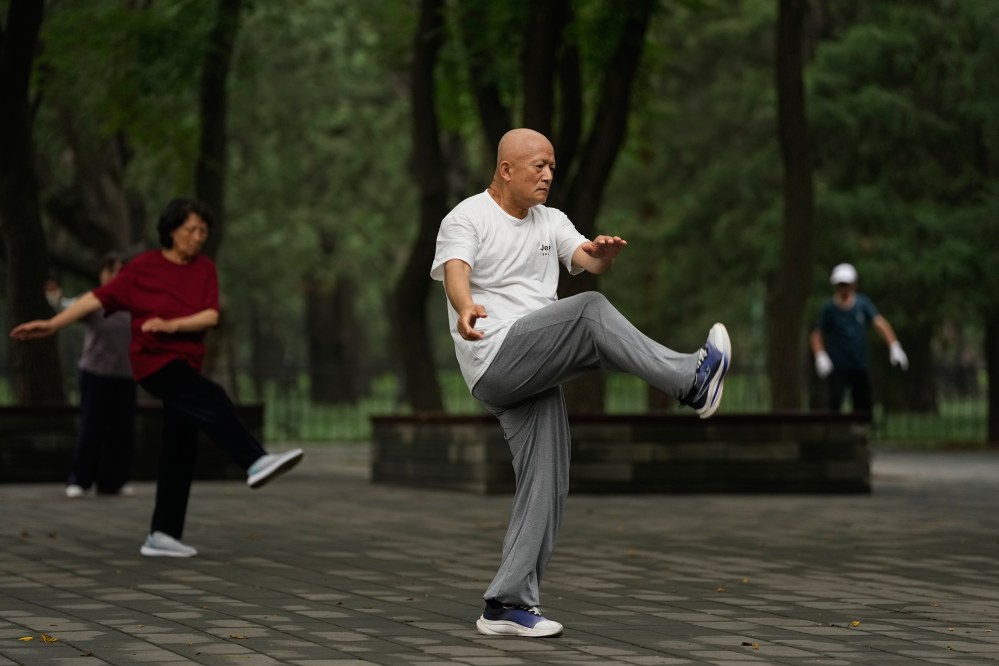
Most practitioners are retirees in their 60s and beyond. Some exercise in groups while a speaker plays relaxing music in the background. Others move silently on their own.
Ye first encountered tai chi in 2010. Recently retired, she took walks across the city and one day spotted the group she now leads.
“I thought it looked good, so I started practicing,” Ye said.
Once a new member joins a group, its leader teaches the basic moves. The apprentice’s progress is reviewed and corrected periodically until a new level is achieved.
Among tai chi’s basic movements are “White Crane Spreads Its Wings,” in which one arm is raised while the other is lowered, and “Part the Wild Horse’s Mane,” a broad, fluid sequence in which the body weight shifts forward while the arms open gently in front of the chest.
“The movements have been passed down from one instructor to another,” Ye said.
Newcomers keep joining
Ye’s tai chi group, Cypress Grove, has around 30 people and recently welcomed its newest practitioner.
Zu Hong, 59, learned a 24-movement routine in about a month. Ye said she’s ready to take on the second set.
“I thought tai chi looked very beautiful,” Zu said. “I wanted to exercise, so I came here to the Temple of Heaven.”
Founded in the 15th century by a Ming dynasty emperor, the site is a complex of religious buildings symbolizing the relationship between heaven and earth.
Its most iconic building is the Hall of Prayer for Good Harvests. It served as the ceremonial site where emperors acted as intermediaries between humans and heaven, offering sacrifices and prayers for good harvests.
Today it serves primarily as a tourist attraction and its surrounding gardens remain open to the public.
Ancient ideas endure
Tai chi carries two meanings in China. It refers both to the martial art, or Taijiquan, and to the philosophical ideas behind it, or Taiji.
One of its key concepts is qi, or vital energy, which is understood as a life breath that flows through the body.
In traditional Chinese medicine, health depends on qi circulating through a network of pathways known as meridians, which are believed to connect the body’s organs, limbs and other parts. Acupuncture and other traditional treatments aim to regulate that flow.
“Practices like tai chi and qigong are all about activating, regulating or improving the flow of qi in the body,” said James Miller, a professor of Humanities at Duke Kunshan University in China’s Jiangsu province. “That’s something very key to Daoism (Taoism), but it’s also part of the broader Chinese conception of the body and of the world.”
Beyond the human body, qi is also believed to exist in nature. Mountains and rivers are understood to be animated by its flow.
“This is also why it’s traditional to establish temples on mountains,” Miller said. “They’re understood not just as beautiful or remote places, but because they’re closer to nature.”
An ancient practice lives on
There are several styles of tai chi, each with its own forms.
Ye’s group gathers every morning at 7:40 a.m. to practice Yang-style for about an hour and a half. The group rotates through different sets. Some consist of 24, 42 or 48 movements, while others incorporate swords or fans.
“Through exercising, everyone’s health has improved,” Ye said. “Our spirits are especially good.”
Chen-style is widely recognized as the oldest form of tai chi. It was developed in the 17th century by Chen Wangting, a military commander who later in life changed paths to embrace spirituality.
“He practiced Daoist (Taoist) methods of self-cultivation including meditation,” said Tai Chi master Chen Haitao. “Then one day he experienced a sudden awakening: the meridians throughout his body all opened, his mind became enlightened, and wisdom suddenly emerged.”
Chen Wangting’s experience was life-changing, said Chen Haitao. Dreaming of sharing the sensation with others, he found in movement the means to do so.

Both the martial art and the philosophy behind tai chi are meant to work together, Chen said. The movements provide the method while the philosophy gives them meaning.
“One of the great benefits of Taijiquan is that it is suitable for everyone,” Chen said. “As long as you learn the basic principles correctly and maintain proper alignment, whoever practices it will benefit from it.”
___
AP video journalist Wu Jia contributed to this report. ___
Associated Press religion coverage receives support through the AP’s collaboration with The Conversation US, with funding from Lilly Endowment Inc. The AP is solely responsible for this content.
The Free Press acknowledges the financial support it receives from members of the city’s faith community, which makes our coverage of religion possible.