

Video apparently depicting Filipinos as monkeys on China media draws Manila’s protest
Advertisement
Read this article for free:
or
Already have an account? Log in here »
To continue reading, please subscribe:

Digital Subscription
One year of digital access for only $205*
- Enjoy unlimited reading on winnipegfreepress.com
- Read the E-Edition, our digital replica newspaper
- Access News Break, our award-winning app
- Play interactive puzzles
*First annual payment billed as $205.00 + GST for one year. This annual subscription will automatically renew at $233.00 + GST every 52 weeks (10% off the regular annual price of $259.35). Offer available to new and qualified returning subscribers only. Cancel any time.
To continue reading, please subscribe:
Add Free Press access to your Brandon Sun subscription for only an additional
$1 for the first 4 weeks*
- Enjoy unlimited reading on winnipegfreepress.com
- Read the E-Edition, our digital replica newspaper
- Access News Break, our award-winning app
- Play interactive puzzles
*Your next Brandon Sun subscription payment will increase by $1.00 and you will be charged $17.95 plus GST for four weeks. After four weeks, your payment will increase to $24.95 plus GST every four weeks.
Read unlimited articles for free today:
or
Already have an account? Log in here »
MANILA, Philippines (AP) — The Philippine government strongly protested to China what it said was the depiction of Filipinos as monkeys in an editorial video publicized by a Chinese state-owned media outlet, and demanded it be taken down.
The Department of Foreign Affairs in Manila said Friday that the series of opinion and editorial videos and cartoons, particularly an animated video posted by the China Daily on its Facebook page on July 10, centered on Beijing’s rejection of a 2016 arbitration ruling that invalidated China’s expansive claims in the disputed South China Sea.
The Philippines initiated the arbitration in 2013, after China seized a shoal west of the Philippines following a tense standoff. China questioned the jurisdiction of the tribunal in The Hague, refused to take part in the proceedings and rejected its ruling as a sham.
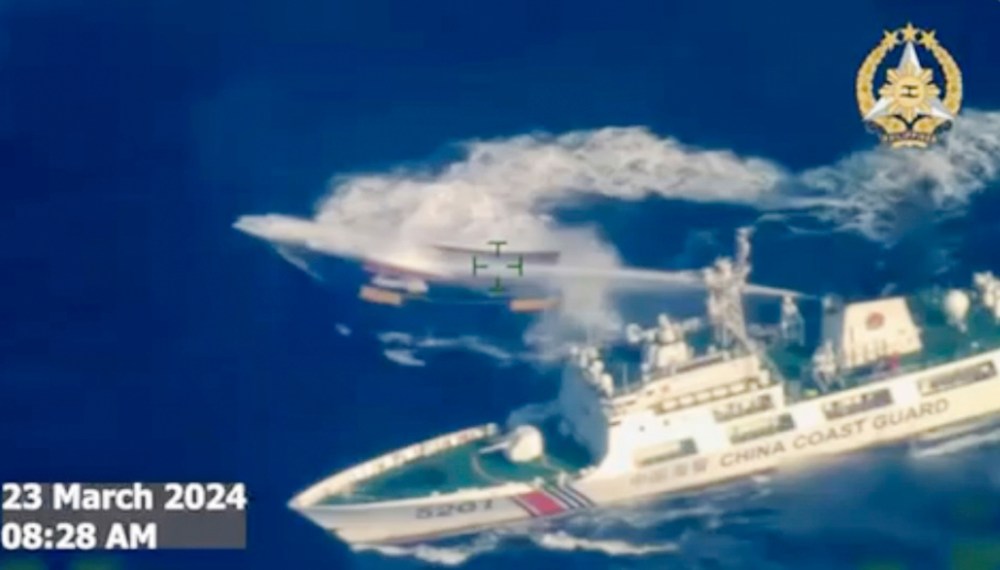
China Daily’s video posted on Facebook shows a monkey holding a piece of paper scribbled with “South China Sea arbitration Award” and wearing what resembles a traditional Philippine shirt with a rural hat and tattered pants. Two hands with sleeves separately marked “USA” and “Japan” later hurl the monkey into the sea, where it’s blasted away by a water cannon of what looks like a Chinese coast guard ship.
The caption mocks the arbitration ruling by saying that it’s not a remedy for peace “but a source of confrontation dressed up as law.” It says that “by clinging to external forces and stirring up trouble in the South China Sea,” Philippine politicians “are turning their country into a pawn in someone else’s geopolitical game.”
The Philippines initially relayed its “firm objection to the offensive content” to Chinese Ambassador Jing Quan in Manila on Thursday. Philippine Foreign Undersecretary Leo Herrera-Lim “demanded that the materials be taken down, stressing that such content is inconsistent with the mutual respect expected between states,” the Foreign Affairs Department said.
It said in its protest that “China Daily went beyond legitimate political debate by resorting to demeaning, dehumanizing, and racist depictions of Filipinos.” It added that “disagreement over legal and political issues does not justify resorting to imagery that has no place in the public discourse of responsible states.”
The Philippine Embassy in Beijing transmitted a letter to the China Daily’s editor-in-chief, reiterating Manila’s demand for the immediate takedown of the offensive material, the department said.
In Beijing, China’s Foreign Ministry spokesperson Lin Jian said Friday that the video “does not represent the official position and I have no comment on it.”
But he said that China viewed the South China Sea arbitration as “a political farce disguised as a legal proceeding.” He added that “the so-called award is illegal, null and void and has no binding force.”
The Philippine government commemorated the anniversary of the July 12, 2016, ruling as a landmark victory of the rule of law against aggression.
The United States, the United Kingdom and a dozen other Western and Asian countries, along with the 27-nation European Union, have also reaffirmed the ruling.
Territorial confrontations in the disputed waters have become more prevalent in recent years, particularly among Chinese, Philippine and Vietnamese forces and fishing fleets. The long-simmering disputes in the strategic waterway, a key global trade route, also involve Malaysia, Brunei and Taiwan.
___
Associated Press writer E. Eduardo Castillo in Beijing contributed to this report.