

Reading the city in its buildings

Advertisement
Read this article for free:
or
Already have an account? Log in here »
To continue reading, please subscribe:

Digital Subscription
One year of digital access for only $205*
- Enjoy unlimited reading on winnipegfreepress.com
- Read the E-Edition, our digital replica newspaper
- Access News Break, our award-winning app
- Play interactive puzzles
*First annual payment billed as $205.00 + GST for one year. This annual subscription will automatically renew at $233.00 + GST every 52 weeks (10% off the regular annual price of $259.35). Offer available to new and qualified returning subscribers only. Cancel any time.
To continue reading, please subscribe:
Add Free Press access to your Brandon Sun subscription for only an additional
$1 for the first 4 weeks*
- Enjoy unlimited reading on winnipegfreepress.com
- Read the E-Edition, our digital replica newspaper
- Access News Break, our award-winning app
- Play interactive puzzles
*Your next Brandon Sun subscription payment will increase by $1.00 and you will be charged $17.95 plus GST for four weeks. After four weeks, your payment will increase to $24.95 plus GST every four weeks.
Read unlimited articles for free today:
or
Already have an account? Log in here »
Cities reveal what they value. Their buildings are the evidence.
Long after today’s debates have ended, buildings remain. They record what a community believed was worth building, what it considered beautiful, what it chose to preserve — and, perhaps most revealingly, what it allowed to disappear. Architecture is history written in brick, stone, concrete, glass, steel and wood.
Architecture is not only about the past. It is also about the future. Every building we preserve, every building we construct and every building we demolish says something about who we are — and what kind of city we hope to become. Our built environment forms part of our collective cultural memory. It tells the story of where we have been while shaping where we are going.
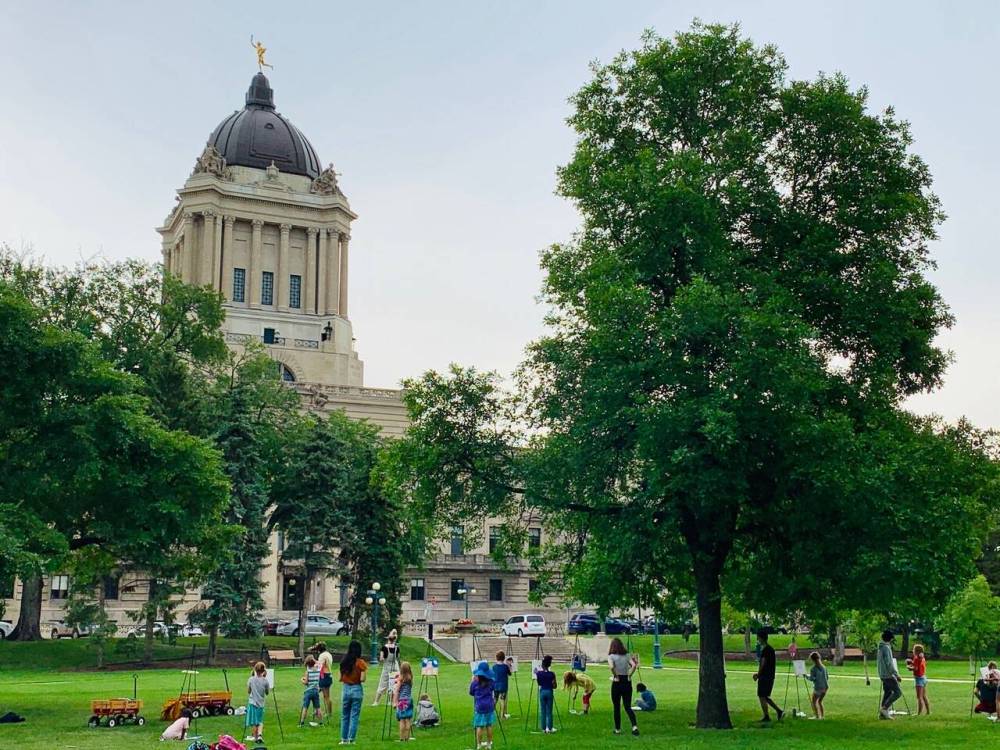
Submitted / Stephen Borys
The Manitoba Legislative Building in Winnipeg. The province’s capital is home to one of Canada’s richest architectural landscapes, Stephen Borys writes.
A city is a manuscript that every generation revises. Our responsibility is to leave the next chapter better than the one we inherited.
Over the past year, I have been working with the Winnipeg Architecture Foundation (WAF) as it develops its strategic vision for the future. The experience reinforced something I have long believed: architecture is never simply about buildings. It is about the kind of community we aspire to become.
As the WAF prepares to celebrate its 30th anniversary, it is worth asking a broader question: why does architectural awareness matter?
Many of us move through Winnipeg without truly seeing it. We notice buildings more when they are threatened with demolition, altered beyond recognition, replaced or burning. By then, the conversation has become reactive rather than thoughtful. Awareness should begin long before a building is endangered.
Winnipeg possesses one of Canada’s richest architectural landscapes. From the Exchange District and its celebrated commercial architecture to historic churches, Prairie modernism and neighbourhood centres, our city tells its story through its buildings.
For nearly 30 years, the WAF has helped Winnipeggers read that story. Through publications, walking tours, lectures, its annual Architecture + Design Film Festival and an outstanding architectural website, the WAF has quietly become one of Winnipeg’s most important cultural organizations. It has done so not by insisting every old or modernist building be preserved, but by helping citizens better understand the built environment that surrounds them every day.
The WAF also takes us to places we might otherwise overlook — a quiet corner of the East Exchange, the former home of a celebrated Winnipegger, a restored bank building or Brookside Cemetery, the largest cemetery in Western Canada.
Architecture is the most public art we create. Every resident lives with the consequences of decisions about our built environment. That is why architectural literacy matters.
Communities rarely protect what they do not like or understand. Awareness is the beginning of stewardship and stewardship begins with learning to see the city differently.
Throughout my career in museum leadership, I have often described museums as places that preserve, interpret and share our cultural heritage. The Winnipeg Architecture Foundation performs a similar role. Rather than caring for objects, it helps us understand the larger story our buildings tell together.
That is why the Foundation deserves the same civic recognition and investment as Winnipeg’s museums, galleries, libraries and archives. The WAF simply works at the scale of the city itself. Its exhibitions are our streets, its galleries our neighbourhoods and its collection is the city we collectively inhabit.
My work has recently led me to three heritage projects.
At the National Indigenous Residential School Museum in Long Plain First Nation, I have been advising on conceptual plans for a significant addition and conservation project. At Oseredok Ukrainian Cultural and Educational Centre, we are exploring how a century-old institution can be renewed while strengthening access to its remarkable collection. At Holy Trinity Church, community consultation is helping shape a new vision for one of Winnipeg’s great historic churches.
Together, these projects have reinforced that heritage conservation is never about freezing places in time. It is about ensuring historic places continue to serve the communities around them.
Working alongside the WAF staff and board reinforced another lesson. The Foundation’s work extends well beyond documenting and celebrating Winnipeg’s architectural heritage. It is helping cultivate a public that is better equipped to understand, question and shape the built environment. That broader mission is shared by architects, planners, historians, educators and volunteers, who recognize that good architecture is about far more than buildings. It is ultimately about the kind of city we choose to create.
Cities must continue to evolve. This is not a plea to preserve every old building. Good stewardship requires discernment as much as passion. Some buildings deserve preservation, others imaginative adaptive reuse and some have reached the end of their useful lives. Every new building is an opportunity to strengthen the city we leave behind.
Too often today, buildings are shaped by short investment cycles rather than long civic ones. Speed can take precedence over quality, convenience can overshadow beauty and immediate economic return can eclipse long-term public value. We should resist the notion that architecture is simply another disposable commodity.
Every building contributes — for better or worse — to the character of a street, a neighbourhood and ultimately our city.
Winnipeg deserves our highest ambitions. We should expect architecture that reflects the confidence, character and identity of our community — not because every building must become a landmark, but because every building contributes to the city we collectively create.
As the WAF celebrates three decades of service, the best way to honour that achievement is to become a more thoughtful citizen of the places we inhabit. Attend a walking tour. Explore its website: winnipegarchitecture.ca. Support its work. Learn to read your city.
The greatest threat to Winnipeg’s architectural future is not demolition.
It is indifference.

Buildings disappear long before the wrecking ball arrives. They disappear when citizens stop paying attention, when short-term thinking replaces long-term stewardship and when we forget that every building — whether a church, museum, warehouse, school or home — contributes to the story of our city.
Every generation inherits a city. Every generation edits that city.
Cities reveal what they value because buildings remember long after we are gone. They outlast the debates that created them. They remain as evidence of what we valued — and what we failed to value.
Architecture is never simply about buildings. It is about the city we choose to leave to those who come after us.
Stephen Borys is president and CEO of Civic Muse, an arts and cultural consulting practice based in Winnipeg. www.civicmuse.ca.
Our newsroom depends on a growing audience of readers to power our journalism. If you are not a paid reader, please consider becoming a subscriber.
Our newsroom depends on its audience of readers to power our journalism. Thank you for your support.
Our newsroom depends on a growing audience of readers to power our journalism. If you are not a paid reader, please consider becoming a subscriber.
Our newsroom depends on its audience of readers to power our journalism. Thank you for your support.
Advertisement Advertise With Us
Advertisement Advertise With Us