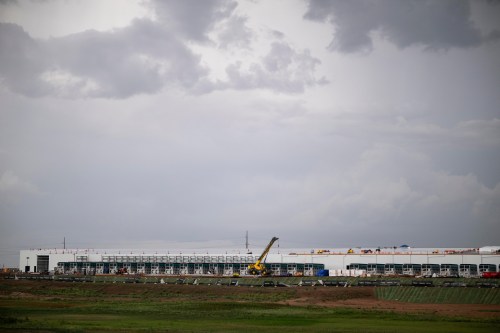
Trump expands a voluntary pledge to protect consumers from high utility bills from AI data centers
Advertisement
Read this article for free:
or
Already have an account? Log in here »
To continue reading, please subscribe:

Digital Subscription
One year of digital access for only $205*
- Enjoy unlimited reading on winnipegfreepress.com
- Read the E-Edition, our digital replica newspaper
- Access News Break, our award-winning app
- Play interactive puzzles
*First annual payment billed as $205.00 + GST for one year. This annual subscription will automatically renew at $233.00 + GST every 52 weeks (10% off the regular annual price of $259.35). Offer available to new and qualified returning subscribers only. Cancel any time.
To continue reading, please subscribe:
Add Free Press access to your Brandon Sun subscription for only an additional
$1 for the first 4 weeks*
- Enjoy unlimited reading on winnipegfreepress.com
- Read the E-Edition, our digital replica newspaper
- Access News Break, our award-winning app
- Play interactive puzzles
*Your next Brandon Sun subscription payment will increase by $1.00 and you will be charged $17.95 plus GST for four weeks. After four weeks, your payment will increase to $24.95 plus GST every four weeks.
Read unlimited articles for free today:
or
Already have an account? Log in here »
WASHINGTON (AP) — President Donald Trump on Thursday had governors and electricity companies join a voluntary pledge to shield U.S. consumers from higher utility bills from data centers — a sign of how the artificial intelligence build-out has become a lightning rod of controversy before the midterm elections.
The president first announced the pledge with leading AI and tech companies in March, but that initial commitment has done little to comfort voters who are already grappling with affordability issues as they worry about competing for electricity, water and land with tech companies controlled by billionaires. It’s unclear, with electricity demand already growing, whether consumers would see genuine savings.
Trump is doubling down on the pledge at a time when the broader social contract is being rewritten by AI, a technology that is evolving so quickly in its capabilities that governments are struggling over how to provide oversight.
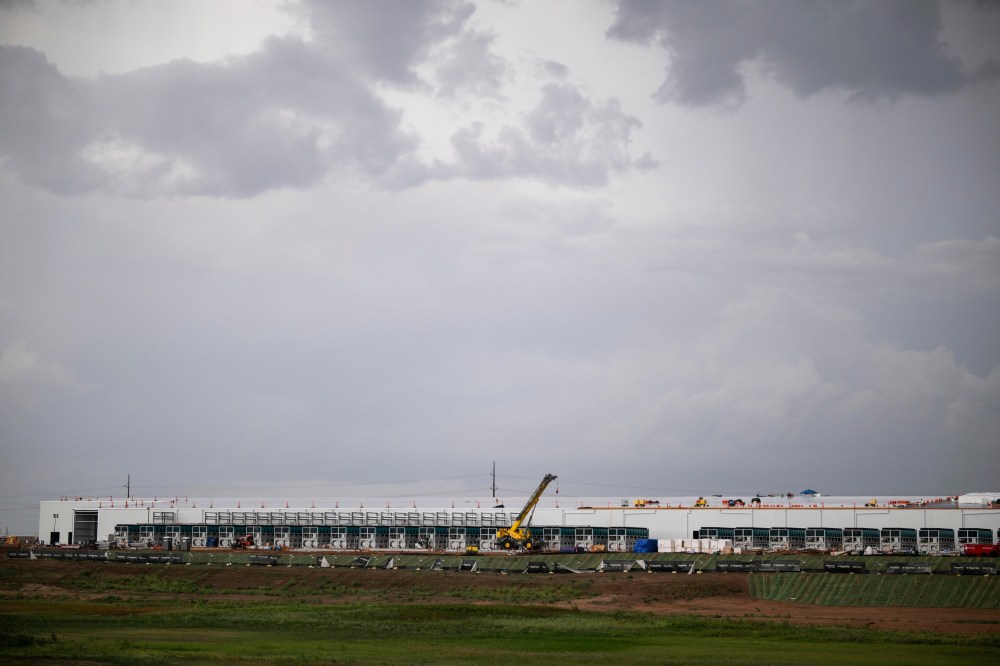
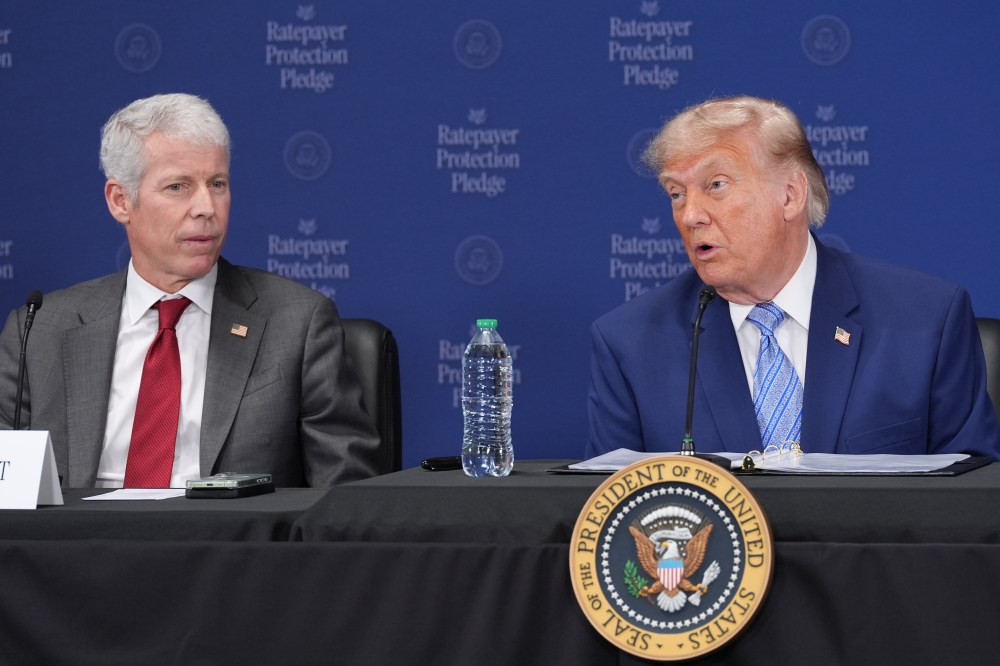
The president, in remarks about the pledge at the Environmental Protection Agency, called on the gathered executives and governors to sell the public on data centers, stressing that the cities and towns that do have them will be “rich.”
“You have to convince your community,” Trump said. “You can’t fight it. You have to go with it.”
The president added: “If you don’t take all that money, somebody else is going to take it. You might as well do it yourselves.”
Concerns about data centers cross party lines
The president promised that electricity prices would drop because of the nonbinding pledge, saying there would be a surplus of power. It’s not clear that data centers generating their own electricity will be sufficient to overcome the rising demand for electricity, but that did not deter Trump from saying that utility bills — a major concern for voters — will be lower.
“Electricity bills for American families will actually come down,” Trump said. “They’re going to have a lot of electricity left over, and they’ll put that into the grid.”
The White House said Thursday the pledge has been signed by 23 governors and at least 187 companies, including 55 utilities and 27 data center developers. Signers include some of the nation’s biggest utilities such as NextEra Energy, Duke Energy, American Electric Power, Southern Co. and Pacific Gas & Electric.
Data center developers that have signed the pledge include Equinix, Digital Realty and Prologis.
A slowdown in data center construction could derail what has been one of the dominant drivers of U.S. economic growth, in addition to possibly ceding the U.S. edge in cultivating the technology to China and create national security risks.
But AI’s increasing ability to perform basic tasks — such as driving, analyzing spreadsheets and writing software — also potentially threatens millions of jobs. That has created mounting public resistance as tech companies concentrate historic levels of wealth in the hands of a select group of tycoons.
The increased electricity demand could cause monthly utility bills to rise by 15% to 40% by 2030, according to a recent analysis by ICF, a consulting and technology services company.
Opposition to data centers has spiraled into a bipartisan issue. Voters are worried about the environmental impact, use of AI in schools and the prospect of data centers making their communities more expensive and less livable. Data center companies say their facilities help to generate tax revenues for school districts and reduce property tax burdens for homeowners.
The opposition has spread into the Republican stronghold of rural Texas and led to frustration with Gov. Greg Abbott, who is now among the 23 Republican governors who signed Trump’s nonbinding pledge.
Gina Hinojosa, the Democratic nominee for Texas governor, has been using the issue to challenge Abbott before the November election.
“They are owned by the richest men in the world,” she said of data centers. “We’re all footing the bill. There are no rules. It is the Wild West of data centers.”
New York Gov. Kathy Hochul, a Democrat, signed an order to ban construction of large server warehouses in her state for a year. In May, Florida Gov. Ron DeSantis, a Republican, signed a law that he said would prevent utilities from passing along energy costs from data centers to residential and small-business customers.
Already, dozens of state legislatures or utility commissions have moved to put in place requirements that data centers pay the cost of their electricity, including new power plants or transmission system upgrades. But it’s not
Tech companies are pushing growth of data centers
In California, however, the industry opposes legislation designed to protect consumers from electricity price increases attributable to data centers, said Matthew Freedman, a staff attorney for the Utility Reform Network.
“It is disappointing, but perhaps not surprising, that the same tech companies signing the Ratepayer Protection Pledge are simultaneously opposing efforts at the state level to force them to deliver on their promises,” Freedman said.
In an interview with The Associated Press last month, Nvidia CEO Jensen Huang, whose computer chips are enabling the AI revolution, said America’s weakness is a lack of power generation for further developing the technology.
Google, Microsoft, Meta, Oracle, xAI, OpenAI and Amazon are among the companies that have already committed to the Trump administration’s “Ratepayer Protection Pledge” that consumers will not shoulder the cost of the data center build-out.
Despite the pledge, there are challenges on addressing issues with electricity prices.
The White House has complained that PJM Interconnection, which oversees electric power in 13 states from Virginia to Illinois, can’t ensure adequate electricity supplies at reasonable prices in the AI-driven boom.

White House spokeswoman Taylor Rogers said Thursday that PJM —- the nation’s largest grid operator — has failed to implement a bipartisan statement of principles signed by the Trump administration and all 13 governors in the region.
“The Trump administration strongly advises PJM and its member companies to proactively reform its stakeholder process, reform its board governance, and implement the Statement of Principles before it is too late,” Rogers said.
There are efforts to formalize Trump’s pledge as law, with the House Energy and Commerce Committee approving a bipartisan bill. The bill would require data centers to bear the costs of grid upgrades.
__
Associated Press writer Marc Levy in Harrisburg, Pa., contributed to this report.
Related Articles
AI models' breakout from human control brings a told-you-so moment for technology researchers
Advertisement Advertise With Us
Advertisement Advertise With Us