

Complex crisis confounds
While Village hub has transitioned from church to community space, entrenched issues persist

Advertisement
Read this article for free:
or
Already have an account? Log in here »
To continue reading, please subscribe:

Digital Subscription
One year of digital access for only $205*
- Enjoy unlimited reading on winnipegfreepress.com
- Read the E-Edition, our digital replica newspaper
- Access News Break, our award-winning app
- Play interactive puzzles
*First annual payment billed as $205.00 + GST for one year. This annual subscription will automatically renew at $233.00 + GST every 52 weeks (10% off the regular annual price of $259.35). Offer available to new and qualified returning subscribers only. Cancel any time.
To continue reading, please subscribe:
Add Free Press access to your Brandon Sun subscription for only an additional
$1 for the first 4 weeks*
- Enjoy unlimited reading on winnipegfreepress.com
- Read the E-Edition, our digital replica newspaper
- Access News Break, our award-winning app
- Play interactive puzzles
*Your next Brandon Sun subscription payment will increase by $1.00 and you will be charged $17.95 plus GST for four weeks. After four weeks, your payment will increase to $24.95 plus GST every four weeks.
Read unlimited articles for free today:
or
Already have an account? Log in here »
On Wednesday afternoon, when the sun shone its hottest, the shaded lawn in front of the Augustine Centre was empty, save for a shopping cart abandoned beside the church’s old stone entry steps. A security guard milled about the sidewalk on the west side of the building, though in that moment, he didn’t have much to do.
Nearby a man was lying, not on church property, but on a grassy bit of boulevard wedged between the sidewalk and Pulford Street. He lay on his back with his sneakered feet akimbo, gazing up at the leaves. Beside him was a shopping cart piled with blankets, a bag of clothes and other sundry belongings.
A few minutes later, someone emerged from the Oak Table drop-in centre in the church basement, strolled up to the prone man and spoke to him briefly. The man sat up, repacked his cart and pushed it across River Avenue. He collected a second cart he’d stashed there, and rattled away down the back lane behind the Gas Station Theatre.
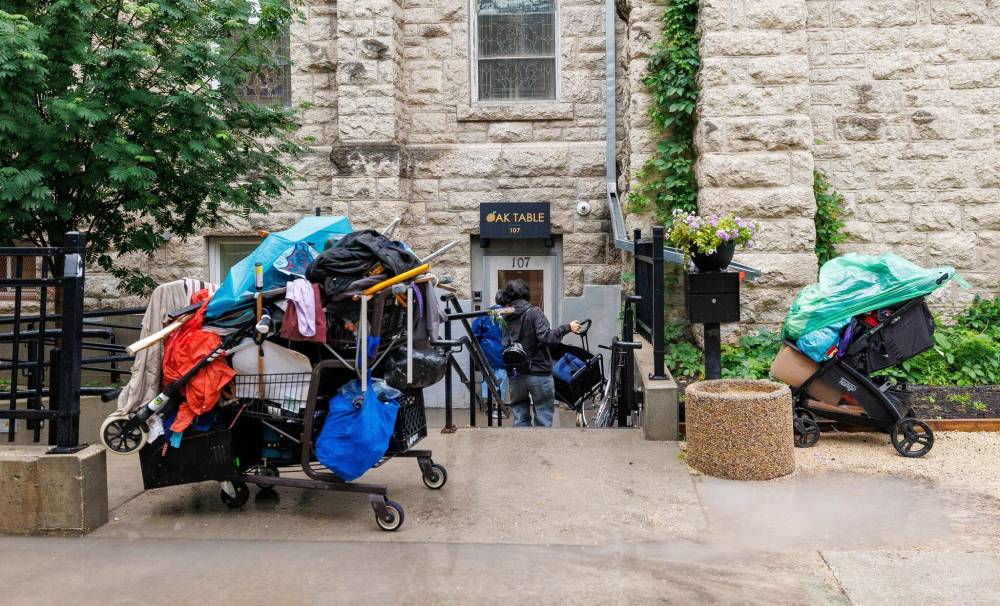
MIKE DEAL / FREE PRESS
Oak Table, located on Pulford Street in Osborne Village and operated by social agency 1JustCity, has implemented new security measures to cope with chronic issues stemming from homelessness and the addiction crisis.
After that, for a while, the only people around the building were the security guard and a few small groups of friends and relatives emerging from the Oak Table drop-in, chatting in friendly conversation as they made their way down the street.
This was, already, a much different scene than it had been just days before, and much different than what those of us who live near the Augustine Centre have observed for many years. Before, on an average summer day such as this, the front lawn was routinely inhabited by makeshift shelters and people with nowhere else to go, sleeping face-down in the grass.
Most likely, those folks still have nowhere else to go. But something needed to shift.
The change came just days after long-simmering frustrations over drug use, encampments and individuals acting in erratic ways boiled up and into the news. The Splash childcare centre, which is located in the same church, worried about the kids under their care. Residents and workers nearby worried about their safety.
Nothing about this situation is remotely new. For six years until 2021, I lived in a condo on Pulford Street, directly across from the old church; and just a block away ever since.
The street had its ups and downs.
In 2018, as Winnipeg faced a spiralling meth crisis, it became more common to encounter individuals exhibiting erratic or even threatening behaviours outside my front door. In 2020, as COVID-19 kept us in our homes, a small and lasting encampment sprung up beside Oak Table’s entrance, for some of the Winnipeggers who had none.
My balcony directly overlooked the encampment; I came to know each regular resident by the sound of their voices. For the most part they tended their camp quietly and kept to themselves. Yet when exiting the back door of my building, I regularly had to sidestep used needles and human feces.
I didn’t hate the campers for this; they had nowhere else to go. What I hated was not knowing what to do or who to call to find a solution that would support their needs while granting all of us more dignity and safety, a solution that didn’t come down to an us-versus-them clash. Eventually, police came and cleared that encampment.
Last week, when my colleague Scott Billeck interviewed residents who live near the church, some expressed similar worries: they didn’t want to be seen as lacking compassion or being bad neighbours. This is one of the core challenges for communities to respond to drug crisis: many Winnipeggers want to act with care. It’s often less clear how we can.
At the Augustine Centre, since those tensions made the news last week, it seems everyone involved has acted quickly to move forward. Even the mayor got involved, sending an adviser to meet with representatives from the neighbourhood and Oak Table, which is operated by social agency 1JustCity. They started coming up with a plan, including added security.
Some headlines about this situation made it sound more acute than chronic. Reading them, a new worry came to my mind. Homelessness and addiction is tragedy enough for our communities already. It would compound that tragedy even more if one of the organizations doing the most to help came to be linked, in the public mind, more with trouble than healing.
The Oak Table has been a core part of Osborne Village community-building since 1981. It started as a cosy fellowship, meeting around an actual oak table. Over the years, as the need in the community grew, the program too expanded, eventually becoming a registered charity and offering a wide range of services.
Today, the centre does remarkable work. It has provided countless meals, showers, hygiene supplies, emergency clothing and a place to warm up for individuals and families from a wide range of backgrounds. It connects people with the health care they need. The community it has built between volunteers and guests is beautiful, lasting and strong.
If you visit the centre during lunch, you will see a safe place, where a diverse range of people come to enjoy a meal with new and old friends.
Some are seniors who thrive on having regular companionship; others face deeper struggles, but find in the centre a place of calm and belonging in a world that already pushes them to the fringes.

It’s true, some of the guests who struggle the most with addiction or mental health have had those challenges become visible outside the centre’s doors. That’s only a tiny minority of the people Oak Table serves; you can sit outside its doors and easily observe how almost all of its guests come and go pleasantly, without incident.
Most importantly, the problems would still exist if Oak Table did not. The centre, and other social supports like it, did not create the pain that persists on this city’s streets. They help heal it. If they disappeared tomorrow, the struggles would still be there, be worse and exist in mostly in the same places; social supports open where there’s already a need.
Ten minutes after his sleep had first been interrupted, the man with the carts had re-emerged onto River Avenue, pushing his belongings back towards the street. He was more agitated now, muttering to himself angrily in a low voice. It was clear that not knowing where to go was contributing to his unease.
Across the street, the front lawn at Augustine Centre was quiet and yet, in the big picture, nothing had truly changed.
melissa.martin@freepress.mb.ca
Melissa Martin
Reporter-at-large
Melissa Martin reports and opines for the Winnipeg Free Press.
Every piece of reporting Melissa produces is reviewed by an editing team before it is posted online or published in print — part of the Free Press‘s tradition, since 1872, of producing reliable independent journalism. Read more about Free Press’s history and mandate, and learn how our newsroom operates.
Our newsroom depends on a growing audience of readers to power our journalism. If you are not a paid reader, please consider becoming a subscriber.
Our newsroom depends on its audience of readers to power our journalism. Thank you for your support.
Melissa Martin
Reporter-at-large
Melissa Martin reports and opines for the Winnipeg Free Press.
Every piece of reporting Melissa produces is reviewed by an editing team before it is posted online or published in print — part of the Free Press‘s tradition, since 1872, of producing reliable independent journalism. Read more about Free Press’s history and mandate, and learn how our newsroom operates.
Our newsroom depends on a growing audience of readers to power our journalism. If you are not a paid reader, please consider becoming a subscriber.
Our newsroom depends on its audience of readers to power our journalism. Thank you for your support.
Related Articles
Almost 250 people moved from city encampments under provincial strategy


Advertisement Advertise With Us
Advertisement Advertise With Us