Province urged to lead effort to prevent dog maulings Advocates want co-ordinated approach following fatal attack on rescue worker
Read this article for free:
or
Already have an account? Log in here »
To continue reading, please subscribe:

Digital Subscription
One year of digital access for only $205*
- Enjoy unlimited reading on winnipegfreepress.com
- Read the E-Edition, our digital replica newspaper
- Access News Break, our award-winning app
- Play interactive puzzles
*First annual payment billed as $205.00 + GST for one year. This annual subscription will automatically renew at $233.00 + GST every 52 weeks (10% off the regular annual price of $259.35). Offer available to new and qualified returning subscribers only. Cancel any time.
To continue reading, please subscribe:
Add Free Press access to your Brandon Sun subscription for only an additional
$1 for the first 4 weeks*
- Enjoy unlimited reading on winnipegfreepress.com
- Read the E-Edition, our digital replica newspaper
- Access News Break, our award-winning app
- Play interactive puzzles
*Your next Brandon Sun subscription payment will increase by $1.00 and you will be charged $17.95 plus GST for four weeks. After four weeks, your payment will increase to $24.95 plus GST every four weeks.
Read unlimited articles for free today:
or
Already have an account? Log in here »
More than two dozen animal advocacy groups are calling for an immediate meeting with federal and provincial governments and First Nations leadership to co-ordinate efforts to deal with problem dog populations following the mauling death of a rescue worker this month.
The Winnipeg Humane Society, K9 Advocacy Manitoba and Partners in Prevention are among the 26 groups asking for the creation of an advisory committee — which would include veterinary experts — to ensure a provincewide strategy on problem dog populations is developed and implemented.
“This is very much that call for action,” said Christina Von Schindler, CEO of the humane society. “The time is now.”
Jennelle Andre-Sealey, left, and Tatiana Janovcik, with dog Bear, whose jaw was injured by a gunshot on God’s Lake Narrows First Nation. The two women worked closely with Amanda Nobiss through their group Partners in Prevention, a branch of K9 Advocacy Manitoba. (Morgan Modjeski / Free Press)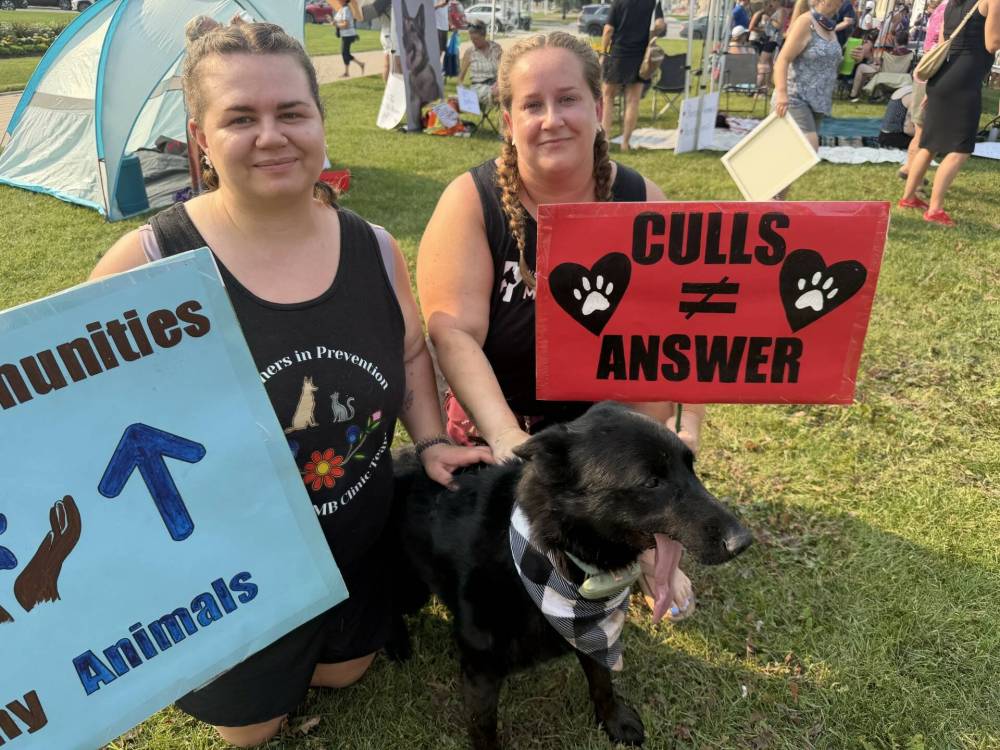
They say there are “systematic gaps” in dealing with overpopulation and the lack of veterinary services in First Nation communities. They say it is tantamount to a public health crisis.
Amanda Nobiss, a 37-year-old Winnipeg woman who volunteered with K9 Advocacy and was passionate about rescuing dogs, was mauled to death on the Sandy Bay First Nation northwest of Winnipeg July 17.
Von Schindler said for too long the debate about jurisdiction has hampered the ability to address the problem of overpopulation in remote communities, which has led to packs of stray dogs being a danger to residents, especially children.
She said rescue groups, which have acted independently, should be brought together so they can tackle the problem in a unified way.
“Our communities in Manitoba has been under-served for far too long and tragedy occurs when that happens,” she said. “We need to get around one table and stop talking and start acting.”
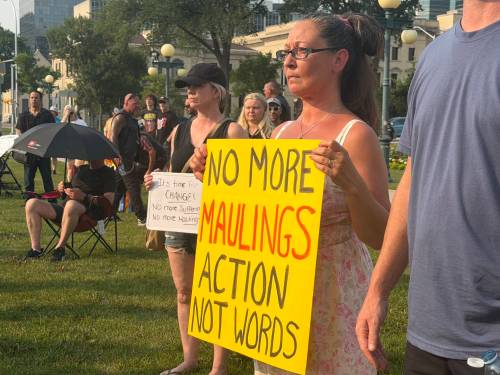
About 200 people gathered at the Manitoba legislature Wednesday evening for a “No More Manitoba Maulings” rally. (Morgan Modjeski / Free Press)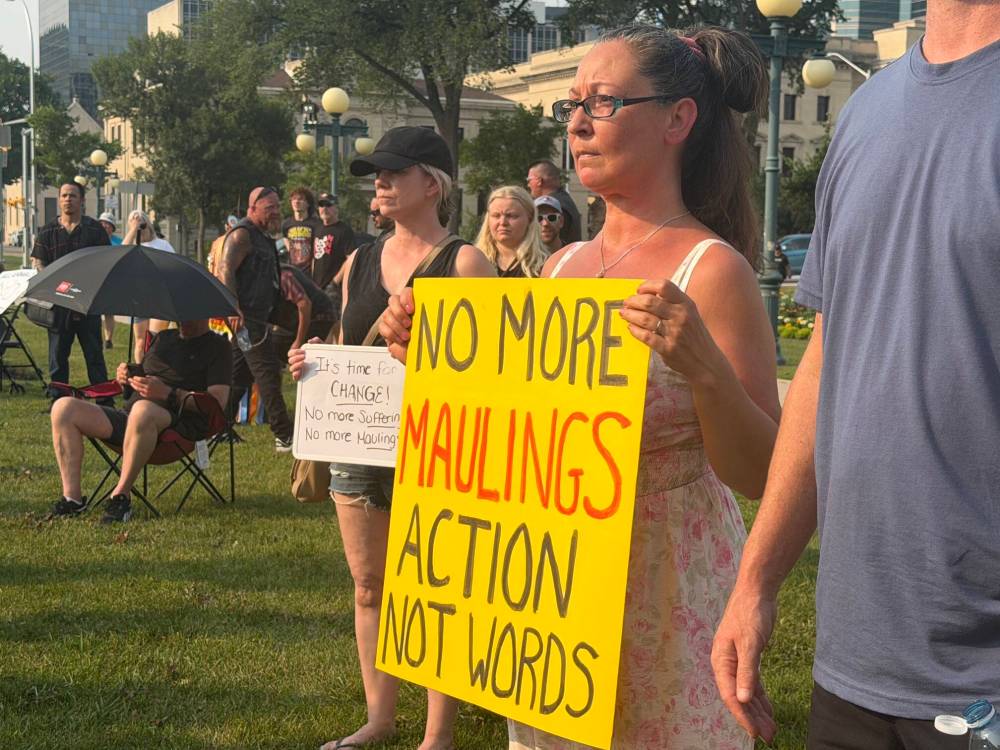
The groups say the provincial and federal governments must fund the effort to keep people safe from harmful dog packs. They want a concerted effort on community-led solutions that are Indigenous-led as part of a provincewide strategy.
“It’s vital and it’s past time,” Von Schindler said, pointing out most of the work currently done is fuelled by volunteers and donations.
Von Schindler said for years people have received life-altering injuries or died as a result of stray and roaming dogs, and Nobiss’s death is the most recent tragedy.
“We can’t keep pretending the need isn’t immediate,” she said, stressing dedicated, multi-year support and planning is needed.
“The communities can’t do that on their own, their rescues sure as heck can’t. We need our government partners to join us and plot this path forward.”
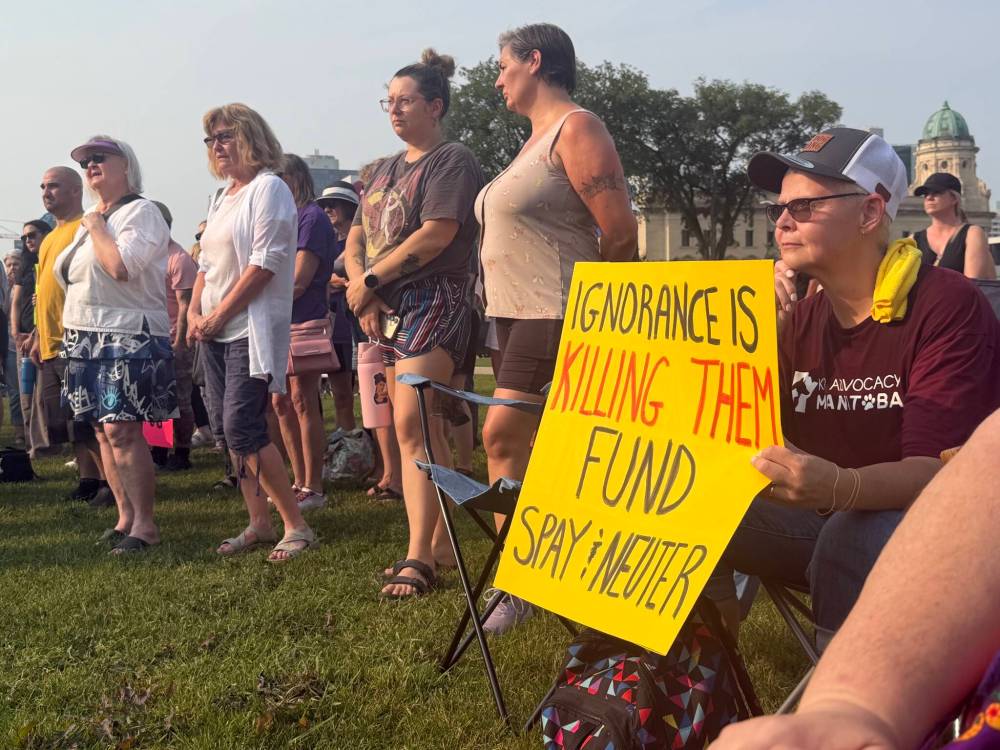
The call was echoed by about 200 people who gathered at the Manitoba legislature Wednesday evening for a “No More Manitoba Maulings” rally.
Jennelle Andre-Sealey and Tatiana Janovcik, who founded Partners in Prevention, the spay and neuter branch of K9 Advocacy Manitoba, along with Nobiss, said connecting with communities is a cornerstone of their mission.
“In order to protect the community, you need to care for the animals in the community,” said Andre-Sealey.
She said dedicated funding would help create animal welfare positions both in and outside First Nations.
“We’re doing it (as volunteers) after a 40-hour work week. So imagine those positions being paid to be there, doing this every day,” she said.
A song recited at the event called Nobiss an “angel to these creatures.”
“It’s showing how fed up and how tired the (advocacy) community is. We need government help.”
Kristy Zamonsky, president of Project Artemis Animal Advocates, who helped organize the rally, said presenting a unified front is critical to getting action on the issue.
“It’s showing how fed up and how tired the (advocacy) community is,” she said. “We need government help.”
The First Nations Police Service release said Tuesday autopsy results indicated Nobiss’s “injuries were consistent with a dog attack.”
She had been in Sandy Bay to pick up several puppies from a resident on behalf of K9 Advocacy Manitoba on the day before she was found, police said.
They believe she went to the home alone and came across the resident’s “protective and aggressive” dogs. A community maintenance worker found her remains one day later.
In February, a 56-year-old man died two days after he was attacked by five dogs on Keeseekoowenin Ojibway First Nation, south of Riding Mountain National Park. Also in February, a 22-year-old woman was significantly injured when four dogs attacked her on Ebb and Flow First Nation as she walked along a highway.
In 2024, a nine-year-old girl was attacked by 10 dogs in Norway House Cree Nation as she was out for a walk with her dog.
A statement from the office of Agriculture Minister Ron Kostyshyn said the government would attend meetings on the issue, noting the minister’s office met with the humane society on Monday. It called the meeting productive.
The province said Manitoba Agriculture spent $1 million to support mobile spay-and-neuter services through the Northern and Remote Veterinary Care Initiative, which the government said, “has serviced thousands of animals and supported many communities across Manitoba.”

The statement said the government is waiting for the results of the police investigation into Nobiss’s death so it can “fully understand what happened.”
The director of Northern Manitoba Paws in Need, a smaller rescue organization, said the number of people hurt by dogs in remote areas is under-reported.
Victoria McNevin, who has run the organization for 14 years, said they work with communities such as Nelson House and South Indian Lake. She said they need help developing bylaws, animal capacity limits and even local dog-rescue facilities.
“They need the ability to start these programs, to launch them and to get constant spay and neuter clinics in so that there’s not such an overpopulation,” she said.
“There’s just so many people who have been mauled or attacked… The children, the elders and the people who live in the community, they’re constantly worrying, ‘Can I let my kids out to play today?’” she said. “It’s crazy. There needs to be a solution.”
morgan.modjeski@freepress.mb.ca
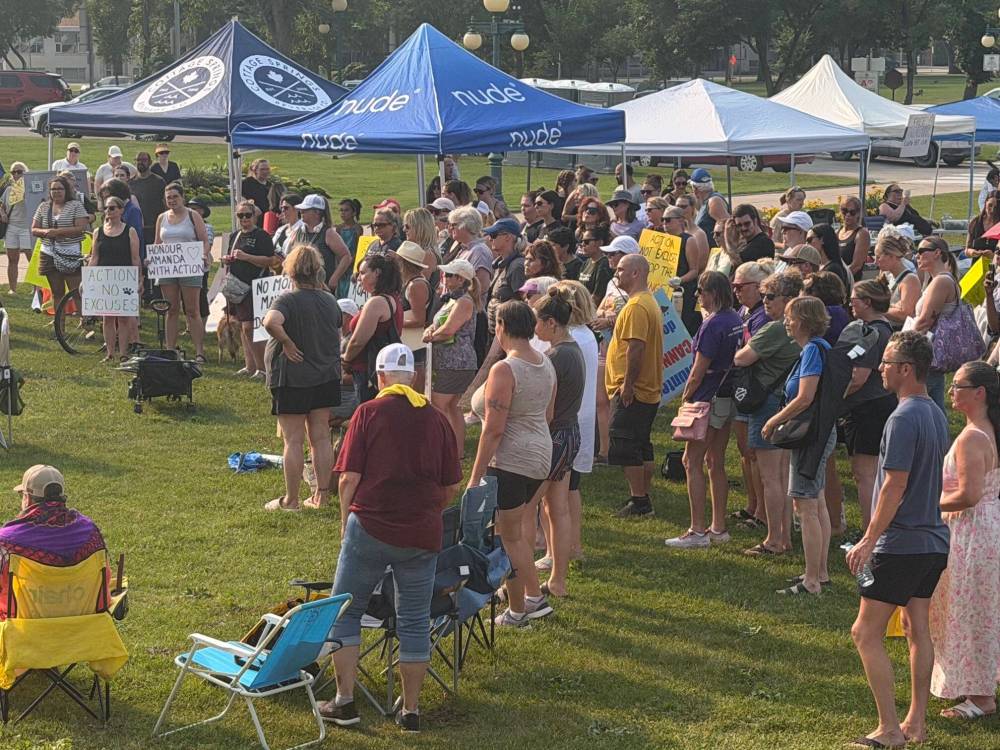
About 200 people gathered at the Manitoba legislature Wednesday evening for a “No More Manitoba Maulings” rally. (Morgan Modjeski / Free Press)

Morgan Modjeski
Reporter
Signal
Morgan Modjeski is a news reporter and multimedia producer for the Free Press. Read more about Morgan.
Every piece of reporting Morgan produces is reviewed by an editing team before it is posted online or published in print — part of the Free Press‘s tradition, since 1872, of producing reliable independent journalism. Read more about Free Press’s history and mandate, and learn how our newsroom operates.
Our newsroom depends on a growing audience of readers to power our journalism. If you are not a paid reader, please consider becoming a subscriber.
Our newsroom depends on its audience of readers to power our journalism. Thank you for your support.
Related Articles
Autopsy confirms dog attack killed animal-rescue volunteer on First Nation