Some Canadians tell Carney Ottawa’s spelling protocol should lean British

Advertisement

Advertise with us

OTTAWA - It seems some Canadians feel quite at home with the federal government's preference for British spelling.

Read this article for free:


or

Already have an account? Log in here »

To continue reading, please subscribe:

Subscribe and receive a limited-edition Free Press branded hat or tote.

Digital Subscription

One year of digital access for only $205*

  • Enjoy unlimited reading on winnipegfreepress.com
  • Read the E-Edition, our digital replica newspaper
  • Access News Break, our award-winning app
  • Play interactive puzzles

*First annual payment billed as $205.00 + GST for one year. This annual subscription will automatically renew at $233.00 + GST every 52 weeks (10% off the regular annual price of $259.35). Offer available to new and qualified returning subscribers only. Cancel any time.

To continue reading, please subscribe:

Add Free Press access to your Brandon Sun subscription for only an additional

$1 for the first 4 weeks*

  • Enjoy unlimited reading on winnipegfreepress.com
  • Read the E-Edition, our digital replica newspaper
  • Access News Break, our award-winning app
  • Play interactive puzzles
Start now

*Your next Brandon Sun subscription payment will increase by $1.00 and you will be charged $17.95 plus GST for four weeks. After four weeks, your payment will increase to $24.95 plus GST every four weeks.

OTTAWA – It seems some Canadians feel quite at home with the federal government’s preference for British spelling.

Messages to Prime Minister Mark Carney on the matter indicate several correspondents see the affectation as a way of countering U.S. cultural dominance.

A flurry of emails to Carney followed news last December that promoters of Canadian English objected to the federal government’s use of British spelling in official documents.
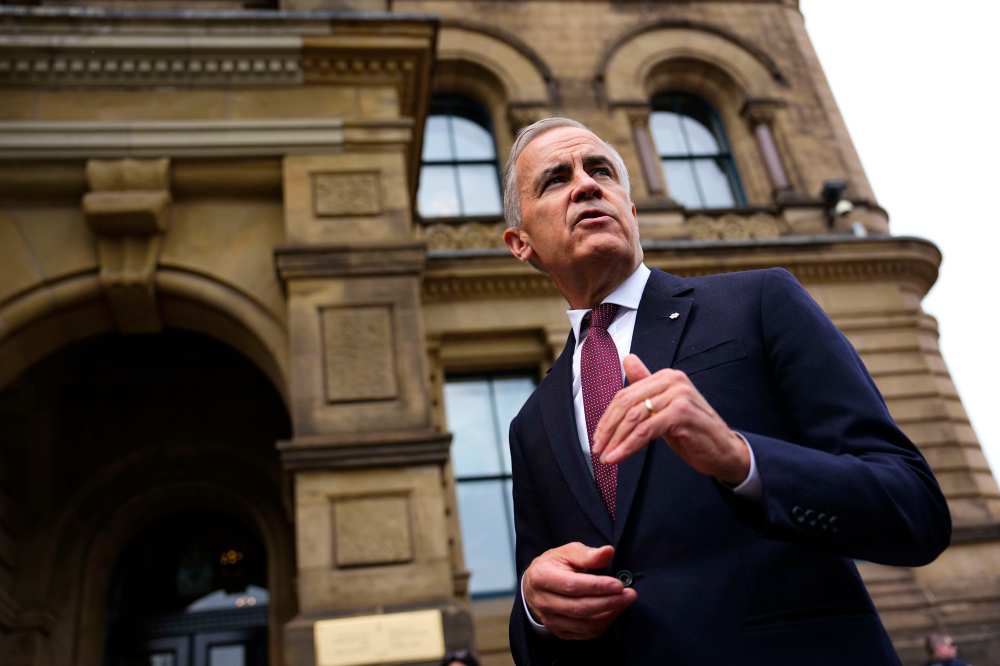
Prime Minister Mark Carney makes a statement outside the Office of the Prime Minister and Privy Council in Ottawa, on Tuesday, July 21, 2026. THE CANADIAN PRESS/Justin Tang

Dozens of pages of messages were released to The Canadian Press in response to an Access to Information request.

While some writers flatly objected to the federal shift, others applauded it as patriotic.

“In our effort to distance ourselves from our acquisitive, abusive southern neighbours, I support this move,” wrote one person.

“Always neighbours, never neighbors.”

In a Dec. 11 letter that touched off the public debate, five linguistics experts and an editors association representative pointed to the use of British spelling — such as utilisation, globalisation and catalyse (instead of utilization, globalization and catalyze) — in government documents, including the 2025 federal budget.

Canadian spelling is used widely and consistently in Canada — in book and magazine publishing, in newspapers and other media, and in the federal and provincial governments and their legislatures, the letter said.

“If governments start to use other systems for spelling, this could lead to confusion about which spelling is Canadian,” it added.

The experts asked the Prime Minister’s Office, the Canadian government and Parliament to stick to Canadian English spelling, “which is the spelling they consistently used from the 1970s to 2025.”

A widely published Canadian Press story about the letter spawned international coverage of the spelling spat.

Standard Canadian English is unique among the varieties of English around the world because, while it is influenced by its geographic proximity to the U.S., it has features distinct from both U.S. and U.K. English, the letter from the experts noted.

That nuance seemed to have been lost on some of those who felt compelled to write to Carney.

“The British spelling is more Canadian than U.S. spelling,” reads one message. “If we don’t protect our Canadian spelling, by favouring the British spelling, eventually our spelling will mimic the U.S.”

The names of the email writers were stripped from the newly released records in keeping with a privacy exemption in the access law.

Another message urged Carney to keep the British spelling “as this is what I grew up with and I quite like the British tradition rather than an American bastardized one.”

The experts’ key point about Canadian acceptance of “-ize” endings also appeared to elude at least one federal official.

In a response to one message expressing a preference for British spelling over American spelling, an officer who handles correspondence for the prime minister pointed to a 2017 blog post on a government website about why Canadian spelling is different.

The post noted that language evolves and that Canadians now share some spelling preferences with their neighbours to the south.

“Take the endings of verbs like ‘organize,’ ‘civilize’ and ‘specialize,’ for example: the majority of us favour the traditional spelling ‘-ize’ (the only spelling used in the U.S.) rather than the variant ‘-ise’ now so popular in British English.”

Several people simply told Carney to stick to Canadian English.

“Something is seriously wrong with our political ‘leaders,'” one person wrote. “We are supposed to be enthusiastically pro-Canadian whenever possible, but not in how we spell our words. Who thought this one up? Fools!”

Another correspondent favoured Canada spelling as a reflection of national identity and consistency in government communications, and alluded to the deep tensions with the United States over U.S. tariffs and threats to Canadian sovereignty.

“Preserving these standards is especially important during this momentous time for our country.”

This report by The Canadian Press was first published Aug. 3, 2026.

Report Error Submit a Tip

More Stories

A new chapter: Renamed Winnipeg Book Festival takes to The Forks this fall

Ben Sigurdson 5 minute read Preview

A new chapter: Renamed Winnipeg Book Festival takes to The Forks this fall

Ben Sigurdson 5 minute read Yesterday at 4:22 PM CDT

Winnipeg’s long-running annual literary festival returns this fall, once again featuring a slate of authors, local and beyond, ready to engage with readers.

New this year is pretty much everything else, including a new name, executive director and team of staff — as well as a shift to a tight, condensed timeline and a move to hold all events under one roof.

The festival formerly known as Thin Air/Livres en fête is now the Winnipeg Book Festival; the event takes place Oct. 1-4 at The Forks Market, with most events offering free admission.

It’s a lot of changes for the stalwart literary festival, which was run for more than two decades by Charlene Diehl, who stepped away in late 2025.

Read
Yesterday at 4:22 PM CDT

Long-awaited supervised drug consumption site opens quietly after months of loud opposition

Malak Abas 11 minute read Preview

Long-awaited supervised drug consumption site opens quietly after months of loud opposition

Malak Abas 11 minute read Updated: Yesterday at 5:57 PM CDT

After three years of planning, delays and constant controversy, Manitoba’s first supervised drug consumption site quietly opened its doors Tuesday morning.

Read
Updated: Yesterday at 5:57 PM CDT

Student union coalition scrutinized, accused of providing minimal benefit for fees paid

Maggie Macintosh 5 minute read Preview

Student union coalition scrutinized, accused of providing minimal benefit for fees paid

Maggie Macintosh 5 minute read Updated: Yesterday at 8:36 AM CDT

Despite being labelled as “permanently closed” online and maintaining a website filled with outdated information, a coalition of student unions is defending itself as an active entity deserving of fees in spite of its low profile.

The Canadian Federation of Students and its local chapter, better known as CFS-MB, collect annual membership dues from campuses across the province to support their advocacy work.

Alan Saji Koshy’s advice to new and returning students to the University of Winnipeg? “Start asking questions.”

“We pay hundreds of thousands of dollars for practically no benefit and students don’t even know (CFS-MB resources) exist,” the recent graduate and former student association president said.

Read
Updated: Yesterday at 8:36 AM CDT

Transcona councillor faces new sex assault charge

Erik Pindera 5 minute read Preview

Transcona councillor faces new sex assault charge

Erik Pindera 5 minute read Updated: Yesterday at 6:40 PM CDT

A city councillor charged with sex assault earlier this year faces new sex charges in a separate incident, in a case Winnipeg’s mayor called “deeply concerning.”

Transcona Coun. Russ Wyatt, 56, was charged Monday with sexual assault and administering a noxious thing with intent to aggrieve or annoy over an October 2023 incident.

Allegations of a 2023 assault were reported to the Winnipeg Police Service in April, a month after Wyatt was charged with sex assault in relation to a 2025 incident.

In the 2023 incident, a man told police he become acquainted with Wyatt through a website in July of that year and said they met in person on more than one occasion.

Read
Updated: Yesterday at 6:40 PM CDT

Killer apologizes to family of 16-year-old he shot in 2024 before judge delivers 18-year manslaughter sentence

Dean Pritchard 5 minute read Preview

Killer apologizes to family of 16-year-old he shot in 2024 before judge delivers 18-year manslaughter sentence

Dean Pritchard 5 minute read Yesterday at 4:26 PM CDT

Sharon Basarowich’s voice quaked with emotion as she told a court Tuesday of the never-ending pain her family has been left with after her 16-year-old grandson was gunned down outside a Boyd Avenue drug house.

“We have a void that will never be filled,” said Basarowich, whose grandson Trey Basarowich, a talented hockey player and youth mentor, was fatally shot Oct. 5, 2024.

“When Trey died, a part of us died, too,” she said.

Devin Evans, 20, was originally charged with second-degree murder in the killing but in a plea bargain admitted to the lesser offence of manslaughter and was sentenced Tuesday to 18 years in prison.

Read
Yesterday at 4:26 PM CDT

AI bio-weapons loom

Gwynne Dyer 4 minute read 2:00 AM CDT

‘Artificial intelligence’ based on large language models is shaping up to be the most efficient destroyer of value since the South Sea Bubble. After “the Crash”, which is inevitably coming, some specific functions of AI will eventually turn out to be genuinely revenue-generating, and a lot of jobs will duly disappear. But the biggest winner (and potentially biggest loser) is medical science.

Dr. Brian Hie, a chemical engineer at Stanford University in California, has just revealed that his team has made the first viruses designed by artificial intelligence. They are ‘bacteriophages’, viruses that only infect bacteria and are widely used to treat people with infections that resist other treatments.

However, natural bacteriophages sometimes fail, so Dr. Hie used generative AI to design new ones that might do the job. The AI generated thousands of designs for new genomes that more or less fit the bill, and he chose around 300 of them to build in the lab. It’s hard work, not magic, but he ended up with 16 ‘novel’ bacteriophages that might work.

He applied them to petri dishes containing two harmful strains of E. coli, a common bacteria that lives in the human gut, and they killed the bacteria off. It’s still early days, but if it is truly becoming possible to tailor-make bacteriophages that target specific bacteria, then we may be getting a major new weapon in the struggle against antibiotic resistance.