This organ will play one composition until 2640. It’s redefining how slowly music can be played

Advertisement

Advertise with us

HALBERSTADT, Germany (AP) — A small organ in eastern Germany is the headliner of the world’s slowest concert. It has been playing the same piece of music by composer John Cage at a glacial pace for nearly 25 years.

Read this article for free:


or

Already have an account? Log in here »

To continue reading, please subscribe:

Subscribe and receive a limited-edition Free Press branded hat or tote.

Digital Subscription

One year of digital access for only $205*

  • Enjoy unlimited reading on winnipegfreepress.com
  • Read the E-Edition, our digital replica newspaper
  • Access News Break, our award-winning app
  • Play interactive puzzles

*First annual payment billed as $205.00 + GST for one year. This annual subscription will automatically renew at $233.00 + GST every 52 weeks (10% off the regular annual price of $259.35). Offer available to new and qualified returning subscribers only. Cancel any time.

To continue reading, please subscribe:

Add Free Press access to your Brandon Sun subscription for only an additional

$1 for the first 4 weeks*

  • Enjoy unlimited reading on winnipegfreepress.com
  • Read the E-Edition, our digital replica newspaper
  • Access News Break, our award-winning app
  • Play interactive puzzles
Start now

*Your next Brandon Sun subscription payment will increase by $1.00 and you will be charged $17.95 plus GST for four weeks. After four weeks, your payment will increase to $24.95 plus GST every four weeks.

HALBERSTADT, Germany (AP) — A small organ in eastern Germany is the headliner of the world’s slowest concert. It has been playing the same piece of music by composer John Cage at a glacial pace for nearly 25 years.

A rare chord change on Wednesday — from seven notes to eight — represented the completion of about 4% of the 639-year endeavor of the John Cage Organ Project Halberstadt.

It was a historic moment inside the medieval Burchardi Church, in Halberstadt, Germany, that reflected the past, present and future of the project, as well as those who are following its — albeit very slow — progression.
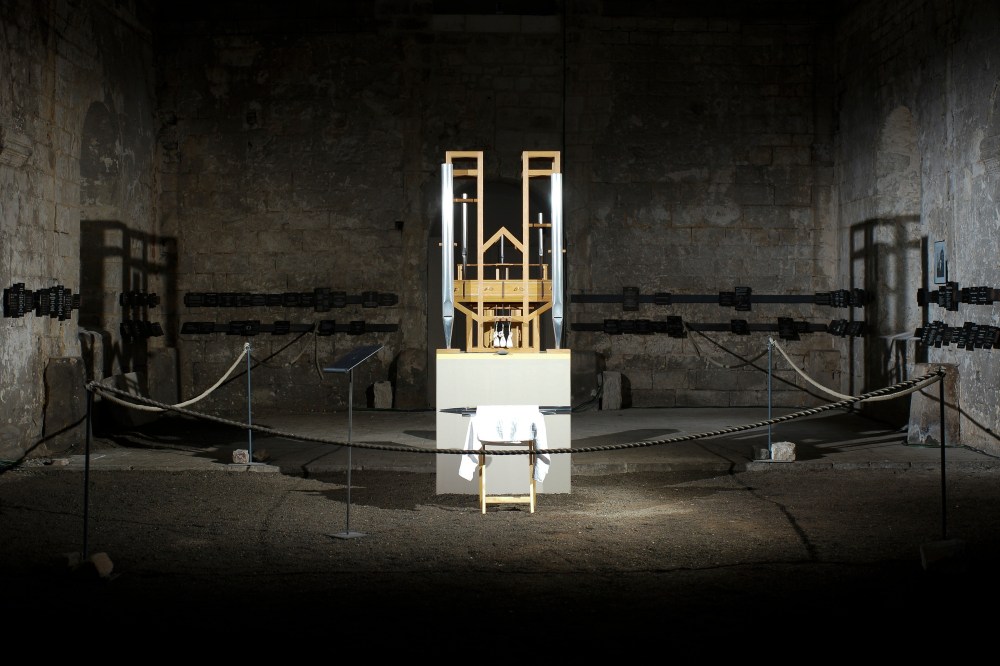
FILE - The organ of the John Cage organ project is illuminated prior to a 'sound change' at the Buchardi Church in Halberstadt, Germany, Sept. 5, 2020. (AP Photo/Markus Schreiber, File)

“As fast as our world is developing, I think it’s a wonderful place to be and to come to yourself and just to be touched by this ‘being there,’”said Anneli Borgmann, chairwoman of the John Cage Organ Project Halberstadt’s board of trustees.

While the project commenced in 2000, the performance began Sept. 5, 2001 — Cage’s 89th birthday — with a silent pause that lasted until Feb. 5, 2003, when the first chords could actually be heard.

The composition — called “ORGAN²/ASLSP (As SLow aS Possible)” — is scheduled to finish on Sept. 4, 2640.

An electric-powered blower system sends wind into the organ to create a continuous sound. A chord change, done manually, means that the sound of the organ pipes changes either because new sounds are added or existing sounds end.

More than 150 people squeezed inside the church Wednesday to witness what was the piece’s 17th chord change, with dozens more watching a livestream outside.

For three minutes, the crowd listened to the “old” chord with its seven pipes. Then, an eighth pipe was slotted into the small organ, bringing with it a new sound that reverberated throughout the church. The spectators listened for another three minutes — some filming with cellphones, others taking it all in with their eyes closed and heads bowed — before breaking out into applause and cries of “bravo!”

“It’s a very subtle difference,” said Jeffrey Lependorf, executive director of the John Cage Trust in New York. “There’s a higher sound that’s a little more prominent.”

Cage’s music inspires after his death
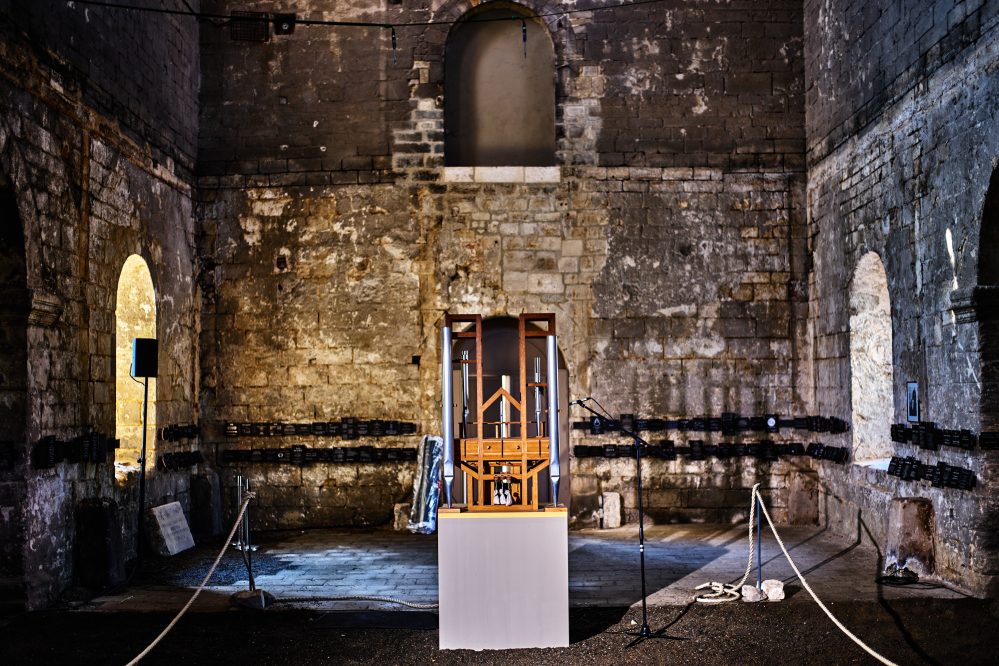
The organ, center, of the John Cage Organ Project Halberstadt is illuminated prior to a chord change of the organ inside the medieval Burchardi Church in Halberstadt, Germany, Wednesday, Aug. 5, 2026. (AP Photo/Markus Schreiber)

Cage, an American avant-garde composer, was born in Los Angeles in 1912 and died in New York in 1992. He was also a renowned music theorist, artist and philosopher whose only direction for this piece was to play it as slowly and as softly as possible. He initially composed it for the piano in 1985 and updated it for the organ in 1987. It was reimagined into the 639-year project after his death.

The interpretation of the composition in Halberstadt has resulted in the smallest unit being one month long. Other units — as well as silences — can last years.

The project has transformed the Burchardi Church, which was left largely in ruins before money was raised for a new roof and other fixes to make the piece a reality. The sound there envelopes visitors throughout the church and gives them new experiences to hear as they move through the empty space.

“I think it really is the organ playing the church and not the other way around,” Lependorf said. “You move two inches in any direction and it sounds not subtly different — very different.”

Generations of stewards ensure organ’s future

The piece will last 639 years, from 2001 to 2640. The time frame was chosen to be a tribute to a historic organ in Halberstadt that dates back to 1361, or 639 years before the project was initiated in 2000, according to Borgmann.

The time frame allows the project’s stewards and visitors to contemplate not only Cage’s legacy but their own as guardians of an organ that will outlive them as each chord change depends upon a new generation of musicians, volunteers and craftspeople to keep the piece going.
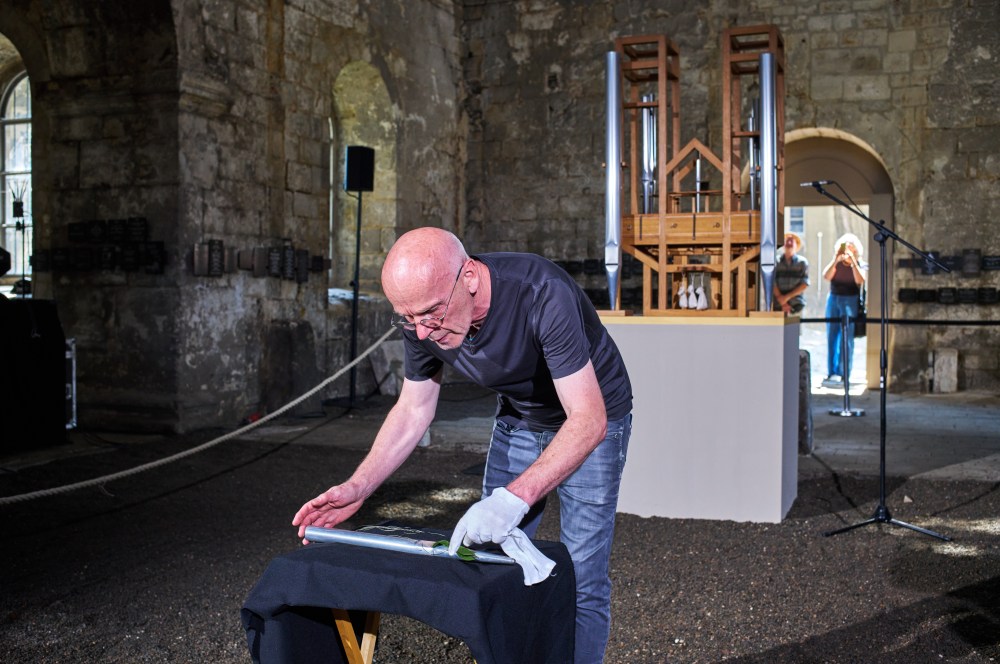
Kay Lautenbach of the board of the John Cage Organ Project Halberstadt of the prepares a new pipe prior to a chord change of the organ inside the medieval Burchardi Church in Halberstadt, Germany, Wednesday, Aug. 5, 2026. (AP Photo/Markus Schreiber)

Cage fan Michael Barnett, 55, from Glasgow, in Scotland, said attending the chord change was a bucket list item.

“This is just one of those things, one of those unique things in the world of music,” he said. “It comes up and you think ‘I just want to do this thing once.’”

Barnett and other enthusiasts also debate what the world will look like by the end of the piece.

“You just wonder what will be left here in 600-odd years time,” Barnett said. “Who will come to the last performance? Will the building still be here? Will the organ still work? What will the world be like?”

The organ, at least, is built to last.

Organ builder Johannes Hüfken said the pipes he’s crafted for this will last at least another 500 years.

“This John Cage project is a good example of thinking ahead for the next generation — thinking outside the box, beyond the completely normal and traditional,” he said.
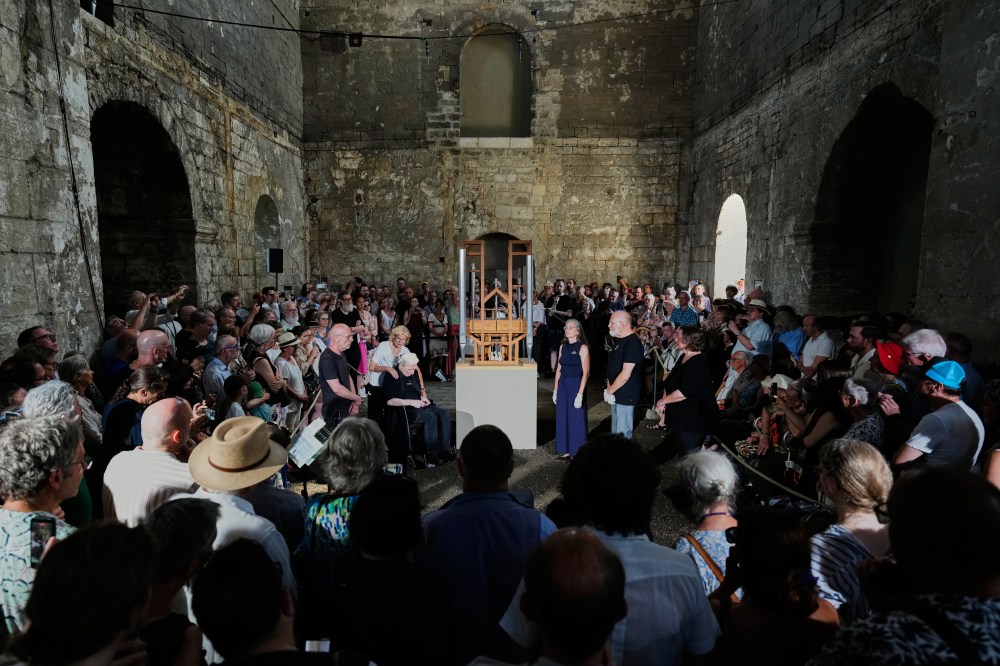
People listen to the sound of the John Cage Organ Project Halberstadt during a chord change of the organ inside the medieval Burchardi Church in Halberstadt, Germany, Wednesday, Aug. 5, 2026. (AP Photo/Markus Schreiber)

The next chord change will take place on Oct. 5, 2027, when the overall sound will be reduced by releasing the E4 pipe.

Inheritable “final tickets” for the Sept. 4, 2640, finale are already being sold for 2,640 euros ($3,045).

___

Markus Schreiber contributed to this report.
Report Error Submit a Tip

More Stories

Doctor pays $500K to revamp courtyard at care home where he works

By Zoe Pierce 4 minute read Preview

Doctor pays $500K to revamp courtyard at care home where he works

By Zoe Pierce 4 minute read Yesterday at 5:06 PM CDT

Fifty years after Dr. Pravinsagar Mehta began caring for residents at Actionmarguerite, a courtyard he had long watched deteriorate is getting a new life after he and his wife committed $500,000 to its redevelopment and long-term maintenance.

The renewed courtyard at Actionmarguerite St. Boniface on Despins Street will officially open Friday, giving its 299 residents an accessible place to spend time outside.

When Mehta, now 80, began working at St. Boniface Home in 1976, the new courtyard reminded him of a park near his childhood home in Uganda — one of the highlights of his upbringing.

“I said, ‘Wow, isn’t it amazing that I can go out, sit outside, and relax there?’” Mehta recalled.

Read
Yesterday at 5:06 PM CDT

Educating youth major priority for artist

Conrad Sweatman 6 minute read Preview

Educating youth major priority for artist

Conrad Sweatman 6 minute read 2:00 AM CDT

It has to be among the biggest skateboard decks in the country, and it hangs in Peatr Thomas’s art studio on Donald Street in the Exchange District.

The four-metre deck’s artwork created by Thomas, depicts Cree skateboarder Joe Buffalo, spirit lines radiating from his airborne figure, as he becomes the first skater to jump over a massive gap (also four metres) in Montreal’s Peace Park.

“I like that idea and practice of falling and getting up again, over and over to achieve something,” says Thomas, 39.

It’s a lesson he applies to his art practice.

Read
2:00 AM CDT

Treating symptoms, not the disease

Charles N. Bernstein 4 minute read 2:00 AM CDT

The backlog in emergency rooms in Manitoba stems from problems before and after the ER, not in the ER.

In Tom Brodbeck’s piece on the chronic and rising emergency room crisis in Winnipeg (Condition critical, Aug. 21) he quoted several experts who alluded to the backlog of accessible beds, beds needed so that acutely ill people can be moved out of the ER onto hospital wards.

This is a problem of an acute-care bed shortage in the acute-care hospitals and a long-term care bed shortage outside of the acute-care hospitals, where patients who no longer need acute care should be.

One major problem not addressed in Brodbeck’s article is the care required to reduce patients’ perceived or real need to come to the ER.

Motion seeks to remove longtime head of Southern Chiefs’ Organization due to ‘behaviour’ concerns

Carol Sanders 4 minute read Preview

Motion seeks to remove longtime head of Southern Chiefs’ Organization due to ‘behaviour’ concerns

Carol Sanders 4 minute read Wednesday, Aug. 26, 2026

For the second time in a year, the leadership of Southern Chiefs’ Organization Grand Chief Jerry Daniels is being called into question.

A motion obtained by the Free Press calls “immediately” for a special summit of the 33 SCO chiefs to consider removing Daniels, who’s been at the helm since 2017.

The Aug. 17 motion, put forward by Lake Manitoba First Nation Chief Cornell McLean and Bloodvein First Nation Chief Lisa Young, cites concerns about “governance, leadership, accountability, transparency, organizational decision-making and confidence of member Nations in the current leadership of the organization.”

McLean would not provide specific examples Wednesday but said the “behaviour” of Daniels is a concern.

Read
Wednesday, Aug. 26, 2026

Meta settlement should be first of many

Editorial 4 minute read Preview

Meta settlement should be first of many

Editorial 4 minute read 2:00 AM CDT

Who knew? A massive company knew its products were harmful to children and teens, and not only kept its products on the market, but worked to make them more addictive, to build their own profits.

Welcome to social media, and a huge settlement in a case against online giant Meta.

First, the cash in the settlement: Meta will pay US$12.1 billion to settle suits by 47 U.S. states, who had argued Meta knowingly exploited teenage weaknesses. (A lot of money, until you consider that Meta’s revenues last year were US$200 billion.)

Meta is promising to limit teens’ access to social media platforms to two hours a day (unless parents allow more), block sites between midnight and 6 a.m., block notifications during school hours, and stop allowing image modifications for teens, among other things.

Read
2:00 AM CDT

Manitoba Hydro’s strategy: Deny, deny, deny

Tim Sale 5 minute read Preview

Manitoba Hydro’s strategy: Deny, deny, deny

Tim Sale 5 minute read 2:00 AM CDT

Here’s a good story…

A man walks into your office and says, “Have I got a deal for you! I want $3 billion (plus perhaps a bit more) to build you something that you might use three or even four times a year, for maybe 30-60 hours each time. Sign here.”

You might respond… “and I’ve got a lovely bridge for sale…”

That is exactly what Manitoba Hydro wants — $3 billion or more, plus the fossil fuel bonus for peak load events that happen a few times each year. They assure us that the gas turbines will only be used very occasionally. At the same time, they tell us that we are headed for a crisis of energy supply by 2030.

Read
2:00 AM CDT