Climate change created conditions for Canada fires, scientists say, as Trump blames mismanagement
Advertisement
Read this article for free:
or
Already have an account? Log in here »
To continue reading, please subscribe:

Digital Subscription
One year of digital access for only $205*
- Enjoy unlimited reading on winnipegfreepress.com
- Read the E-Edition, our digital replica newspaper
- Access News Break, our award-winning app
- Play interactive puzzles
*First annual payment billed as $205.00 + GST for one year. This annual subscription will automatically renew at $233.00 + GST every 52 weeks (10% off the regular annual price of $259.35). Offer available to new and qualified returning subscribers only. Cancel any time.
To continue reading, please subscribe:
Add Free Press access to your Brandon Sun subscription for only an additional
$1 for the first 4 weeks*
- Enjoy unlimited reading on winnipegfreepress.com
- Read the E-Edition, our digital replica newspaper
- Access News Break, our award-winning app
- Play interactive puzzles
*Your next Brandon Sun subscription payment will increase by $1.00 and you will be charged $17.95 plus GST for four weeks. After four weeks, your payment will increase to $24.95 plus GST every four weeks.
Read unlimited articles for free today:
or
Already have an account? Log in here »
Human-caused climate change doubled the likelihood of the tinderbox weather conditions that sparked Canada’s massive summer wildfires and in turn angered U.S. President Donald Trump, according to a study released Thursday.
And fire and climate scientists said Trump, who has talked about punishing Canada for poor fire management and sending days of choking smoke across the border, should look more in the mirror than up north when it comes to blame. They point to the United States’ huge historical emissions of heat-trapping gases from the burning of coal, oil and gas.
The fire weather conditions in the Northwest Territories and northwestern Ontario, while unusual but not that rare, were still made twice as likely by global warming, said Thursday’s study by World Weather Attribution, a group of international scientists who examine extreme weather conditions to see if there are climate change fingerprints. It’s about the same as the team found for summer fires in France, but not nearly as clear a climate fingerprint as they calculated in Spanish fires, which the scientists said were 20 times more likely because of climate change.
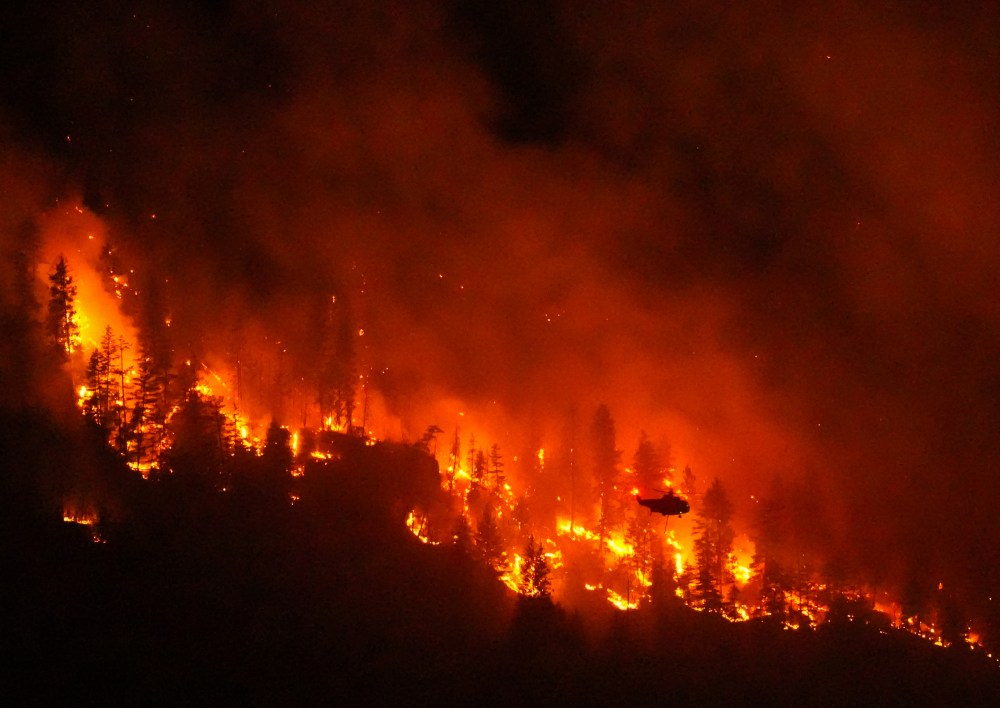
The study, which was done so quickly it has not been peer reviewed yet, looked at the weather conditions that are connected to large wildfires and the Canadian index for those conditions, which are heat, lack of rain, humidity and wind. The researchers found the doubling of frequency when — using scientifically accepted techniques to search for climate fingerprints — they compared current conditions to a world without the 2.5 degrees (1.4 degrees Celsius) of warming that’s occurred since the industrial age and burning of fossil fuels started. The weeklong weather conditions that led to the fires in Ontario are now the type that can happen every six years or so, the report said.
“In a pre-industrial climate this would have been much less likely to occur, maybe once in a lifespan. So climate change has made those events more likely,” said study co-author Jonathan Boucher, a fire scientist at Canada’s Forest Service.
Hotter, drier conditions connected to burning
Outside climate and fire scientists said the flash study made sense and reflects a world where hotter and drier conditions are making fires burn more often and more intensely.
“Mother Nature’s been burning. Now she’s on amphetamines and she burns more and more,” said Thompson Rivers University fire scientist Mike Flannigan, a Canadian expert who wasn’t part of the study.
Hazardous smoke spread across both the United States and Canada, choking large cities such as New York.
By burning more and more fossil fuels, “we’re putting nails in our coffins,” Flannigan said.
In the larger and remote Northwest Territories fires, where more than 5,000 square miles (12,950 square kilometers) burned, it’s clear the spark was from lightning but it was the climate conditions that took that initial ignition and made the fire burn intensely and spread too fast to control, said Boucher and report lead author Theodore Keeping, a climate scientist at Imperial College in London.
While people start about half of Canada’s wildfires — accidentally or on purpose — fires sparked by lightning are responsible for more than 90% of the land area burned in Canada, Flannigan said.
“What we’re facing here is more of a climate related problem than a forest management problem,” Boucher said.
That’s not how Trump sees it.
Trump blames mismanagement, but scientists point to carbon
“A lot of damage has been done. They’re not managing their forests properly,” Trump said July 21. “And the wind has a tendency to blow right over New York City, right over, you saw Detroit, they had to close the whole place. Michigan was really affected. They had to close businesses for four days. It’s very serious what they’re doing, and they don’t seem to be able to do anything about it. If they managed their forests, they wouldn’t have the fires.”
When asked Sunday about punishing Canada, Trump on Air Force One told reporters he has decided on a punishment, adding “you’ll find out about it soon.”
Canadian climate and fire scientists said Trump doesn’t understand the root causes.
“Smoke does not carry a passport, but carbon pollution does have a history. That history shows that the United States contributed more than any other country,” said University of Victoria climate scientist Andrew Weaver. “President Trump is pointing at the smoke while ignoring America’s fingerprints on the climate conditions behind it.”
Study co-author Friederike Otto, an Imperial College London climate scientist, said, “if you care about anyone but the super rich, you have to stop burning fossil fuels because the impacts are here and they’re now and have huge consequences.”

Canada has warmed 65% more than the United States in recent decades. In the past 30 years, the amount of land annually burned by Canadian wildfires has gone up by about 50% while the amount in the United States has more than doubled.
A big problem that Trump doesn’t appear to understand is that much of Canada’s forests are remote, northerly and full of spruce and pine that burns hard and fast, all making it difficult to get a handle on, Boucher and Flannigan said.
“In Canada, when things are extreme, you have about a 30-minute window to put that fire out,” Flannigan said. “If you don’t get there in 30 minutes, you’re out of luck. And many of the fires that start in Canada are northern remote areas that are more than 30 minutes away from an airport. So even with perfect detection systems, we would get there too late and these fires are going to burn.”
___
The Associated Press’ climate and environmental coverage receives financial support from multiple private foundations. AP is solely responsible for all content. Find AP’s standards for working with philanthropies, a list of supporters and funded coverage areas at AP.org.