

Walking past history — and understated renewal

Advertisement
Read this article for free:
or
Already have an account? Log in here »
To continue reading, please subscribe:

Digital Subscription
One year of digital access for only $205*
- Enjoy unlimited reading on winnipegfreepress.com
- Read the E-Edition, our digital replica newspaper
- Access News Break, our award-winning app
- Play interactive puzzles
*First annual payment billed as $205.00 + GST for one year. This annual subscription will automatically renew at $233.00 + GST every 52 weeks (10% off the regular annual price of $259.35). Offer available to new and qualified returning subscribers only. Cancel any time.
To continue reading, please subscribe:
Add Free Press access to your Brandon Sun subscription for only an additional
$1 for the first 4 weeks*
- Enjoy unlimited reading on winnipegfreepress.com
- Read the E-Edition, our digital replica newspaper
- Access News Break, our award-winning app
- Play interactive puzzles
*Your next Brandon Sun subscription payment will increase by $1.00 and you will be charged $17.95 plus GST for four weeks. After four weeks, your payment will increase to $24.95 plus GST every four weeks.
Read unlimited articles for free today:
or
Already have an account? Log in here »
Several times each week I walk, cycle, or drive along Taché Avenue in St. Boniface.
It is one of Winnipeg’s most remarkable streets. Within a few hundred metres stand St. Boniface Cathedral, the cemetery where Louis Riel is buried, the archbishop’s residence, St. Boniface Hospital, La Vérendrye Park, and the Musée de Saint-Boniface. Few places in Canada bring together so many layers of history within such a compact landscape. This is where Manitoba’s story began. More than 175 years later, it remains one of the country’s most important historic precincts.
Yet it is always the museum that captures my attention.
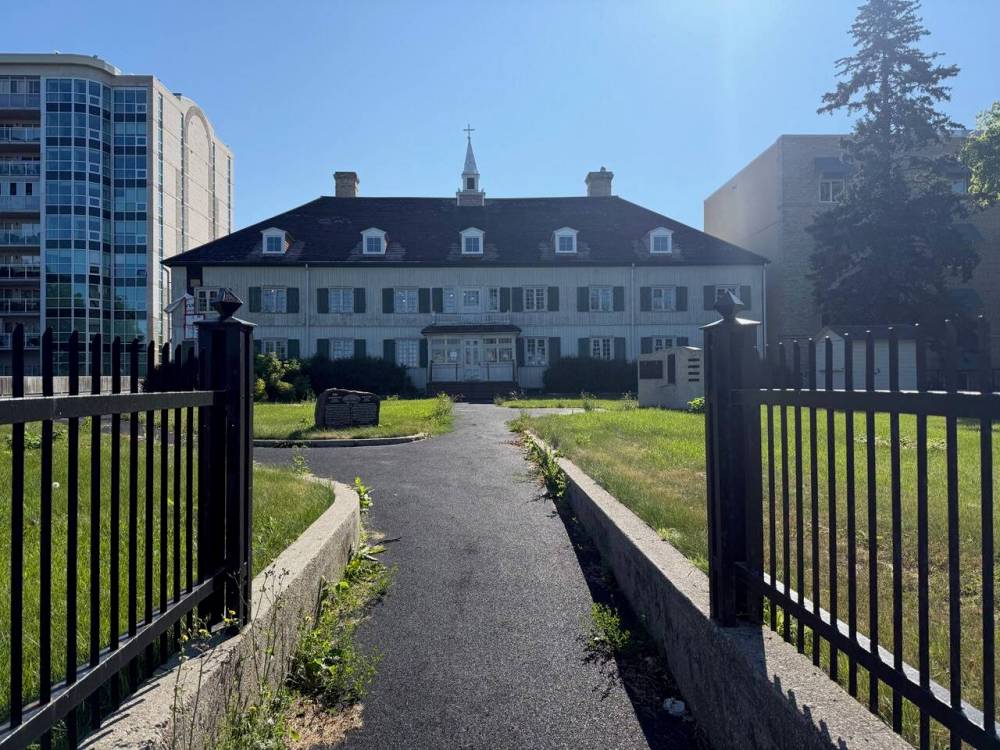
Stephen Borys photo
Le Musée de Saint-Boniface / St. Boniface Museum stands at 494 Taché Ave.
It may be because I have spent much of my professional life working in museums and heritage institutions. More likely, it is because the old Grey Nuns’ convent has always struck me as one of those rare buildings that is far more than architecture. It has witnessed nearly two centuries of Manitoba’s history.
Constructed in 1846, it is Winnipeg’s oldest surviving building, one of the largest surviving oak log structures in North America, and among the finest examples of Red River frame construction anywhere. Over nearly two centuries it has served as a convent, Western Canada’s first hospital, an orphanage, a home for the elderly, a school attended by generations of children — including Louis Riel — and, since 1967, the Musée de Saint-Boniface. Few buildings in Canada have lived so many lives.
Its story, however, cannot be separated from that of the Grey Nuns themselves.
When they arrived at Red River in 1844, they came to serve a young and often isolated community. Within two years they had begun building what they affectionately called “la petite maison blanche”. From here they established what became Western Canada’s first hospital, cared for the sick during epidemics, educated children, sheltered orphans, looked after the elderly, and welcomed newcomers. Their work extended far beyond these walls and helped lay the foundations of health care, education, and social services in what would become Manitoba.
When the Sisters left in 1956, there were genuine fears the building might be lost. Instead, another generation stepped forward. The convent became a National Historic Site in 1958, underwent a major restoration before reopening as a museum during Canada’s Centennial in 1967, and was renewed again during the 1990s. Every generation has inherited the responsibility of preserving this remarkable place for the next.
Today, the next chapter in that history is being written.
For the past two years the museum has been closed while another major restoration takes place. I have little doubt that the work is complex and essential. Buildings approaching two centuries of age inevitably reveal new challenges once conservation work begins. This work requires patience, specialized expertise, and an enormous respect for authenticity.
What has caught my attention, however, is not what is happening inside the building, but what visitors experience — or don’t experience — when passing the site.
If you knew nothing about the restoration project, you could easily walk past the museum without realizing the magnitude of the conservation project underway.
A damaged museum sign sits above a government funding sign installed when restoration began in 2024. The entrance gate has seen better days. The landscape, trees, and planting beds appear largely unattended. Monuments and plaques feel disconnected. An empty sculpture plinth remains. The oversized asphalt walkway continues to dominate what should be one of Canada’s finest heritage sites.
Beyond the building itself, there is little visible evidence that an ambitious renewal is quietly unfolding behind the walls. For a place of such national historic significance, the overall impression is one of neglect rather than renewal. The disconnect is difficult to reconcile.
Curious to understand what was happening behind the locked doors, I began looking for answers.
I explored the museum’s website, reviewed fundraising materials, read the recently released economic impact study, and followed media coverage. Together they describe an ambitious restoration, a renewed vision for the museum, and an important investment in Manitoba’s cultural future. Gradually, a much richer picture emerged.
Only after doing that was I able to piece the story together. Most people walking or cycling past the museum may never take those extra steps — and they shouldn’t have to. For a museum devoted to interpretation and public engagement, that feels like a significant missed opportunity.
Museums exist to help us understand the stories behind places, people, and objects — and this building project is one of those stories. It occurred to me that the restoration of the Grey Nuns’ convent may be the museum’s most important current exhibition.
Instead of paintings or artifacts, it features nearly 180-year-old timbers, conservation science, engineering, traditional craftsmanship, and the decisions required to preserve Winnipeg’s oldest surviving buildings. It reflects the work of architects, conservators, engineers, historians, skilled tradespeople, donors, and community members securing the future of an extraordinary place.
The restoration deserves to be shared and understood.
Not because people need regular construction updates, but because understanding creates connection. People support what they understand. When they can follow a project and appreciate why it matters, they become invested in its success. They volunteer, advocate, donate, and encourage others to become involved. They develop a sense of shared ownership.
First impressions matter.

Visitors begin forming opinions long before they step through the front door. The approach, signage, commemorative sculptures, and surrounding grounds all become part of the museum experience. At the moment, the public face of the site does not fully reflect the national significance of the building or the remarkable work taking place within it.
It will change. The grounds will be renewed, the façade restored, and the interior spaces improved. The doors will reopen. Visitors will once again discover one of Canada’s great historic places.
My hope is that we don’t wait until that day to invite people back into the story. The restoration itself is part of the museum’s history, and sharing that journey can only strengthen the community’s connection to this place. Along the way, I’d also be interested in knowing when the museum is expected to reopen — and what the final project cost will be.
After all, the restoration is not preparing the museum for its next chapter — it is writing it.
Stephen Borys is president and CEO of Civic Muse, an arts and cultural consulting practice based in Winnipeg. www.civicmuse.ca
Our newsroom depends on a growing audience of readers to power our journalism. If you are not a paid reader, please consider becoming a subscriber.
Our newsroom depends on its audience of readers to power our journalism. Thank you for your support.
Our newsroom depends on a growing audience of readers to power our journalism. If you are not a paid reader, please consider becoming a subscriber.
Our newsroom depends on its audience of readers to power our journalism. Thank you for your support.
Advertisement Advertise With Us
Advertisement Advertise With Us