

Federal judge orders Virginia county to replace Confederate school names it restored in 2024
Advertisement
Read this article for free:
or
Already have an account? Log in here »
To continue reading, please subscribe:

Digital Subscription
One year of digital access for only $205*
- Enjoy unlimited reading on winnipegfreepress.com
- Read the E-Edition, our digital replica newspaper
- Access News Break, our award-winning app
- Play interactive puzzles
*First annual payment billed as $205.00 + GST for one year. This annual subscription will automatically renew at $233.00 + GST every 52 weeks (10% off the regular annual price of $259.35). Offer available to new and qualified returning subscribers only. Cancel any time.
To continue reading, please subscribe:
Add Free Press access to your Brandon Sun subscription for only an additional
$1 for the first 4 weeks*
- Enjoy unlimited reading on winnipegfreepress.com
- Read the E-Edition, our digital replica newspaper
- Access News Break, our award-winning app
- Play interactive puzzles
*Your next Brandon Sun subscription payment will increase by $1.00 and you will be charged $17.95 plus GST for four weeks. After four weeks, your payment will increase to $24.95 plus GST every four weeks.
Read unlimited articles for free today:
or
Already have an account? Log in here »
ROANOKE, Va. (AP) — A federal judge has sided with the Virginia NAACP in its lawsuit against a county school board’s reinstatement of Confederate military names to two schools, saying the decision discriminated against Black students and ordering the board to change the schools’ monikers again.
In an opinion filed Thursday in U.S. District Court of Virginia, Judge Michael F. Urbanski said the school board in Shenandoah County violated Black students’ rights under the 14th Amendment’s equal protection clause, which forbids racial discrimination in state-supported institutions. The decision also violates the Equal Educational Opportunities Act, the court found.
Confederate army officers’ names are “vestiges” of Shenandoah County’s segregationist history that required separate schools for Black and white students.
“The Confederate names were restored with complete awareness of their historic legacy and ongoing discriminatory impact,” Urbanski wrote. “In the court’s view, the affirmative act of reinstating these vestiges of segregation is far more problematic than a passive failure to remove a long-standing name or symbol.”
The judge ordered the board to settle on new school names “on a racially nondiscriminatory basis with all deliberate speed.”
Unlike memorials named after Confederate figures, schools are places where children should have an “educational environment free of vestiges of racial discrimination,” Urbanski added.
Jim Guynn, the attorney representing Shenandoah County, did not immediately respond to a phone message seeking comment.
In a statement Friday, the NAACP Virginia State Conference called the ruling “a decisive victory” for students.
“For decades, the practice of honoring Confederate leaders in Virginia schools has been steeped in a history of racial discrimination,” said its president, the Rev. Cozy Bailey. “The school board’s 2024 renaming decision is impossible to explain except through the lens of race.”
The Washington Lawyers’ Committee for Civil Rights and Urban Affairs represented the NAACP.
“The court acknowledged that such names inflict real, racially disproportionate harm,” said Kaitlin Banner, deputy legal director.
The Virginia NAACP filed the suit on behalf of six students and their parents in June 2024 after the school board voted 5-1 to change Mountain View High School back to Stonewall Jackson High School and Honey Run Elementary back to Ashby-Lee Elementary, which combines the names of Gen. Robert E. Lee and Turner Ashby, a Confederate cavalry officer. The board reversed a 2020 decision to remove the original names against a backdrop of nationwide protests over racial injustice.
The NAACP argued in its lawsuit that Black students, who make up less than 3% of the school system’s population, would be “required against their will to endorse the violent defense of slavery pursued by the Confederacy and the symbolism that these images have in the modern White supremacist movement.”
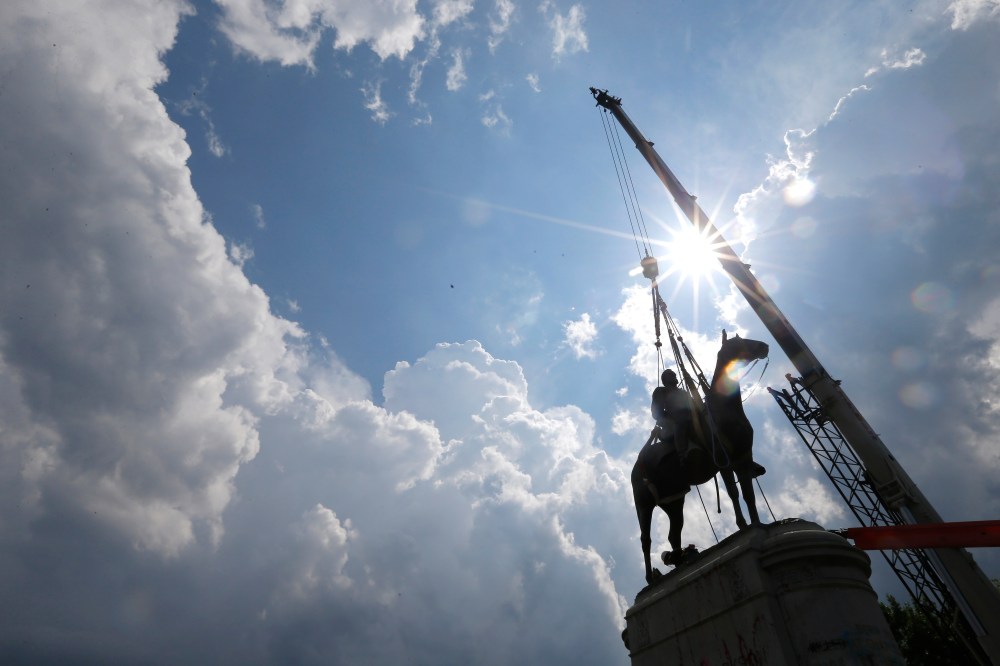
Under President Donald Trump’s second administration, some statues honoring Confederate figures have been restored after being removed in 2020. It is part of Trump’s ongoing efforts to control how American history is framed at Smithsonian museums, monuments in national parks and in classrooms.
Board members who voted to restore the Confederate names said they were honoring popular community sentiment. They said the previous board members who voted to remove the names in 2020 had ignored constituents and due process on the matter.