

Israel: the new political divide?

Advertisement
Read this article for free:
or
Already have an account? Log in here »
To continue reading, please subscribe:

Digital Subscription
One year of digital access for only $205*
- Enjoy unlimited reading on winnipegfreepress.com
- Read the E-Edition, our digital replica newspaper
- Access News Break, our award-winning app
- Play interactive puzzles
*First annual payment billed as $205.00 + GST for one year. This annual subscription will automatically renew at $233.00 + GST every 52 weeks (10% off the regular annual price of $259.35). Offer available to new and qualified returning subscribers only. Cancel any time.
To continue reading, please subscribe:
Add Free Press access to your Brandon Sun subscription for only an additional
$1 for the first 4 weeks*
- Enjoy unlimited reading on winnipegfreepress.com
- Read the E-Edition, our digital replica newspaper
- Access News Break, our award-winning app
- Play interactive puzzles
*Your next Brandon Sun subscription payment will increase by $1.00 and you will be charged $17.95 plus GST for four weeks. After four weeks, your payment will increase to $24.95 plus GST every four weeks.
Read unlimited articles for free today:
or
Already have an account? Log in here »
Abdul won and Avi is thrilled.
Federal NDP Leader Avi Lewis emerged from electoral hiding to tell us how it is “exhilarating to witness” a “wave of progressive populism” in the United States. He was referring to the upset winner of Tuesday’s heavily-watched Michigan Senate primary race, Abdul El-Sayed, who barely prevailed over his establishment opponent for the Democratic nomination.
Premier Wab Kinew’s favourite New Democrat (after himself) steadfastly hesitates to take a risk and run for a House of Commons seat in a byelection to kickstart Canada’s version of progressive populism. No hesitation, though, in Lewis immediately basking in the reflected glory of those international comrades and fellow travellers who do.
The Canadian Press
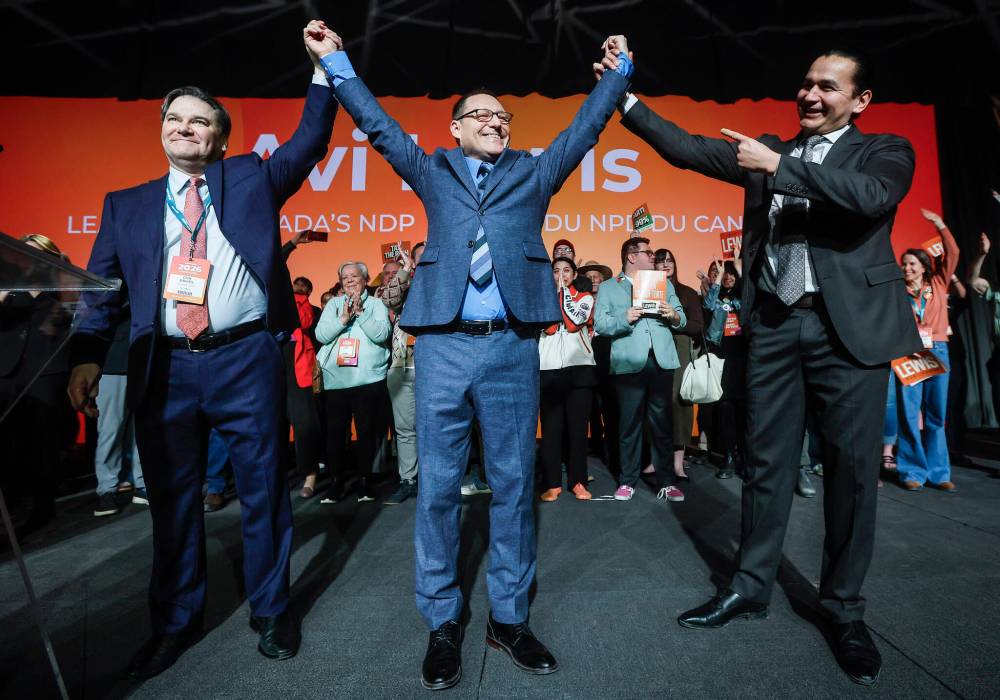
Avi Lewis (centre), the new leader of the NDP, celebrates with former interim leader Don Davies (left) and Manitoba Premier Wab Kinew at the party convention in Winnipeg on March 26, 2026.
Writing about the state of Canada’s New Democrats feels like a hate crime — you hate wasting your time — and this is no exception. A better story is what’s driving this modest but undeniable political movement in U.S. politics and whether it might gain traction here in Canada.
Our country is no stranger to foreign influence in politics. Not the interfering kind that necessitates the federal government creating a foreign influence registry as it finally did last week to track and make transparent countries and interests seeking to influence election outcomes.
Rather, the influence of foreign political movements that animate and drive debate here at home.
The most obvious example is, of course, the Make America Great Again (MAGA) influence on the Conservative Party of Canada over the past decade. It found expression in everything from policy, such as immigration restrictions, to the dominance of “brocaster” influencers in the party ecosystem, such as Jordan Peterson and Joe Rogan.
The success of Donald Trump led many to consider populism as solely a right-wing phenomenon raging against governing institutions and elites. Kid yourself not. Progressive populism exhibits the same rage, just against different governing institutions and elites. In their case, it is money and Israel.
MAGA was spawned by the Tea Party protests during the Obama administration. With Trump it took over the Republican Party to the point that one is indistinguishable from the other. To win a Republican nomination these days, you need to be as Trumpian as he is.
Progressive populism has its heroes — or villains — too. Sen. Bernie Sanders kickstarted its germination within the Democratic Party when he ran for the presidential nomination as a democratic socialist against Hillary Clinton in 2016. Ten years on, his endorsement of Alexandra Ocasio-Cortez and Zohran Mamdani helped propel them to congressional and mayoral victories, respectively, in New York. He has now done the same with Abdul El-Sayed in Michigan.
It is risky to prognosticate trends based on a few breakthroughs. Still, you must start somewhere. There is no incipient social democratic revolution in the offing in Canada. No new orange or pink wave has yet appeared on the horizon. But those same forces disrupting politics in America also have force here.
The most obvious is Israel. El-Sayed triumphed over his very pro-Israel opponent despite her receiving $30 million in donations from AIPAC, the powerful America Israel Public Affairs Committee. His winning coalition was powered by young, educated, white voters, and higher-income voters. The Israel-Palestinian conflict, turbocharged by the Gaza War, has increasingly laid claim to determine the political fealty of Democratic candidates, for and against.
Democratic Sen. John Fetterman of Pennsylvania says support for Israel is the No. 1 issue for him as he periodically supports Republicans in Congress against his own party. He is increasingly alone among Democrats. Support for Israel is dropping around the world. A Pew Research Centre poll of 36 countries found majority negative views of Israel in most of them, including a 65 per cent unfavourable rating in Canada and 60 per cent unfavourable rating in the U.S.
Once a bipartisan issue in the U.S. and Canada, support for Israel is splitting along ideological and party lines in both countries. The Pew poll found that negative views of Israel are strongest amongst those on the ideological left. In Canada, 80 per cent on the left were unfavourably disposed towards Israel compared to 52 per cent on the right, a 28-point difference.
Democrats are far more likely than ever to say the U.S. is too supportive of Israel — 58 per cent in a July Associated Press poll, up from 45 per cent two years before. Young Americans, Democrat and Republican, are driving this.

Canadian polls show the same results. A Leger poll in April found only 22 per cent had a favourable view of Israel, down 10 points from before the Gaza War. An Environics poll last fall found twice as many Canadians expressing sympathy for Palestinians over Israelis — 32 per cent to 15 per cent.
Diaspora politics are not new. Yet, there are 10 times as many Jews as Palestinians in Canada. That means there is a broader dynamic at play here. Conservatives are vocally far stronger for Israel than Liberals. The federal Liberal government has officially recognized the State of Palestine. The Conservative opposition vociferously labelled this as “recognizing the Hamas state.”
Where you stand on Trump’s America is today’s most salient political divide in Canada.
Where you stand on Israel may become tomorrow’s.
David McLaughlin is a former clerk of the executive council and cabinet secretary in the Manitoba government.
Our newsroom depends on a growing audience of readers to power our journalism. If you are not a paid reader, please consider becoming a subscriber.
Our newsroom depends on its audience of readers to power our journalism. Thank you for your support.
Our newsroom depends on a growing audience of readers to power our journalism. If you are not a paid reader, please consider becoming a subscriber.
Our newsroom depends on its audience of readers to power our journalism. Thank you for your support.
Advertisement Advertise With Us
Advertisement Advertise With Us