

Why information officer kept camera rolling even as he fled B.C. wildfire with family
Advertisement
Read this article for free:
or
Already have an account? Log in here »
To continue reading, please subscribe:

Digital Subscription
One year of digital access for only $205*
- Enjoy unlimited reading on winnipegfreepress.com
- Read the E-Edition, our digital replica newspaper
- Access News Break, our award-winning app
- Play interactive puzzles
*First annual payment billed as $205.00 + GST for one year. This annual subscription will automatically renew at $233.00 + GST every 52 weeks (10% off the regular annual price of $259.35). Offer available to new and qualified returning subscribers only. Cancel any time.
To continue reading, please subscribe:
Add Free Press access to your Brandon Sun subscription for only an additional
$1 for the first 4 weeks*
- Enjoy unlimited reading on winnipegfreepress.com
- Read the E-Edition, our digital replica newspaper
- Access News Break, our award-winning app
- Play interactive puzzles
*Your next Brandon Sun subscription payment will increase by $1.00 and you will be charged $17.95 plus GST for four weeks. After four weeks, your payment will increase to $24.95 plus GST every four weeks.
Read unlimited articles for free today:
or
Already have an account? Log in here »
PENTICTON – When Erick Thompson decided he had to flee with his family as a wildfire roared towards Summerland, B.C., around 1:40 a.m. on Saturday, he also knew he had to keep filming.
That’s because Thompson is the senior manager of communications for the Regional District of Okanagan-Similkameen, and his livestream videos on YouTube have connected thousands of anxious residents with the latest updates on the fire, evacuations and support.
The videos are raw and unfiltered, rolling as Thompson answers phone calls, talks to colleagues, tinkers with his computer and sometimes leaves his desk unattended.
His videos are among the social media that is helping fill an information void for worried evacuees and other residents.
The B.C. government has said there was significant structure loss, but without a chance for on-the-ground assessments, official details about the damages have been scant.
Instead, some have been relying on videos and photos shared on social media platforms — Faulder, B.C., resident Kyla Gaudiuso said she became aware her house had been destroyed when she received a photo that has been widely shared, showing the ridge where her home once stood engulfed in flames.
A video that was also circulating on social media, and was later provided to The Canadian Press, provided some of the first confirmation that Faulder had largely been destroyed, with home after home reduced to smoking rubble.
Peter Ryan, an associate professor of public relations at Mount Royal University, said there’s been a recent and “real crystallization” around the idea of intergovernmental co-operation with emergency personnel to improve emergency information communications nationally.
Ryan, who is also a director for the Canadian branch of the Center for Risk Communication, said the inability to share news on platforms owned by Meta shows how American tech firms are “limiting what our policies can do.”
“So, the situation continues to be bad for news organizations and bad for the platforms and even worse for the public in terms of disaster and emergency communications,” he said. “If anything, it’s gotten worse because there’s been more fires and the situation hasn’t changed.”
Police in B.C. have cautioned against misinformation about fires being posted on social media.
Ryan said “official channels” have limited resources, yet people are in need of up-to-date and accurate emergency information.
Instead, he said they turn to social media and have to deal with “noise” during “what might be the worst experiences of their lifetime.”
“It might not be the key part of the story, about policy right now, when people are dealing with being evacuated,” he said. “It definitely is something that more Canadians will become aware of through all of these horrifying stories.”
Though he had become a public face of the wildfire emergency for viewers — many thanking him for his work on the livestream’s busy chat — Thompson said the story wasn’t about him and he was just doing his job.
The stream’s most dramatic moment came when Thompson left the emergency operations centre before resuming the video from his darkened vehicle after picking up his family to escape the fire.
He said the moment felt surreal, but he told the director of the district’s emergency operations centre that he felt he should continue livestreaming to encourage residents.
“Just to show that, you know, I’m in the middle of this just like you are and we can be calm,” he said in an interview Sunday.
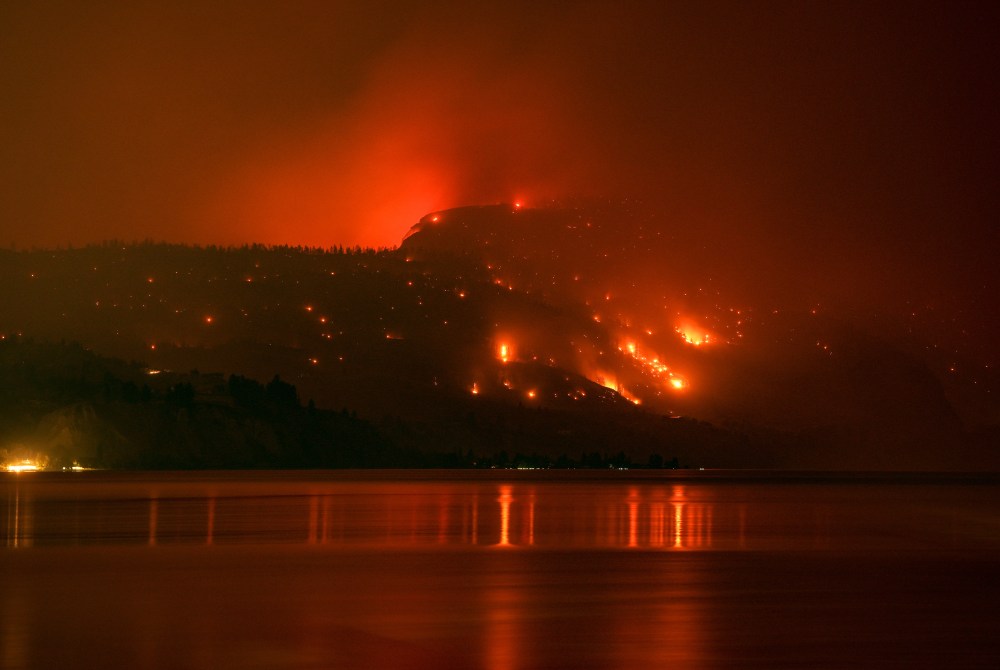
With ash raining down, Thompson said he packed and alerted his neighbours it was time to go.
Even as he drove into the night, he provided information to viewers, telling them of backed-up traffic as he and his family fled south.
Thompson said he thought only 30 or so people were watching at the time, but the next morning a friend in Halifax called to say she had seen the clip of him leaving his home.
“I said how did you know that? She said it was on the media,” he said. “And then I realized that that’s probably that dramatic video you see of somebody escaping a wildfire and I didn’t mean it to be that.”
Thompson said he didn’t know how he felt about the moment’s unexpected virality.
He didn’t want to be thought of as “doing anything special because I’m not,” he said.
“I’m doing this because it’s my job and I’m dedicated to getting out the most and best information I can,” he said.
He added that although he was affected by the evacuation order, he felt fortunate that his family was staying friends and that everybody was safe.
The Bald Range fire has triggered a state of emergency in B.C., and forced 20,000 residents of the Okanagan region to evacuate.
One woman has been confirmed dead in the fire, which continues to burn out of control on the western shore of Okanagan Lake.
This report by The Canadian Press was first published Aug. 10, 2026.
— With files from Darryl Greer in Vancouver
Related Articles
B.C. wildfire evacuees told to brace for devastation, as RCMP launch criminal probe
Advertisement Advertise With Us
Advertisement Advertise With Us