Working together in a trade war
Advertisement
Read this article for free:
or
Already have an account? Log in here »
To continue reading, please subscribe:

Digital Subscription
One year of digital access for only $205*
- Enjoy unlimited reading on winnipegfreepress.com
- Read the E-Edition, our digital replica newspaper
- Access News Break, our award-winning app
- Play interactive puzzles
*First annual payment billed as $205.00 + GST for one year. This annual subscription will automatically renew at $233.00 + GST every 52 weeks (10% off the regular annual price of $259.35). Offer available to new and qualified returning subscribers only. Cancel any time.
To continue reading, please subscribe:
Add Free Press access to your Brandon Sun subscription for only an additional
$1 for the first 4 weeks*
- Enjoy unlimited reading on winnipegfreepress.com
- Read the E-Edition, our digital replica newspaper
- Access News Break, our award-winning app
- Play interactive puzzles
*Your next Brandon Sun subscription payment will increase by $1.00 and you will be charged $17.95 plus GST for four weeks. After four weeks, your payment will increase to $24.95 plus GST every four weeks.
Read unlimited articles for free today:
or
Already have an account? Log in here »
In the Second World War, a grand coalition, held together politically by U.S. President Franklin D. Roosevelt, succeeded in defeating Nazi Germany, after many bumps in the road. The rich history of this period reinforces the truism that coalitions — bringing together parties of divergent strength and interests to face together a common challenge — are fraught with many points of potential fracture.
Canada was not only a partner in the great international war effort but also fashioned a national coalition — presided over by Prime Minister Mackenzie King — necessitated by the federalist nature of our government. It worked after a fashion — conscription notwithstanding — and we emerged as a trusted friend and ally of our southern neighbour.
Oh, how times have changed. We are again faced with an existential threat; not to be compared to a world war, but serious enough given it’s posed not by a distant foe on another continent, but by the most powerful country in the world, with whom we share 8,800 kilometres of heretofore undefended border.
The Canadian Press files
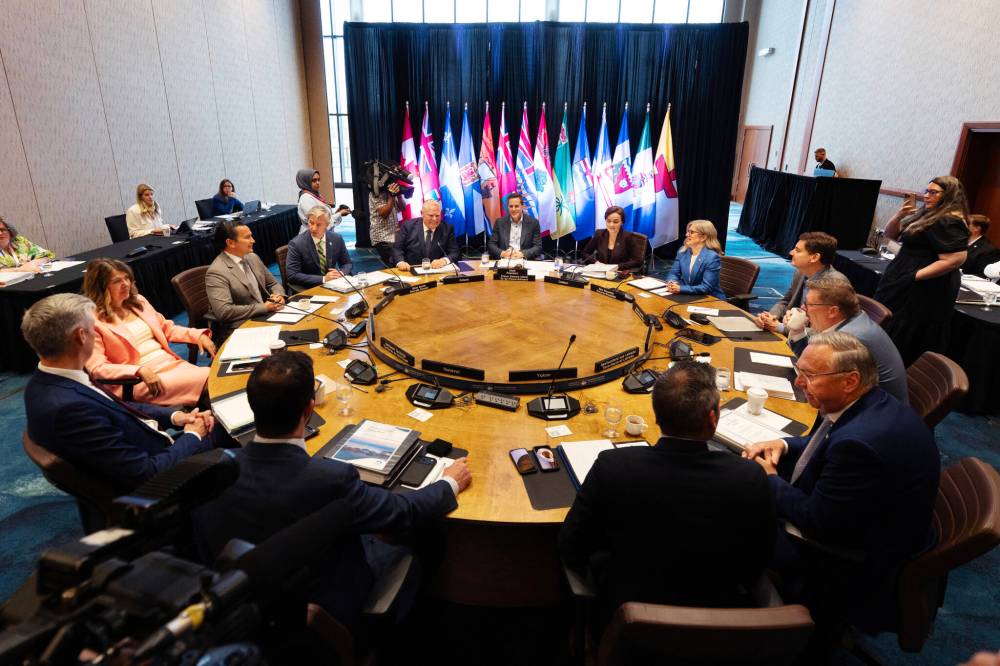
Canada’s premiers meet at the Council of the Federation meeting in Charlottetown in July.
The unprovoked attack on Canada has been economic; tariffs, threats of tariffs, scrapped trade agreements and so forth — measures that have already had significant impact and promise to escalate. How does a country of 10 quasi-independent provinces with a national government constitutionally pre-eminent in international relations respond?
This was not a dilemma in the first six decades or so of our existence, when Ottawa held sway over many provinces with limited capacity to assume the responsibilities assigned to them under the constitution. That changed in the 1930s after the “ownership” of the land and resources was turned over to all the provinces created after confederation.
The unprovoked attack on Canada has been economic; tariffs, threats of tariffs, scrapped trade agreements and so forth
Development was encouraged, revenues grew and governments increased in size and scope. And provincial governments became acutely aware that in taking on their mandated responsibilities — public health, education, resource management, development of all kinds — their actions had much more direct affect on the lives of their citizens than did actions of the federal government.
That inherent tension has been with us for the better part of a century. We have responded in a variety of ways with varying success. When it works we call it co-operative federalism. When it doesn’t we credit Ottawa arrogance or provincial selfishness.
But it’s the federal government that must forge a coalition with the provinces to work together on issues of national importance, such as climate change and trade. It is Ottawa that has the fiscal clout, the national reach and the international voice that provinces do not. On the other hand, there are many international commitments that cannot be fulfilled without the co-operation of the provinces. Ottawa offering to get U.S. alcohol back on Canadian shelves as a bargaining chip to have extortionate American tariffs lowered, is a recent example.
Provinces — now fully exercising the powers granted under the constitution, while constantly trying to milk the overarching fiscal power of Ottawa — nonetheless consider themselves more or less independent actors; and, of course, in some respects they are. It is no surprise that this has produced its share of prima donna premiers.
So, how have we managed to hold this potentially unstable coalition together?
In the Depression era, it was the power of the federal purse that kept provinces afloat
In the Depression era, it was the power of the federal purse that kept provinces afloat — and financed the research and subsequent actions that rescued agriculture on the prairies; and spawned regional-based agencies to address the diverse conditions in such a vast country that can only be addressed on the ground. The Prairie Farm Rehabilitation Agency, established to “drought-proof” the prairies, is probably the most successful example; it survived into the 21st century.
Post war, the provinces began to act more as full rather than junior partners. This despite the fact that the constitution, while being quite precise in assigning certain functions, is ambiguous with others — “environment” for example, is not mentioned. Even where there is clear assignment to the provinces, federal funding, or standard setting, inevitably draws Ottawa onto provincial turf.

Of course, bilateral relations can deal with some of the issues arising from shared jurisdiction, but a certain degree of uniformity is in order. Committees. That’s the Canadian way and we have, to this day, federal-provincial ministerial committees for virtually every sector of government responsibility, as well as an overarching Council of the Federation and ad hoc meetings galore.
Successful wartime coalitions spoke with a single voice while keeping their inevitable acrimonious disputes behind closed doors. In a trade war rather than a shooting war, this is not possible. The Big Four premiers continue to hop in and out of the trade spotlight — they can’t help themselves — but, all in all, Prime Minister Mark Carney has herded the cats without too many mishaps.
Fending off the U.S. trade assault has united Canadians and (so far) their elected officials. Continuing this unity on the rocky road ahead will depend on 11 men and women (14, really, as the territories, although having different arrangements with Ottawa, still have a voice in this matter); and ultimately with you and I.
If we stay the course, our leaders will follow.
Norman Brandson is the former deputy minister of the Manitoba departments of environment, conservation and water stewardship.